


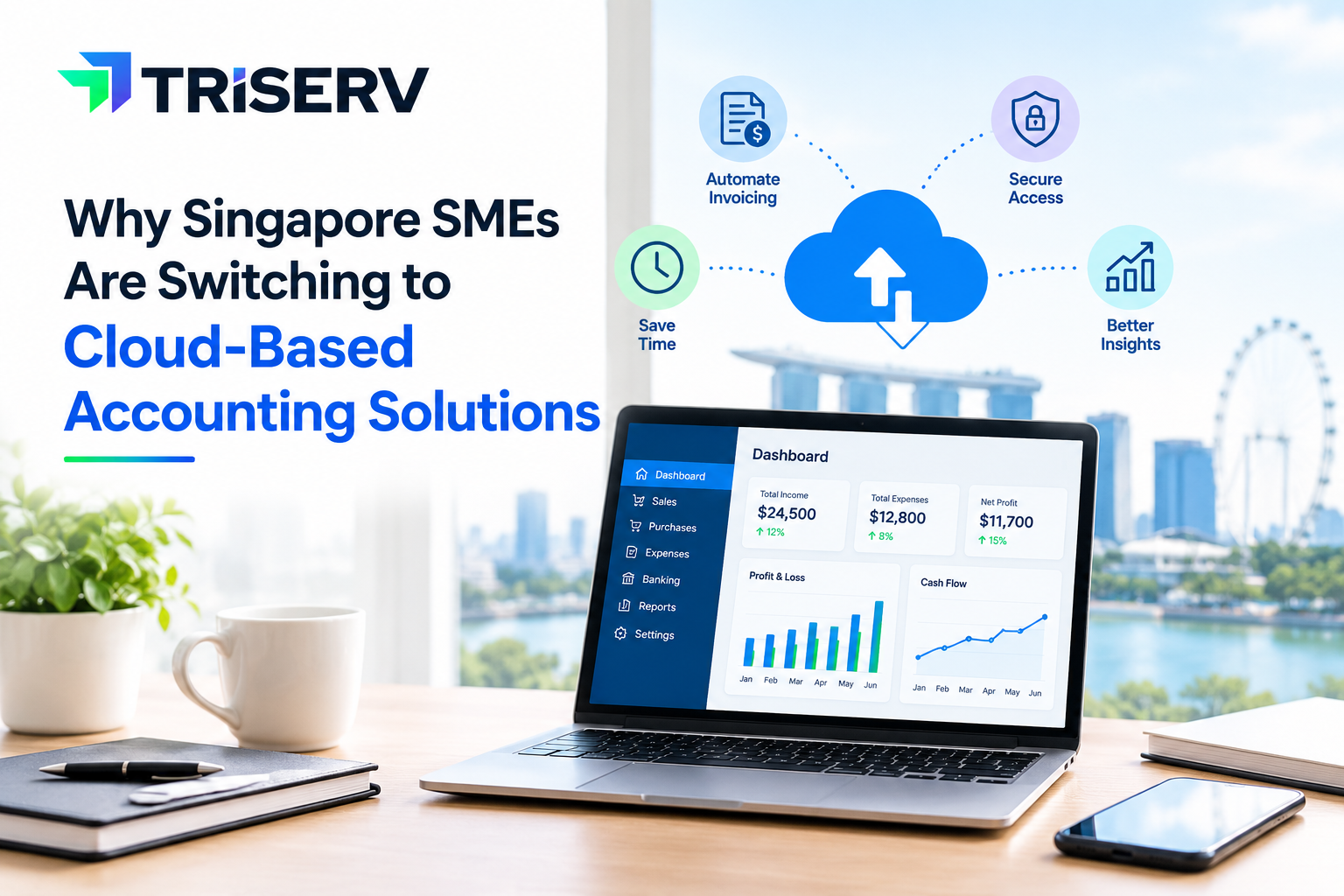
 SMEs in Singapore are shifting toward cloud accounting services as they offer real-time financial visibility, cheaper overhead cost and the ability to handle finances remotely. With the Singapore government aggressively pushing digital adoption through grants and initiatives and the rise of enterprises embracing hybrid work, cloud-based accounting is no longer a convenience but a competitive need for growing businesses.
The move is not a trend. This is a significant change in the way that small and mid-sized companies in Singapore look at financial management. Cloud accounting services are reducing manual effort, ensuring IRAS regulations are met and enabling SMEs to make faster business decisions – all without being connected to a physical office or a single workstation.
The Digital Push That’s Changing SME Finance in Singapore
Singapore is one of the most digitally developed business environments in South East Asia. The Infocomm Media Development Authority (IMDA) and Enterprise Singapore have long been advocates for SME digitalization through initiatives like the SMEs Go Digital program which has accounting software as a pre-approved solution category under the Productivity Solutions Grant (PSG).
SMEs account for 99% of all firms in Singapore and contribute around 45% to Singapore’s GDP, according to Enterprise Singapore. Yet, many of these businesses still rely on spreadsheets or old desktop software to manage their accounting. That gap is what cloud-based digital accounting solutions are closing — fast.
What’s Actually Driving the Switch to Cloud Accounting Singapore?
The reasons SMEs are making the move are practical, not theoretical. Here’s what’s actually pushing businesses to shift:
Remote and Hybrid Work Has Made Desktop Accounting Unworkable
When business owners or finance staff can’t be in the office, desktop-based accounting becomes a bottleneck. Cloud accounting Singapore platforms allow authorised users to access financial data from anywhere — whether that’s a home office, a client site, or while travelling regionally.
This became especially evident post-pandemic. Many SME owners realised that having accounts locked to a single device was a serious operational risk. Cloud platforms eliminated that dependency overnight.
Real-Time Financial Data Enables Smarter Decisions
Traditional accounting is retrospective. You get a picture of your finances after the fact — sometimes weeks after. Cloud-based systems update in real time, so business owners can see cash flow, outstanding invoices, and expenses as they happen.
For an SME managing tight margins, that kind of visibility isn’t a luxury. It’s the difference between catching a cash flow problem early and finding out too late.
GST Compliance and IRAS Reporting Are Easier to Manage
Singapore’s GST-registered businesses face strict reporting obligations. Online accounting platforms built for the Singapore market are typically aligned with IRAS requirements, making it easier to generate accurate GST returns, maintain proper audit trails, and avoid compliance penalties.
Manual processes leave room for error. Automated cloud systems reduce that risk significantly — and many platforms flag potential issues before you submit.
Cloud vs. Traditional Accounting: A Practical Comparison
| Feature | Traditional Accounting | Cloud Accounting |
|---|---|---|
| Access | Single device or local server | Anywhere, any device |
| Data updates | Manual, periodic | Real-time, automated |
| GST compliance support | Manual calculation | Built-in IRAS-aligned tools |
| Collaboration with accountants | File sharing, delays | Live shared access |
| Cost structure | High upfront (software + IT) | Low monthly subscription |
| Scalability | Requires upgrades | Scales with your business |
| Data security | Local backup dependent | Encrypted cloud backup |
SME Accounting: The Cost Argument Is Getting Harder to Ignore
One of the biggest objections SMEs had to cloud accounting was cost. That argument has largely collapsed. Many cloud accounting platforms now operate on subscription models that cost a fraction of what traditional software licensing and IT maintenance used to run.
On top of that, Singapore SMEs can offset adoption costs through the Productivity Solutions Grant (PSG), which supports pre-approved digital accounting tools with co-funding of up to 50%. This effectively halves the financial barrier to entry for qualifying businesses.
When you factor in the time saved on manual data entry, reconciliation, and reporting — the return on investment becomes compelling very quickly.
How Cloud Accounting Changes the Relationship Between SMEs and Their Accountants
This is an underappreciated benefit. When both the business owner and the external accountant have live access to the same financial data, the relationship becomes genuinely collaborative rather than transactional.
Instead of emailing spreadsheets back and forth, or waiting for month-end reports, SME owners and their accounting partners can work from the same numbers simultaneously. Queries get resolved faster. Year-end processes are less stressful. And advisory conversations — about tax planning, cash flow management, or business growth — can happen with current data on the table.
What to Look for in a Cloud Accounting Solution for Your SME
Not all platforms are created equal. When evaluating options, Singapore SMEs should consider:
- IRAS and GST compliance support — Does the platform generate F5/F7 returns and maintain proper audit logs?
- Multi-currency functionality — Critical for SMEs with regional suppliers or clients across ASEAN
- Bank feed integration — Automatic transaction imports from your Singapore bank accounts save hours every month
- User access controls — Ability to set permissions for staff, directors, and external accountants separately
- Scalability — Can it handle your transaction volume as you grow, without forcing a full system migration?
- Local support — Having a provider or partner based in Singapore means faster help when you need it
Is Cloud Accounting Secure Enough for Business Financial Data?
Security is the most common concern SME owners raise — and it’s a fair one. However, reputable cloud accounting platforms typically offer bank-grade encryption, automated backups, and compliance with international data security standards.
The honest comparison is this: a local hard drive or a server sitting in a back office is far more vulnerable to theft, hardware failure, or data loss than a professionally managed cloud environment with redundant backups. For most SMEs, moving to the cloud actually improves their data security posture rather than weakening it.
The Bigger Picture: Digital Financial Management Is Now a Business Standard
Digital financial management is a fundamental expectation, not a differentiation, given the Smart Nation agenda in Singapore and the digitalization push by Enterprise Singapore. The longer a business continues to operate on manual or old systems, the more friction it will have. Audits take longer, error rates increase and there is little capacity to link with other electronic tools such as inventory management, payroll or e-invoicing platforms.
InvoiceNow, the nation-wide e-invoicing network in Singapore based on the Peppol framework, is a clear harbinger of things to come. Businesses that have already implemented SME accounting platforms with Peppol integration are already one step ahead. And those who are stuck in spreadsheets will face increasing pressure to catch up.
It’s not about chasing technology to get to cloud-based financial management. This is about remaining operationally competitive in a market that is digitizing at pace and in depth. For Singapore SMEs looking to make that step, TriServ has accounting services geared around the specific compliance and operational demands of firms operating in Singapore — with the experience to help you transfer seamlessly and manage your finances more effectively from day one.
Frequently Asked Questions
What is cloud accounting and how does it work for SMEs in Singapore?
Cloud accounting is storing your financial data on remote servers accessed securely over the Internet instead of a local device. Singapore SMEs can view finances, prepare GST reports and work with their accountants in real time from anywhere using a browser or mobile app.
Is cloud accounting software eligible for Singapore government grants?
Yeah. The Productivity Solutions Grant (PSG) is handled by Enterprise Singapore and many cloud accounting platforms are pre-approved under it. Eligible SMEs can benefit from up to 50% co-funding for eligible digital accounting solutions, helping to drastically reduce the cost of adoption.
How does cloud accounting help with GST compliance in Singapore?
For the Singapore market, cloud accounting platforms are equipped with capabilities that automate GST computations and generate IRAS-compliant returns. They have comprehensive audit trails and cut down on manual errors that are frequent when firms calculate GST using spreadsheets or old software.
Can small businesses in Singapore afford cloud accounting solutions?
For the Singapore market, cloud accounting platforms are equipped with capabilities that automate GST computations and generate IRAS-compliant returns. They have comprehensive audit trails and cut down on manual errors that are frequent when firms calculate GST using spreadsheets or old software.
What’s the difference between online accounting and hiring an in-house accountant?
Online accounting software automates data entry, reconciliation and reporting, but doesn’t replace professional accounting judgment. Most Singapore SMEs utilize cloud platforms with an outsourced or part-time accountant to handle compliance, tax filing and financial consulting – obtaining the most of both efficiency and experience.
How secure is financial data stored in cloud accounting platforms?
Most on-premise installations are less safe than reputable cloud accounting companies who use bank-grade encryption and automated backups. The risk of local hardware failure, theft or inadvertent deletion is significantly larger than the security risk of using reputable cloud accounting services for Singapore SMEs.
