Taxation services in Singapore cover the full scope of a business’s tax obligations — from corporate income tax filing and GST registration to withholding tax compliance and tax planning. For SMEs, these services help ensure timely, accurate submissions to IRAS while identifying legal deductions and incentives that reduce the overall tax burden.
If you run a small or medium business in Singapore, tax compliance is not optional — it’s foundational. Yet many SME owners treat it as an afterthought, only scrambling when deadlines approach. The truth is, the way you handle taxation services in Singapore directly affects your cash flow, legal standing, and long-term growth.
This guide breaks down every key tax service your business needs, explains how each works, and shows you how to use them strategically — not just reactively.
Why Tax Compliance Matters More for SMEs Than You Think
Large corporations have dedicated in-house tax teams. SMEs usually don’t. That gap creates real risk.
According to the Inland Revenue Authority of Singapore (IRAS), corporate income tax is assessed on a preceding-year basis, meaning your YA 2026 filing covers income earned in 2025. Timely and accurate filing is essential—not only to avoid penalties, interest charges, and potential IRAS audits, but also to maximise available tax benefits. For YA 2026, eligible companies can receive an enhanced 50% Corporate Income Tax (CIT) Rebate, capped at S$40,000, along with a S$2,000 CIT Rebate Cash Grant for businesses that meet the local employee condition. These benefits are computed automatically by IRAS based on your tax filings.
Beyond compliance, Singapore’s tax framework is genuinely SME-friendly — if you know how to use it. The government offers a range of schemes, exemptions, and reliefs specifically designed to support growing businesses. Accessing them, however, requires knowing they exist and filing correctly.
Core Taxation Services Every Singapore SME Should Have
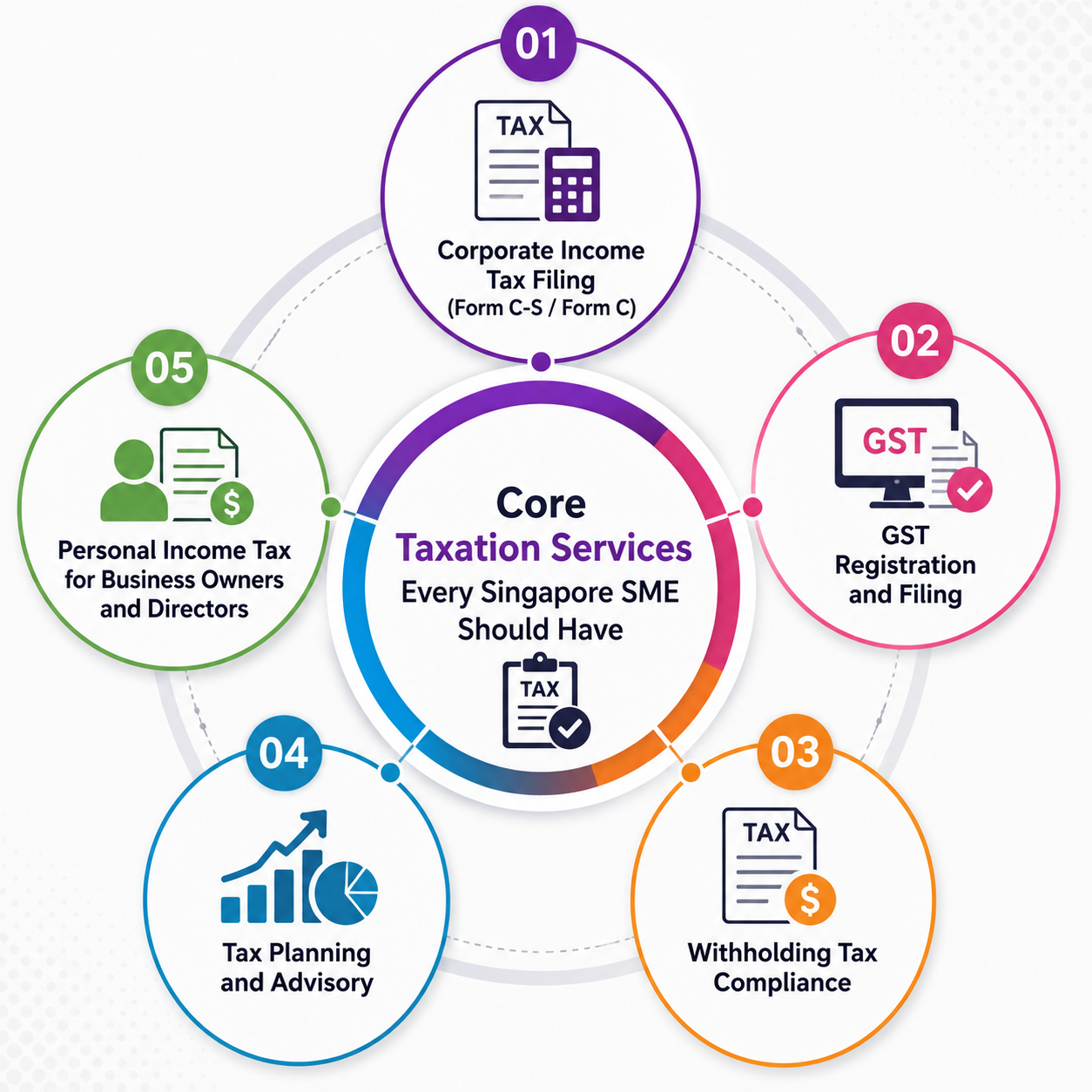
1. Corporate Income Tax Filing (Form C-S / Form C)
This is the cornerstone of business tax compliance in Singapore. All companies must file an Estimated Chargeable Income (ECI) within three months of their financial year-end, followed by an annual income tax return.
Qualifying SMEs with annual revenue below S$5 million can use Form C-S, a simplified filing option. Those with more complex structures file the standard Form C. A tax professional ensures that the correct form is used, legitimate deductions are claimed, and nothing is left on the table.
Key deductions SMEs often miss:
- Staff training and development costs
- Business-related travel expenses
- Renovation and refurbishment under the Section 14Q deduction
- Startup tax exemptions for the first three years of assessment
2. GST Registration and Filing
Registration is compulsory if your business’ taxable income is more than S$1 million in one year. However, there are certain businesses that can voluntarily register even if their business does not meet the compulsory requirement, especially those who have high B2B or import operations.
Once you get registered, you will have to file your GST returns on a quarterly basis. Inaccuracies in claiming input tax or output tax are some of the common queries that arise from the IRAS.
3. Withholding Tax Compliance
Many SMEs overlook withholding tax until they receive a penalty notice. If your business makes payments to non-resident companies or individuals — for services, royalties, interest, or rent — you’re likely required to withhold a portion and remit it to IRAS.
The applicable rates vary based on the nature of payment and whether a Double Taxation Agreement (DTA) applies. Singapore has DTAs with over 90 countries, which can significantly reduce withholding tax rates when correctly applied.
4. Tax Planning and Advisory
Compliance keeps you out of trouble. This is where the money really gets saved through tax planning.
Your tax consultant ensures that you manage your transactions and timing of expenses so as to fully take advantage of tax concessions such as Productivity Solutions Grant (PSG) and Enterprise Development Grant (EDG). If you are a business that plans to employ more people, grow or invest in technology, planning ahead may give you a big tax saving advantage next year.
This is also how business tax services become more than simply completing your taxes.
5. Personal Income Tax for Business Owners and Directors
For those who are either sole proprietors or directors on salaries, your individual income tax liability is directly related to your company’s accounts. In Singapore, directors’ fees, dividends, and salaries are all taxed separately.
Mistakes in this aspect like misclassification may cause IRAS to scrutinize your personal and business accounts. This is where a tax expert comes in.
Key Singapore Tax Incentives SMEs Should Know
| Incentive / Scheme | Who It’s For | Benefit |
|---|---|---|
| Startup Tax Exemption (SUTE) | New companies (first 3 YAs) | 75% exemption on first S$100,000 of chargeable income |
| Partial Tax Exemption (PTE) | All companies not under SUTE | 75% exemption on first S$10,000; 50% on next S$190,000 |
| Section 14C / 14D | R&D-active businesses | Enhanced deductions on qualifying R&D expenditure |
| Enterprise Development Grant | SMEs expanding capabilities | Up to 50–70% funding support for qualifying projects |
When Should an SME Engage a Professional Tax Service?
The short answer: before you need to, not after.
Most SMEs engage a tax firm when they’re already behind on filings or facing an IRAS query. That reactive approach is costlier and more stressful than early engagement. Ideally, you should onboard a tax professional:
- At incorporation, to structure the company correctly from day one
- When approaching the S$1 million GST threshold
- Before making cross-border payments or entering contracts with foreign vendors
- When planning significant capital expenditure or business restructuring
Related Post: How an Accounting Company in Singapore Helps Businesses Stay IRAS Compliant
What to Look for in a Tax Service Provider in Singapore
Not all providers are equal. When evaluating your options, consider these factors:
- ACRA and IRAS familiarity: Your provider should be deeply familiar with Singapore’s regulatory landscape, not just general accounting principles.
- Proactive communication: The best providers flag upcoming deadlines and potential issues before they become problems.
- Scalability: As your business grows, your tax needs change. Choose a firm that can grow with you.
- Transparent pricing: Avoid providers who are vague about fees or scope of work.
Common Tax Mistakes SMEs Make in Singapore
Knowing what to avoid is just as important as knowing what to do.
- Missing ECI deadlines: IRAS imposes late filing penalties. ECI must be filed within 3 months of financial year-end.
- Mixing personal and business expenses: This creates reconciliation problems and is a common audit trigger.
- Not maintaining proper records: IRAS requires businesses to keep documents for at least 5 years.
- Ignoring related-party transactions: Transfer pricing documentation is required even for SMEs engaging in controlled transactions.
If your business operates across borders or works with foreign shareholders, the complexity increases significantly. That’s precisely when professional support pays for itself.
Staying Ahead With the Right Tax Partner
Filing taxes in Singapore might not be as scary as you think – but this is only true if you do it right. The IRAS system offers benefits for companies that file correctly, work proactively, and use the available tax incentives.
If your SME company needs to concentrate on development and not worry about filling out forms, then it is not an unnecessary expenditure to employ a tax specialist. Our firm Tan Chan & CPA offers a full range of tax services for SME companies in Singapore.
Frequently Asked Questions
What are taxation services in Singapore for SMEs?
SME taxation services in Singapore range from corporate tax filing, GST registration and returns, withholding taxes to tax planning. This helps you meet your tax responsibilities with regard to IRAS in a timely manner while ensuring that all possible exemptions and deductions are utilized.
Do all SMEs in Singapore need to register for GST?
The registration process for GST becomes compulsory when the taxable income of the business crosses S$1 million within a span of 12 months. Registration on a voluntary basis is also possible and can prove beneficial for small businesses that claim tax credit through their purchases and imports.
What is the corporate tax rate for SMEs in Singapore?
Corporate tax in Singapore amounts to 17%. Nevertheless, for eligible companies during their initial three-year assessment period, Singapore offers the Startup Tax Exemption Scheme. It allows them to pay considerably lower tax rates, making Singapore one of the best tax jurisdictions for startup businesses in Southeast Asia.
How often do Singapore companies need to file taxes?
The ECI must be filed by the company within three months from the end of its financial year, while the income tax return must be submitted to IRAS before the date stipulated by the same agency – usually in November (for paper filing) or December (for e-filing).