Ballet training includes various methods which have not made as significant an impact on the dance industry as the Vaganova method has. Russian creators developed this system, which now teaches students at top ballet institutions throughout the world to develop their physical power, dance grace and technical proficiency.
Choosing the right educational path for dance students and their parents remains a difficult selection process. Different ballet systems often promise excellent results, but their teaching methods can vary greatly. The selection of methods which develop proper technique while building long-term growth keeps dancers in a state of uncertainty.
This guide shows its unique features and compares it to other ballet education systems while demonstrating why dancers worldwide select this Russian training method.
What Is the Vaganova Method?
Agrippina Vaganova was a ballet dancer who became a teacher. She spent years studying what helped dancers improve — and what held them back.
She wrote it all down in a book called Fundamentals of the Classic Dance in 1934. The Vaganova Academy in St Petersburg established its teaching system based on her approach, which produced numerous world-famous ballet performers.
The method is not just a list of steps. It is a full system. The body initiates all movements from its core, which then spreads in all directions.
What Makes It Different — The Core Ideas
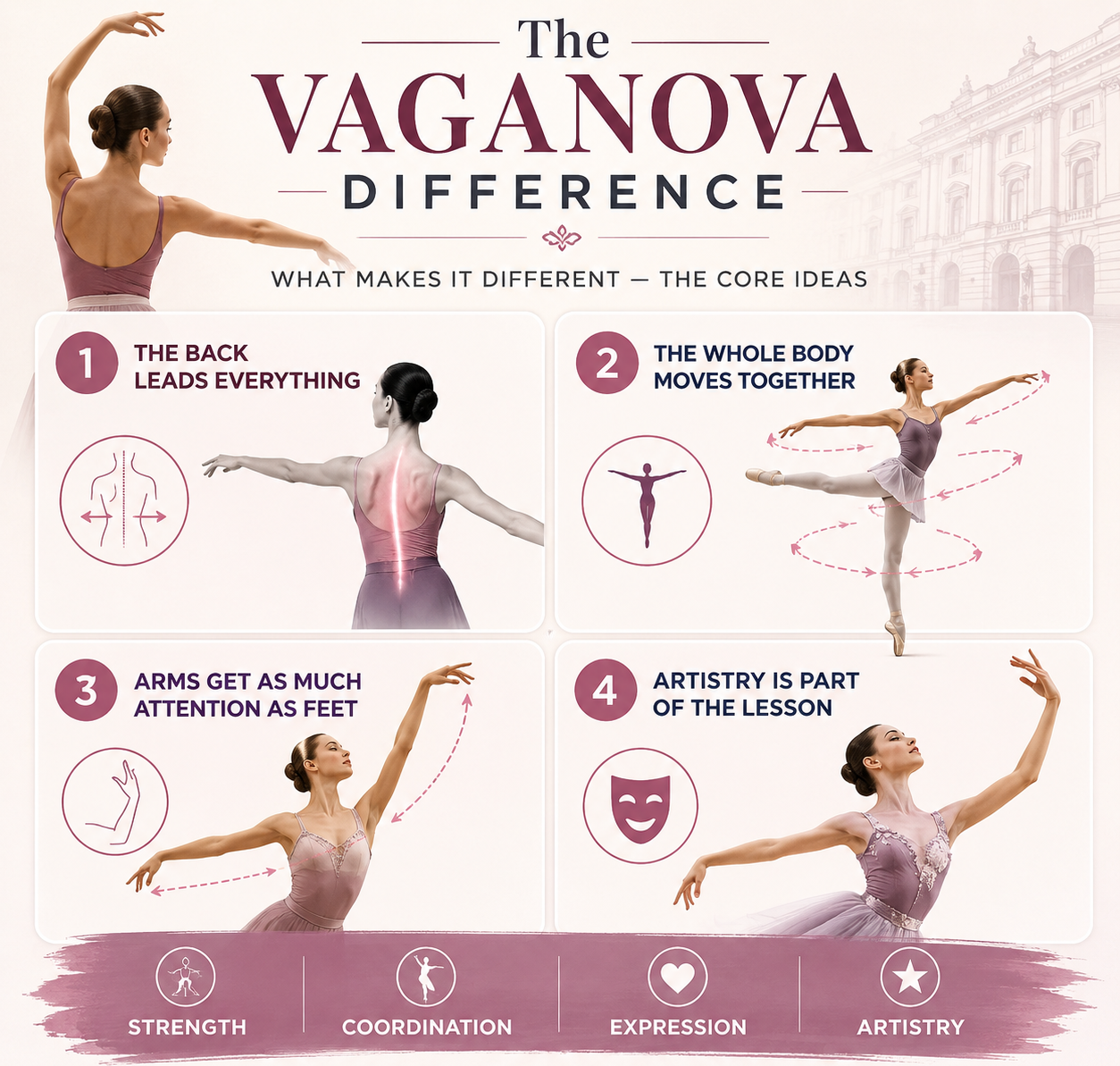
The Vaganova method stands out as the preferred choice of numerous dancers because it combines the development of technical skills with physical power and creative expression.
The Back Leads Everything
The Vaganova method starts its movement training by teaching dancers to move their backs and cores instead of beginning with leg movements. The movement pattern produces enhanced balance with improved control and generates stronger power output.
The Whole Body Moves Together
Students start their education by learning how to coordinate their arms, head, torso, and legs as a complete body system. The movements show a combination of graceful flow and unified execution, which produces an appearance of effortlessness.
Arms Get as Much Attention as Feet
The method places equal importance on arm movements and footwork. The training method enables dancers to create beautiful body positions which help them express their emotions better during performances.
Artistry Is Part of the Lesson
Students acquire technical abilities through artistic methods which teachers build into every educational phase. Students learn how to bring emotion and meaning to their movements from an early age.
Also Read: Adult Beginner Ballet Classes: A Complete Guide to Starting Ballet in Singapore
Vaganova vs Other Methods — Side by Side
| Feature | Vaganova | RAD | Cecchetti | Balanchine |
| Origin | Russia | UK | Italy | USA |
| Main Focus | Whole-body coordination | Graded syllabus | Precise footwork | Speed and clean lines |
| Arm Work | Very high priority | Moderate | Moderate | Low priority |
| Back and Core | Central to all moves | Secondary | Secondary | Secondary |
| Artistry | Taught from the start | Grows over time | Grows over time | Not a main focus |
| Exam System | Internal progress | External graded exams | Graded exams | No formal grading |
| Known For | World-class professionals | Wide reach | Classical shows | Neo-classical style |
The Unique Training Elements of Russian Vaganova Ballet
The Russian Vaganova ballet is known for its structured approach and attention to every aspect of a dancer’s development.
Strong Back and Core Development
Every movement in the Vaganova method requires a solid foundation, which includes both back strength and core stability. Students develop these muscles through carefully planned exercises that improve posture, balance, and control.
Musical Awareness
Music serves as a vital component which unites all educational spaces and physical activities. Students learn to move with rhythm, understand musical phrasing, and develop a natural connection between movement and music.
Attention to Detail
Teachers help dancers achieve better performance through their focus on proper body positioning and arm movement, and their guidance for achieving fluid movements between dance steps.
Why Many Families Choose the School of Russian Ballet
The School of Russian Ballet represents the best Ballet classes in Singapore because it teaches students through the genuine methods of Russian ballet education.
School of Russian Ballet provides authentic Vaganova-based education through its organised Russian curriculum, which experienced teachers deliver to students who want to build their technique and artistic abilities and self-assurance in an educational space that supports their development.
The school focuses on:
- Genuine Vaganova methodology
- Progressive skill development
- Individual student attention
- Performance readiness
- Strong artistic foundations
This balanced approach helps students build both technical excellence and a lasting appreciation for ballet.
Choosing Ballet Classes Singapore Families Can Trust
A child will experience permanent effects on their development when they select the perfect ballet school for their education.
- Teacher qualifications: You should select instructors who possess official ballet qualifications, together with experience in Vaganova training.
- Structured curriculum: A clear syllabus helps students progress steadily and build strong foundations.
- Performance opportunities: Stage experience helps performers develop their artistic abilities and build their self-assurance.
- Student development: Strong schools focus on both technical growth and personal development.
Is the Vaganova Method Right for Every Child?
The Vaganova method establishes a strong base for children because it teaches them through step-by-step instruction in an organised educational system. Young students begin their training with exercises suited for their age, which help them develop coordination skills and maintain proper posture while learning basic movement abilities before they advance to more complex techniques.
Children require training that grows with their development of physical and mental skills as they grow older. Students acquire multiple benefits from their ballet training because they develop better posture, improved coordination and musical skills and self-discipline and confidence.
Conclusion
The Vaganova method gives dancers something most other systems do not — a complete training that covers technique, body strength, arm work, and artistry all at once.
Parents from Singapore need to begin their search for excellent ballet instruction by understanding the teaching approach which schools implement.
Want to find out more about how the School of Russian Ballet teaches the Vaganova method — or find the right class for your child? Reach out to the team today. They are happy to help.
FAQs
What is the Vaganova method in ballet?
Agrippina Vaganova developed the Vaganova method, which provides students with a complete classical ballet education. It teaches students to use their entire body for movement, which includes their back, arms, legs and head while they learn proper technique and artistic expression from the beginning.
Is the Vaganova method good for young children?
Yes. The first stage of Vaganova training involves students learning soft and enjoyable activities. The initial education for children includes learning proper posture and fundamental movement skills and developing their interest in physical activity.
Where can I find Vaganova ballet classes in Singapore?
The School of Russian Ballet in Singapore offers proper Vaganova-based training. The school provides Russian ballet training through certified instructors who deliver authentic Vaganova method instruction, which makes their program unique in Singapore.
Can Vaganova training help with other dance styles?
Yes. The core strength, body control, and coordination built through Vaganova training carry over into contemporary, jazz, and other dance forms. Most professional dancers who perform various dance styles began their training by learning classical ballet techniques.