

Customers expect quick service and a smooth experience every time they visit a business. Yet long waiting times, poor customer flow and slow responses still frustrate many people. These issues can damage trust, reduce repeat visits and even lead to lost sales.
An IP security camera does much more than protect property. It helps businesses understand customer movement, respond faster and make better decisions based on real-time information.
From retail shops to hospitals and banks, organisations are using this technology to improve service standards. Understanding its role today can help businesses prepare for the customer expectations of tomorrow.
Why Queues Are Still a Problem in 2026
Long lines are a daily struggle for numerous businesses. Even with modern technology, there are a lot of businesses that resort to guesswork rather than to real-time data to control the customer flow.
- The outcome is a bad experience for both customers and employees.
- Customers walk out because they do not know how long the wait will be.
- Employees get stressed during peak hours, thus the impact on the quality of their services.
- Long lines are often mentioned in negative reviews.
- Frequent customers opt for competing businesses that provide a quicker service.
Today, there is nothing easier than increasing customer satisfaction by lowering the time spent waiting.
What Is an IP Security Camera?
The IP security camera, unlike the analogue one, transmits the video via the Internet. Since it is a part of the computer network, it has numerous capabilities other than filming.
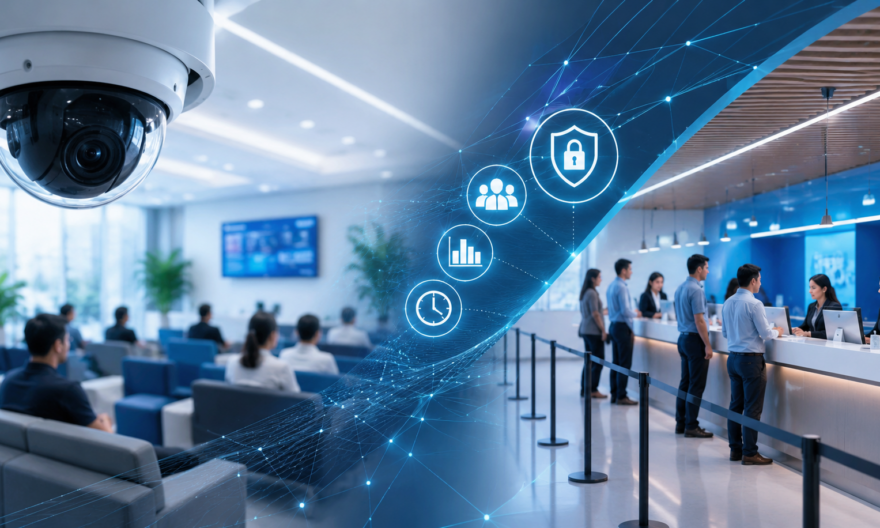
Most modern IP cameras have advanced technology installed inside them. They have the ability to count the number of visitors, measure the time spent standing in one place and signal about long queues. This transforms an ordinary camera into a queuing system.
How It’s Different From Old CCTV
| Feature | Old CCTV | IP Security Camera |
| Picture quality | Standard | High definition or better |
| Smart tracking | None | Counts people automatically |
| Remote viewing | Limited | Full access through an app |
| Add-ons | Stands alone | Works with queuing software |
How IP Cameras Power Smart Queuing Systems
An IP Security Camera is capable of monitoring customers’ movements in real time and generating statistics, which will make it possible to manage the queue in a more efficient way.
Count People and Discover Peak Hours
It allows for counting the number of people who enter a particular area and tracking customers’ movements. It helps identify peak hours and adjust the employee schedule accordingly.
Calculate and Display Live Queue Waiting Time
Camera statistics will help calculate the approximate waiting time for each customer joining the queue. The waiting time will be displayed on the screen, thus keeping customers informed.
Send Notification to Employees When the Limit Is Reached
When a queue exceeds a certain threshold, a notification will be sent to the manager or an employee. He will open an additional service point before the queue starts getting longer.
Integrate With a Digital Display
Most companies integrate the queue management system with a digital display. Their customers will see their position in the queue and the approximate waiting time.
Who’s Already Using IP Security Cameras in Singapore
Many organisations across Singapore already use these systems to improve customer service and reduce waiting times.
Hospitals and Polyclinics
Healthcare institutions deal with many patients on a daily basis. Intelligent cameras assist in managing patient traffic so that healthcare providers do not have to spend much time managing queues.
- More accurate prediction of patient waiting times.
- Real-time monitoring of busy reception areas.
- Improved staffing during peak times.
Shops and Shopping Malls
Retail stores employ IP cameras to monitor customer traffic and react promptly to congested checkout lines.
- Detect busy checkout lines immediately.
- Add more tills during rush hours.
- Enhance the entire shopping experience.
Food Stalls and Restaurants
Fast food services are dependent on a fast response to maintain their customers. CCTV monitoring can help in responding to the problem before queues become very long.
- Detect the forming of queues at a glance.
- Inform the staff about adding one more counter for service.
- Minimise the queue during busy meal periods.
Banks and Government Service Centres
Smart queue management helps banks and government departments ensure their customers visit them systematically and efficiently.
- Improve your handling of ticket numbers.
- Decrease crowding in the waiting area.
- Optimise customer traffic during the day.
Picking the Right Camera for Queue Management
Selecting the right camera is no less crucial than selecting the right software.
High-Resolution Video
Make sure the camera has at least 2MP resolution. Higher quality video will help you to get accurate statistics of your customers.
Wide Dynamic Range
The lighting around the camera might be quite different depending on the time of day, especially around windows. This feature will ensure that your video is clear in both dark and light areas.
Smart Analytics Inbuilt
Inbuilt AI can process your data independently and won’t need a separate server for that. It helps to speed up your alert system and minimise the workload of your network.
Support for Cloud Storage
With cloud storage, managers will be able to analyse the footage and customer dynamics no matter where they are located. It also simplifies the work with your data.
Power Over Ethernet (PoE)
This type of power source lets the camera receive power and data from one cable. It helps to simplify the installation process.
Setting Up Your Queuing System: A Simple Guide
But getting going is less difficult than you might think.
- Plan out your spots for queues: Locate where queues typically form.
- Choose cameras that have smart capabilities: Ensure the cameras can count and measure wait times.
- Locate your cameras to have maximum coverage: Pick an angle at which your camera will cover the entire queue, without any blind spots.
- Connect your camera to queuing software: Integrate your camera feed into a dashboard, where you convert your video footage into numbers.
- Educate your employees on alerts: Train your staff on how to act when alerted by the software.
- Analyse data once a week: Locate trends and change staffing accordingly.
Conclusion
The customer demands will never be satiated and will continue to rise; the companies need more efficient methods to cope with them. The IP security camera is not only a tool for securing anymore; the system gives instant feedback, which allows reducing wait time, improving customer movement and making decisions.
It helps to spot the busiest times, adapt to customer demands and create a comfortable environment both for the clients and the employees. With the development of technology, the importance of such solutions is going to rise. Choosing the proper system will help to secure the future competitiveness and success of the business.
FAQs
Do we need additional equipment for an IP security camera to become a queuing system?
No, not necessarily. Many IP cameras have chips that allow counting people without adding sensors. There is still some equipment where the camera is combined with special software for better results.
How accurate is people counting using a camera?
If the placement of an IP camera is right and the software is good enough, then it should be highly precise with more than 95% probability. It greatly depends on light, the position of the camera and the crowd density.
Is it legal to install IP cameras for a queuing system in Singapore?
It is if a business complies with PDPA regulations, i.e., puts up a sign. Most of the systems do not recognise faces but only count people.
Will this take away jobs from workers?
No, it will give workers precise information on when to take some actions, e.g. open an additional counter. People will make all decisions and interact with visitors.