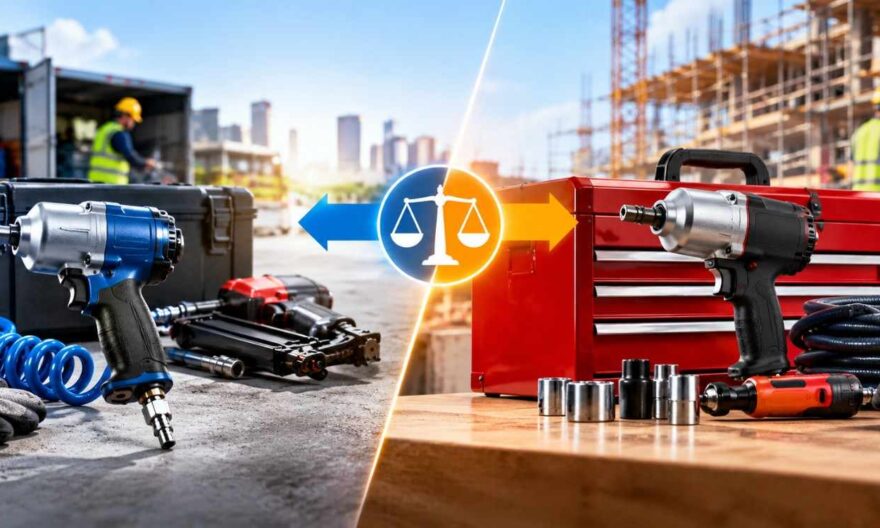
When a project has a fixed timeline, committing to a full equipment purchase rarely makes financial sense. For contractors weighing up tool costs, the choice between renting and buying pneumatic tools in Singapore comes down to usage frequency, project duration, and total cost of ownership.Renting is good for one off or short term needs, but buying pays off if tools are used regularly on multiple jobs.
Direct Answer: Short term projects are often better off renting pneumatic tools than buying. Rental provides no up-front capital, maintenance and storage problems. Buying only makes financial sense if you’ll be using the tools frequently on ongoing projects. The break-even point is normally a function of how often the tool will be used over a 12-month period.
What Are Pneumatic Tools and Why Does the Decision Matter?
Pneumatic tools are tools powered by compressed air supplied by a compressor. Typical examples are nail guns, impact wrenches, spray guns, grinders and sanders. Their power to weight ratio and durability make them popular in construction, automotive, fabrication and maintenance work.
In Singapore’s project-based construction environment, such tools are a recurring cost decision for contractors. The wrong tool, bought at the wrong time, means you are sitting on depreciating assets that drain capital between jobs.
Renting Pneumatic Tools: When It Makes Sense
Rental is the logical default for any contractor who cannot guarantee consistent tool usage beyond a single project. Here is why it works:
- No capital outlay: You pay only for the days you need the tool, preserving cash flow for materials and labour.
- No maintenance cost: Rental companies service and calibrate equipment before every hire. Worn seals, faulty valves, and compressor compatibility issues are their problem, not yours.
- Access to specialised tools: A concrete chisel hammer or a high-torque impact wrench may be needed once per year. Rental gives you access without storage or depreciation concerns.
- Flexibility: Upgrade to a higher-spec tool mid-project if requirements change, without the sunk cost of ownership.
Typical Short-Term Scenarios Where Renting Wins
- A renovation contractor brought in for a one-off HDB or condo unit upgrade
- A civil contractor needing additional pneumatic drills for a two-week tunnelling or road-breaking phase
- A small M&E outfit covering a temporary installation contract
- Any project where the pneumatic tool is needed for fewer than 15–20 working days per year
Buying Pneumatic Tools: When Ownership Pays Off
Ownership starts making financial sense when a tool is used consistently and frequently. The capital investment is recovered faster, and you gain control over availability, calibration, and condition.
- High utilisation rate: If a tool is used more than three to four times a month, purchase cost is typically recovered within 12 to 18 months.
- Brand and spec consistency: Owning your fleet means your team knows the exact tools, reducing setup time and operational errors on site.
- Long-term cost efficiency: A quality pneumatic tool, well-maintained, can last 5 to 10 years. The per-use cost drops significantly over time.
- Asset value: Owned tools can be listed on equipment schedules for tender submissions — relevant for larger contractors bidding for Building and Construction Authority (BCA)-registered projects in Singapore.
Ownership Suits These Contractor Profiles
- General contractors running multiple concurrent projects with overlapping tool requirements
- Automotive workshops and fabrication yards with daily pneumatic tool use
- Specialist contractors in ACMV, plumbing, or structural steel who rely on specific tool types consistently
Cost Comparison: Renting vs Buying Pneumatic Tools
The table below illustrates a simplified cost comparison for a mid-range pneumatic impact wrench commonly used on construction sites in Singapore:
| Cost Factor | Renting | Buying
|
|---|---|---|
| Upfront Cost | None | SGD 300 – SGD 800+ |
| Daily / Weekly Cost | SGD 30 – SGD 80/day (est.) | Amortised over lifespan |
| Maintenance | Included in rental | SGD 50 – SGD 200/year |
| Storage | Not required | Requires secure storage |
| Break-Even Point | N/A | ~12–18 months at regular use |
| Best For | 1–3 projects/year | 4+ projects/year |
These figures are estimates based on typical Singapore market rates. Actual costs vary by tool type, supplier, and project duration.
Hidden Costs Contractors Often Overlook
Both options carry costs that do not always appear in the headline price. Understanding these will sharpen your decision.
Hidden Costs of Renting
- Damage liability clauses — read the rental agreement carefully
- Transport costs to and from the rental depot
- Availability risk during peak project seasons when demand is high
Hidden Costs of Buying
- Depreciation — pneumatic tools lose market value even when properly maintained
- Downtime cost if a tool fails mid-project and spare parts are not immediately available
- Insurance and inventory management for larger equipment fleets
- Air compressor compatibility — owning tools means ensuring your compressor matches the CFM and PSI requirements of each tool
The Break-Even Rule of Thumb for Singapore Contractors
Here’s a good rule of thumb for project managers and site supervisors: If the total rental cost over 12 months is more than 60–70% of the purchase price, it’s almost certainly better to buy.
For example, a pneumatic grinder that costs SGD 400 to buy, and you’re paying SGD 250–280 a year in rental, the payback period is less than two years — even after factoring in annual maintenance. Then ownership is a better long-term value.
What to Ask Before Making the Decision
Before committing to either path, run through these qualifying questions:
- How many times will this tool be used in the next 12 months?
- Does the project require a specialised tool I would not use again?
- Do I have the infrastructure to store and maintain equipment properly?
- Is cash flow a constraint right now, or can I absorb an upfront purchase?
- Does ownership of this equipment strengthen my tender submissions or BCA project eligibility?
If most answers point toward low frequency, limited storage, and tight cash flow — renting is the smarter move. If you are running a steady pipeline of work and the tool is core to your operations, buying builds long-term efficiency.
Building Your Pneumatic Tool Strategy
Most of the experienced contractors in Singapore are using a hybrid approach. They own the core tools they use every day — impact wrenches, nail guns, spray systems — and rent out specialized or high-cost tools for certain stages of a project.
This approach keeps capital committed to high-utilisation assets while remaining lean on equipment that is idle between jobs. It also minimizes the risk of over-investing in tools that newer cordless or electric alternatives could eventually replace.
For contractors looking to build or expand a reliable pneumatic tool inventory — or explore whether a purchase makes sense for your current project pipeline — Chee Fatt carries a comprehensive range of pneumatic tools suited to both trades and industrial applications. Their product range spans air compressors, impact tools, grinders, and accessories, making it a practical first stop whether you are buying one tool or equipping a full team.
Frequently Asked Questions
Is it cheaper to rent or buy pneumatic tools for a one-month project?
For a single month-long project, renting is almost always cheaper. You avoid upfront purchase costs, maintenance, and storage. Unless the same tool will be used heavily across multiple projects within the same year, rental keeps costs proportional to the actual work duration.
What types of pneumatic tools are most commonly rented in Singapore?
Pneumatic jackhammers, concrete breakers, heavy-duty impact wrenches, and specialty grinders are among the most commonly rented tools. These are high-cost items with infrequent use, making rental more practical than ownership for most contractors on project-based work.
How do I calculate the break-even point between renting and buying?
Divide the total purchase price by the daily rental rate to find the number of rental days at which buying becomes cheaper. Add estimated annual maintenance costs to the purchase side for a more accurate comparison. If you exceed that day count within a year, buying makes financial sense.
Do I need to own an air compressor to use rented pneumatic tools?
Not necessarily. Many rental providers offer compressor hire alongside tools. However, if you already own a compressor, verify that its CFM and PSI output matches the rented tool’s requirements to avoid performance issues or equipment damage on site.
Are there any BCA or regulatory requirements in Singapore that affect pneumatic tool ownership?
While the Building and Construction Authority (BCA) does not mandate tool ownership for most contracts, having owned equipment can support prequalification submissions and demonstrate operational capacity. Always verify specific tender requirements, as some public sector contracts may specify equipment ownership as a qualifying criterion.
What should I check before renting pneumatic tools from a supplier?
Confirm the tool’s service history, air pressure compatibility, rental period terms, and damage liability clauses before signing. Ensure the supplier provides calibrated, fully functional equipment and clarify whether delivery, pickup, and replacement in case of breakdown are included in the rental agreement.