


For most SMEs the decision of whether to recruit an in-house accountant or use outsourced accounting services comes down to cost, expertise and the rate of growth of the organization. Outsourcing is often cheaper, gives a wider range of skills and can expand with the firm – so it’s a smart move for startups and SMEs that are developing and require solid financial backing without the cost of taking someone on full-time.
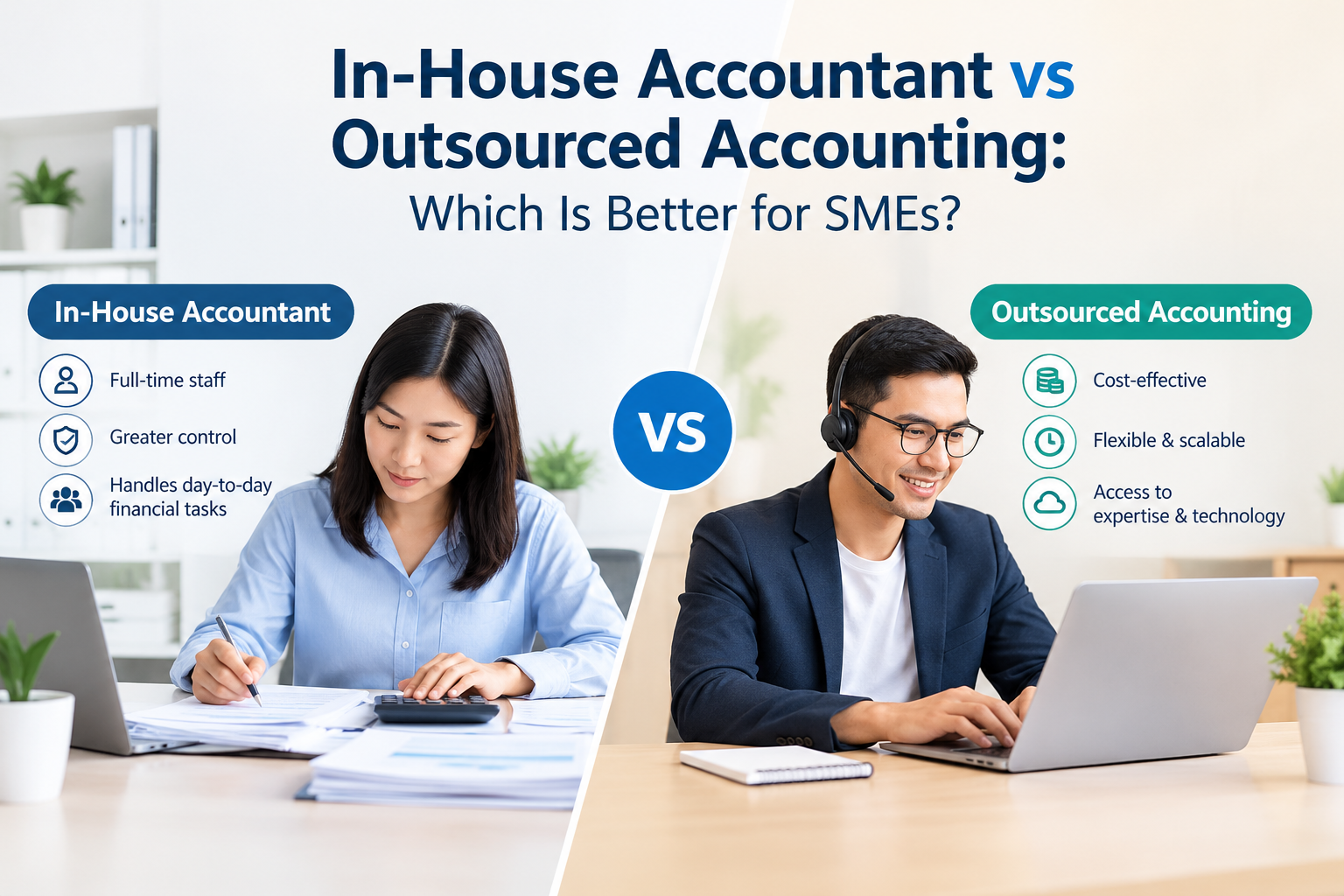
Why This Decision Matters More Than Most SMEs Realise
Accounting is more than filing taxes one year at a time. This encompasses bookkeeping, GST compliance, payroll, financial reporting and cash flow management – all of which have a direct impact on the health and legal status of your business in Singapore.
Get it incorrectly and the consequences can be anything from an IRAS penalty to bad financial decisions based on false information. Get it properly and your accounts are a tool for progress, not a source of stress.
Every SME owner faces the decision of whether to outsource their accounting services or establish their own in-house operation, at some point – and often sooner than they think.
The Real Cost of an In-House Accountant in Singapore
Salaries are only part of the picture. According to the Ministry of Manpower’s occupational wage data, an experienced accountant in Singapore earns between SGD 4,500 and SGD 7,000 per month, depending on seniority and industry.
Add to that:
- CPF contributions (employer’s share at 17% for employees under 55)
- Annual leave, medical benefits, and performance bonuses
- Training and professional development costs
- Accounting software licences
- Recruitment fees, which can run 1–2 months’ salary
For a lean SME or a startup still finding its footing, committing to SGD 70,000–90,000 annually for a single headcount — before overhead — is a significant financial commitment.
In-House Accountant vs Outsourcing: A Side-by-Side Comparison
| Factor | In-House Accountant | Outsourced Accounting |
|---|---|---|
| Monthly Cost | SGD 4,500–7,000+ (salary alone) | SGD 500–2,500 depending on scope |
| Expertise | Limited to one individual’s knowledge | Team of specialists across tax, audit, and compliance |
| Scalability | Requires rehiring or restructuring | Scales up or down with business needs |
| Availability | Subject to leave, turnover, and sick days | Consistent service with business continuity built in |
| Software & Tools | Business bears full cost | Often included in service package |
| Compliance Knowledge | Depends on individual’s up-to-date training | Firm stays current with IRAS and ACRA requirements |
| Best For | Large SMEs with complex, high-volume transactions | Startups, growing SMEs, businesses entering new markets |
When an In-House Accountant Makes Sense
Sometimes the proper move is to promote from within. If you’re a company with hundreds of transactions to execute daily, complicated multi-entity arrangements, or want real-time financial management that’s integrated into operations, a dedicated in-house accountant offers the proximity and institutional expertise that external teams may find hard to match.
Companies in regulated sectors – financial services, healthcare or with investor reporting duties – may also benefit from having someone immersed in the firm who understands the specifics of the operation day-to-day.
That said, these organizations commonly combine an internal finance head with outsourced accounting support for specialty duties such as tax planning, audit preparation or consultancy services.
When Outsourced Accounting Services Make More Sense
You Are a Startup or Early-Stage SME
Before revenue stabilises, committing to a full-time salary is high-risk. Outsourced accounting support lets you access professional-grade financial management at a fraction of the cost, freeing up capital for product, sales, or operations.
Your Accounting Needs Are Cyclical
Many SMEs have peak periods — year-end closing, GST filing quarters, or audit cycles — where accounting workload spikes. Outsourcing lets you scale support during these periods without maintaining that capacity year-round.
You Need More Than One Skill Set
One accountant cannot be an expert in bookkeeping, GST, corporate tax, and management reporting all at once. An outsourced accounting firm brings a team — each member with specific expertise — without the cost of hiring multiple specialists internally.
You Cannot Afford the Risk of Turnover
Staff turnover in Singapore’s accounting sector is a real operational risk. When an in-house accountant leaves, they take institutional knowledge with them — and you face a recruitment gap that can delay compliance deadlines. Outsourced providers offer continuity by design.
Compliance in Singapore: What SMEs Cannot Afford to Get Wrong
Singapore’s regulatory framework is clear but demanding. SMEs must comply with IRAS requirements for corporate income tax and GST, file annual returns with ACRA, and maintain proper accounting records under the Companies Act.
IRAS has stepped up its audit and enforcement activities in recent years, particularly around GST and e-commerce transactions. Errors in filing — whether from an overwhelmed in-house hire or a business owner managing their own accounts — can result in penalties, interest charges, or formal investigations.
Outsourced accounting services in Singapore keep your filings current, accurate, and aligned with any regulatory changes — without placing that burden on a single internal resource.
The Hybrid Model: A Practical Middle Ground
Some SMEs benefit from a hybrid approach — a part-time finance manager or bookkeeper internally, combined with outsourced accounting support for compliance, tax, and strategic advisory. This model gives you internal visibility without the full cost of a senior in-house hire.
It is particularly effective for businesses in growth mode, where financial complexity is increasing but a full finance function is not yet justified by revenue or headcount.
In-House vs Outsourcing: Which Model Wins for Most SMEs?
For the majority of SMEs and startups in Singapore, outsourced accounting delivers better value across cost, expertise, scalability, and compliance reliability. The exception is larger SMEs with high transaction volumes, complex operations, or specific needs that require a dedicated internal resource.
The most important factor is not which model is universally better — it is which model fits your current stage, complexity, and growth trajectory.
If you are evaluating your options, Triserv offers tailored outsourced accounting services in Singapore designed specifically for SMEs — covering everything from routine bookkeeping to GST compliance, corporate tax, and financial reporting. Their team works as an extension of your business, giving you professional accounting support without the overhead of a full-time hire.
Frequently Asked Questions
Is outsourcing accounting services suitable for very small businesses or sole proprietors?
Yes. Outsourced accounting is particularly well-suited for sole proprietors and micro-SMEs who need accurate, compliant financial records but cannot justify a full-time hire. Most providers offer flexible packages that scale with your business size and transaction volume.
What accounting tasks can be outsourced in Singapore?
Most core accounting functions can be outsourced, including bookkeeping, GST filing, corporate income tax preparation, payroll processing, ACRA annual return filing, and management reporting. Some firms also offer CFO-level advisory on a fractional basis.
How do I know if my business is ready to switch from in-house to outsourced accounting?
Common triggers include rising staff costs, a recent accountant resignation, compliance errors, or business expansion into new markets. If your current accounting setup is reactive rather than strategic, it is worth evaluating outsourced accounting support.
Does outsourcing accounting mean losing control of my finances?
No. Reputable outsourced accounting firms provide regular reports, cloud-based access to your financial data, and clear communication throughout. You retain full oversight — the difference is that the execution is handled by specialists rather than an internal hire.
How much does outsourced accounting cost in Singapore for an SME?
Costs vary based on transaction volume and scope of services, but SMEs typically pay between SGD 500 and SGD 2,500 per month. This is considerably less than the total cost of employing a mid-level in-house accountant, including CPF and benefits.
What is the difference between a bookkeeper and an outsourced accountant?
A bookkeeper records transactions and maintains financial records, while an outsourced accountant provides broader services including tax compliance, financial analysis, and strategic reporting. Many outsourced accounting firms in Singapore offer both functions within a single engagement.

