


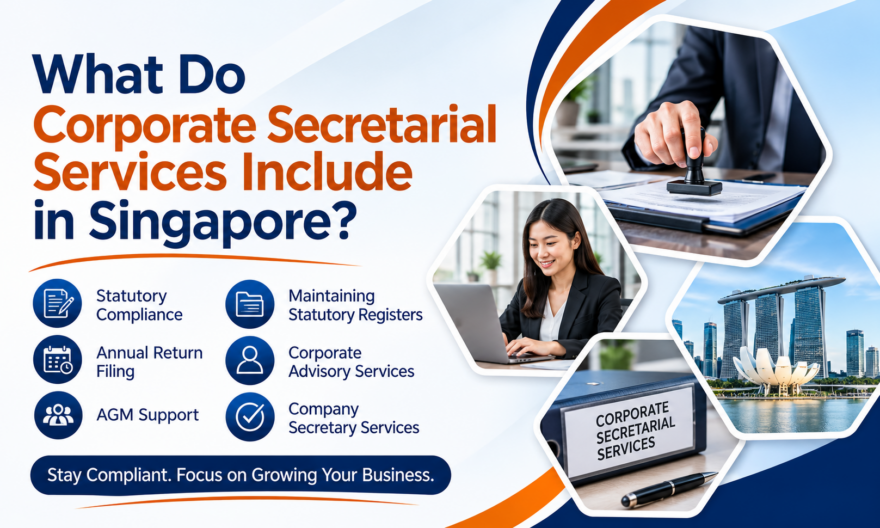
Corporate secretarial services in Singapore cover a range of statutory and compliance obligations that every registered company must fulfil. These include maintaining statutory registers, filing annual returns with ACRA, drafting board and shareholder resolutions, managing AGM requirements, and ensuring the company stays compliant with the Companies Act. A qualified corporate secretary acts as the company’s compliance backbone.
Running a business in Singapore means dealing with more than just sales and operations. Behind every compliant, well-structured company is a corporate secretary quietly keeping everything in order. If you are a startup founder, an SME director, or a foreign entrepreneur setting up here, understanding what corporate secretarial services actually involve helps you stay ahead of regulatory requirements — and avoid costly penalties.
Why Every Singapore Company Needs a Corporate Secretary
Under the Singapore Companies Act (Cap. 50), every company incorporated in Singapore must appoint a corporate secretary within six months of incorporation. The secretary must be a natural person ordinarily resident in Singapore. This is not optional — it is a legal requirement enforced by the Accounting and Corporate Regulatory Authority (ACRA).
Failure to maintain a corporate secretary or meet statutory deadlines can result in fines, penalties, or even striking off the company. For busy founders and directors, outsourcing to a professional firm is often the most practical route.
Core Services Included in Corporate Secretarial Services
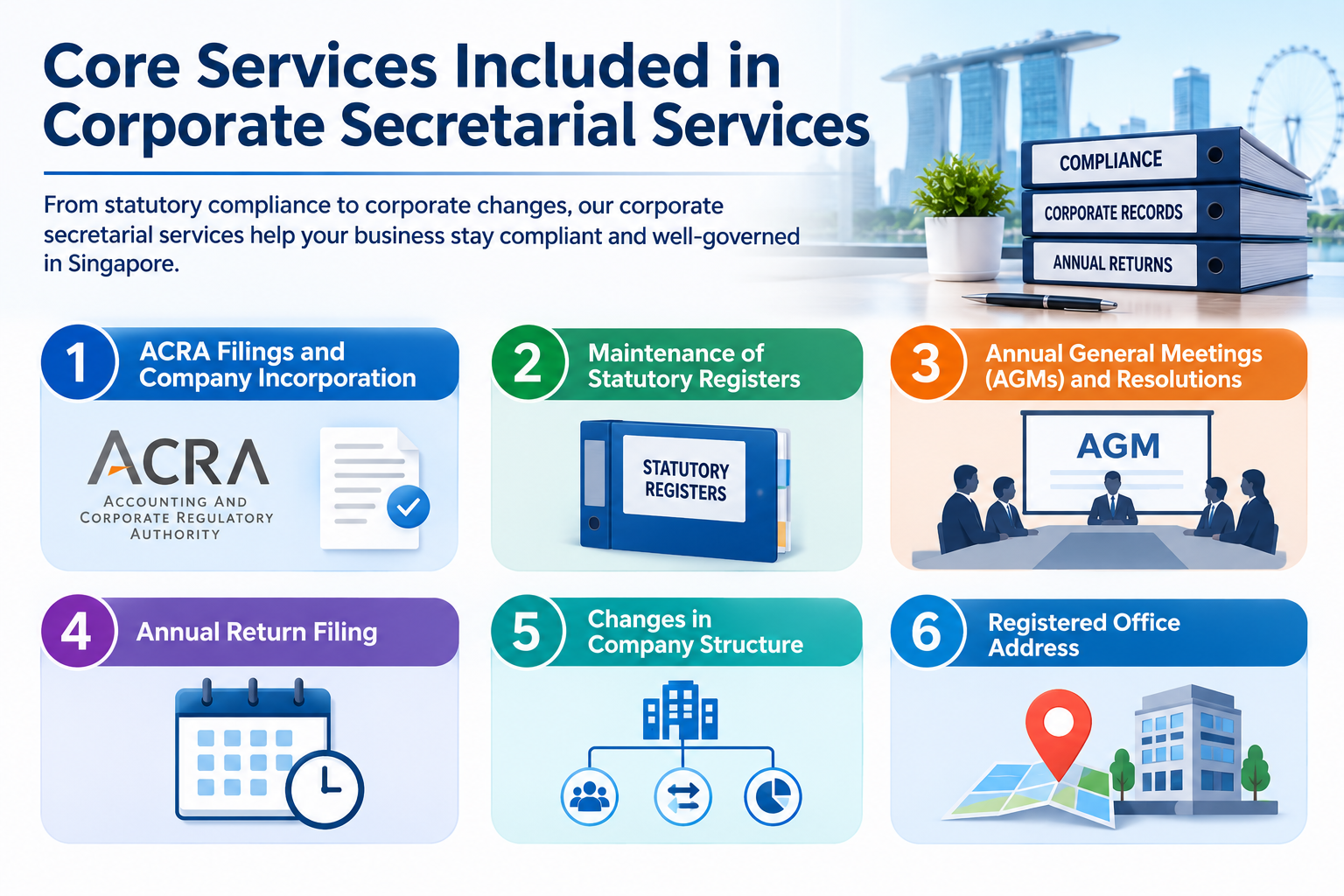
Not all secretarial service packages are the same, but most professional Accounting company in Singapore cover a consistent set of statutory responsibilities. Here is what a comprehensive engagement typically includes:
1. ACRA Filings and Company Incorporation
Your corporate secretary handles all filings with ACRA through the BizFile+ portal. This includes updates to company particulars such as changes in directors, shareholders, registered addresses, and share capital. Any such change must be lodged with ACRA within the prescribed timeframe — typically within 14 days.
During incorporation, the secretary prepares the constitution, registers the company, and ensures the correct business activity codes (SSIC codes) are selected.
2. Maintenance of Statutory Registers
Every Singapore company must maintain a set of statutory registers at its registered office or with its secretary. These include:
- Register of Members (shareholders)
- Register of Directors and Chief Executive Officers
- Register of Auditors
- Register of Charges
- Register of Registrable Controllers (the beneficial ownership register)
These are not just paperwork exercises. ACRA can inspect these registers, and inaccuracies carry penalties. A corporate secretary ensures they are kept current and accurate at all times.
3. Annual General Meetings (AGMs) and Resolutions
Private companies in Singapore are generally exempt from holding AGMs if they send their financial statements to members within five months of the financial year end. However, any member or auditor may still request an AGM. The secretary manages the entire process — from issuing notices to recording minutes.
Board resolutions and shareholder resolutions are also drafted and maintained by the secretary. These cover decisions such as opening bank accounts, approving financial statements, declaring dividends, or making significant business changes. These documents carry legal weight and must be properly prepared.
4. Annual Return Filing
Filing the annual return with ACRA is one of the most critical recurring obligations. For a private company, this must be filed within seven months of the financial year end. The annual return confirms that company information on ACRA’s register remains accurate and includes details about the company’s financial statements.
Missing this deadline results in a composition fine. The corporate secretary tracks these deadlines and handles the submission, ensuring nothing slips through the cracks.
5. Changes in Company Structure
Businesses evolve. Directors resign, new shareholders come on board, share transfers happen, and company names change. Every one of these events requires a formal process — board resolutions, updated registers, and ACRA filings. The secretary manages the documentation and ensures each step is completed in the correct order and within the legal timeframe.
6. Registered Office Address
Under Singapore law, every company must maintain a local registered office address that is open to the public during business hours. Many secretarial service providers offer their office address as the company’s registered address — a practical solution for home-based business owners or foreign-incorporated companies operating remotely.
How Corporate Secretarial Services Connect to Audit and Compliance
Secretarial services and audit obligations are closely linked. A company’s financial year end, determined partly by the secretary, sets the timeline for both audit completion and annual return filing. Many businesses in Singapore choose to work with an audit firm in Singapore that also offers secretarial services — this keeps records aligned and simplifies the compliance calendar.
For example, if your company’s financial statements are prepared by your auditors and need to be tabled at the AGM or included in the annual return, having a coordinated team avoids communication gaps and reduces the risk of missed deadlines.
What Happens If You Do Not Comply?
ACRA takes statutory compliance seriously. Here is a quick overview of what non-compliance can lead to:
|
Obligation |
Deadline |
Penalty for Non-Compliance |
|---|---|---|
| Appoint corporate secretary | Within 6 months of incorporation | Fine up to S$1,000 |
| File annual return | Within 7 months of financial year end | Composition fine; director liability |
| Update ACRA on changes | Within 14 days of change | Fine up to S$5,000 |
| Maintain statutory registers | Ongoing | Fines; potential striking off |
Directors bear personal responsibility for many of these obligations. Even if a secretary is appointed, the director cannot simply hand over responsibility and assume everything is handled — staying informed matters.
Choosing the Right Corporate Secretary in Singapore
When evaluating secretarial services Singapore providers, look beyond pricing. Consider whether the firm:
- Employs qualified professionals (SAICSA-accredited or legally trained)
- Uses secure, cloud-based document management
- Proactively alerts you to upcoming deadlines
- Can coordinate with your auditor and tax agent
- Has experience with your business structure — especially if you are a foreign-owned company or holding structure
Responsive communication is non-negotiable. You need a secretary who treats your compliance calendar as a priority, not an afterthought.
Conclusion
Corporate secretarial work is detailed, time-sensitive, and legally consequential. For most business owners, outsourcing this function to an experienced provider is the smartest move. Tan Chan & Partner offers professional corporate secretarial services alongside audit, tax, and accounting support — giving businesses a single, coordinated team to handle every compliance obligation. If you are setting up in Singapore or reviewing your current arrangements, ensuring your secretarial function is properly managed is a good place to start.
Frequently Asked Questions
What is included in corporate secretarial services in Singapore?
Corporate secretarial services in Singapore typically include ACRA filings, maintenance of statutory registers, drafting of board and shareholder resolutions, annual return filing, AGM management, and updates for changes in company structure. These services ensure the company remains compliant with the Singapore Companies Act throughout its operational life.
Is a corporate secretary mandatory for Singapore companies?
Yes. Under the Singapore Companies Act, every locally incorporated company must appoint a corporate secretary within six months of incorporation. The secretary must be a natural person ordinarily residing in Singapore. Failure to appoint one is a breach of statutory obligation and carries financial penalties for the company and its directors.
Can a director act as the company’s corporate secretary?
A sole director cannot also serve as the company’s corporate secretary in Singapore. If there are at least two directors, one may take on the secretary role, provided they meet the residency and qualification requirements. In practice, most companies outsource to a professional firm to ensure full compliance and avoid conflicts of interest.
How often does the annual return need to be filed with ACRA?
Every Singapore-incorporated company must file its annual return with ACRA once per financial year. For private companies, this must be done within seven months of the financial year end. The annual return confirms the accuracy of company information on ACRA’s register and must include details about the company’s financial statements.
What is the Register of Registrable Controllers?
The Register of Registrable Controllers is a statutory register that records individuals or entities with significant ownership or control over a company. Singapore companies must maintain this register and lodge the information with ACRA. It supports anti-money laundering efforts and increases corporate transparency under Singapore’s regulatory framework.