

Custom booklet printing gives event organisers a professional, tangible way to deliver schedules, company information, speaker profiles, and presentations to attendees. A well-designed booklet keeps participants informed, reinforces brand credibility, and serves as a lasting reference after the event ends. For corporate events, seminars, and conferences, printed booklets remain one of the most effective communication tools available.
Why Printed Booklets Still Matter at Corporate Events
Digital screens are everywhere, yet printed materials continue to hold their ground at professional gatherings. There is a reason seasoned event organisers always factor print into their budgets — it works.
A printed booklet does something a mobile app or email cannot. It sits on the table in front of every delegate, requires no Wi-Fi, and does not compete with notification pings. Attendees engage with it throughout the event and often take it home.
In Malaysia, corporate events and professional conferences have seen consistent growth, with MICE (Meetings, Incentives, Conferences, and Exhibitions) tourism contributing significantly to the national economy. According to Tourism Malaysia, the country hosted thousands of business events annually pre-pandemic and has been actively rebuilding that volume since 2022. For every one of those events, printed materials play a central role in the attendee experience.
What Types of Booklets Are Used at Corporate Events?
Not all event booklets serve the same purpose. The format and content depend heavily on the type of event and the audience involved. Here are the most common use cases:
Event Programme Booklets
These are the backbone of any well-run conference or seminar. They outline the daily schedule, session timings, breakout rooms, speaker bios, and venue maps. Delegates rely on them from the moment they arrive. A clearly laid-out programme booklet reduces confusion and positions the organiser as thorough and professional.
Company Profile and Corporate Brochures
Corporate booklets printed for AGMs, investor briefings, or partner conferences often double as a company overview. They include key milestones, service offerings, leadership profiles, and financial highlights. These are handed to stakeholders and decision-makers — the people who judge your brand on first impressions.
Training and Workshop Handbooks
HR teams running internal training programmes or external workshops use printed handbooks to deliver structured content. These booklets guide participants through modules, include note-taking space, and serve as a reference document long after the session ends.
Product Launch and Exhibition Booklets
When companies introduce new products or services at trade expos or corporate launches, a printed booklet supports the pitch. It reinforces the sales narrative, outlines specifications, and gives prospects something to review at their own pace.
Key Benefits of Custom Booklet Printing for Events
- Brand Consistency: Every page can carry your logo, colour palette, and typography — creating a cohesive visual experience from cover to cover.
- Credibility: A professionally printed booklet signals that your organisation takes the event seriously. First impressions at a corporate level are rarely made twice.
- Information Retention: Research consistently shows that people retain printed information better than digital content. For complex agendas or detailed presentations, this matters.
- Post-Event Value: Delegates keep useful booklets. That means your brand stays in their hands — literally — well beyond the closing ceremony.
- No Technology Dependency: No app downloads, no dead batteries, no connectivity issues. Your content is always accessible.
How to Choose the Right Booklet Format for Your Event
The format you choose affects both cost and impact. Here is a quick comparison to help event organisers and HR teams make an informed decision:
| Booklet Type | Best For | Typical Page Count | Binding Style
|
|---|---|---|---|
| Saddle-Stitched | Event programmes, seminar guides | 8–48 pages | Stapled at spine |
| Perfect Bound | Company profiles, annual reports | 48+ pages | Glued flat spine |
| Wire-O Bound | Training manuals, workshop handbooks | Any | Wire coil, lies flat |
| Staple Bound | Short schedules, quick-reference guides | 4–16 pages | Corner or centre staple |
Saddle-stitching is the most popular choice for event programmes in Malaysia due to its clean finish and cost-effectiveness at higher print runs. Perfect binding works well when your booklet needs to look polished on a desk or shelf — ideal for investor and partner-facing documents.
Paper Stock, Finish, and Size — What Actually Makes a Difference
These decisions seem minor but they shape how your booklet is perceived the moment someone picks it up.
Paper Weight
Cover pages typically use 250–300 gsm art card for a premium feel, while inner pages use 130–170 gsm art paper. Thicker paper communicates quality. Thin, flimsy pages undermine the professional image you are trying to build.
Finish Options
Gloss lamination adds vibrancy to images and gives a sleek, modern look. Matte lamination is more subdued — popular for corporate booklets that aim to feel refined rather than flashy. Spot UV and soft-touch finishes are worth considering for high-stakes events like annual gala dinners or executive summits.
Size Considerations
A5 is the standard for event programmes — it fits in a bag without being bulky. A4 works well for training manuals and company profiles where more content needs to breathe on the page. DL (⅓ of A4) suits compact schedules or introductory inserts.
Planning Your Print Timeline for Events
Last-minute printing is one of the most common — and avoidable — stresses in event management. Build your print schedule backwards from your event date.
- 6–8 weeks before: Finalise content structure and confirm page count
- 4–5 weeks before: Submit design files and approve digital proof
- 2–3 weeks before: Production and quality check
- 1 week before: Delivery and collation
Rushing the process forces compromises — on paper quality, binding, or accuracy. Event booklets with typos or outdated speaker information reflect poorly on the organiser, not the printer. Allow your team enough runway to get it right.
What to Include in a Conference Booklet
The content inside your conference booklet should be purposeful. Every page should earn its place. A well-structured conference booklet typically includes:
- Welcome message from the organiser or keynote sponsor
- Full event schedule with session times, room allocations, and breaks
- Speaker profiles with photographs and credentials
- Floor plan or venue map
- Sponsor recognition pages
- Networking session details
- Notes pages for delegates
- Contact information and post-event follow-up details
For internal corporate events, HR teams often add company values, training objectives, and team activity briefs. The more purposeful the content, the more delegates will actually use and keep the booklet.
Getting the Most Value from Your Event Booklet Budget
Bulk printing reduces unit cost significantly. If your event has 200 attendees, printing 250 copies is usually more cost-effective than printing exactly 200. The surplus serves as backup stock, press kit copies, or post-event distribution to absentees.
Partnering with the right printer matters as much as the design. Look for a provider with experience in corporate booklet printing, a clear proofing process, and reliable turnaround times. Last-minute surprises at the production stage can derail your entire event preparation timeline.
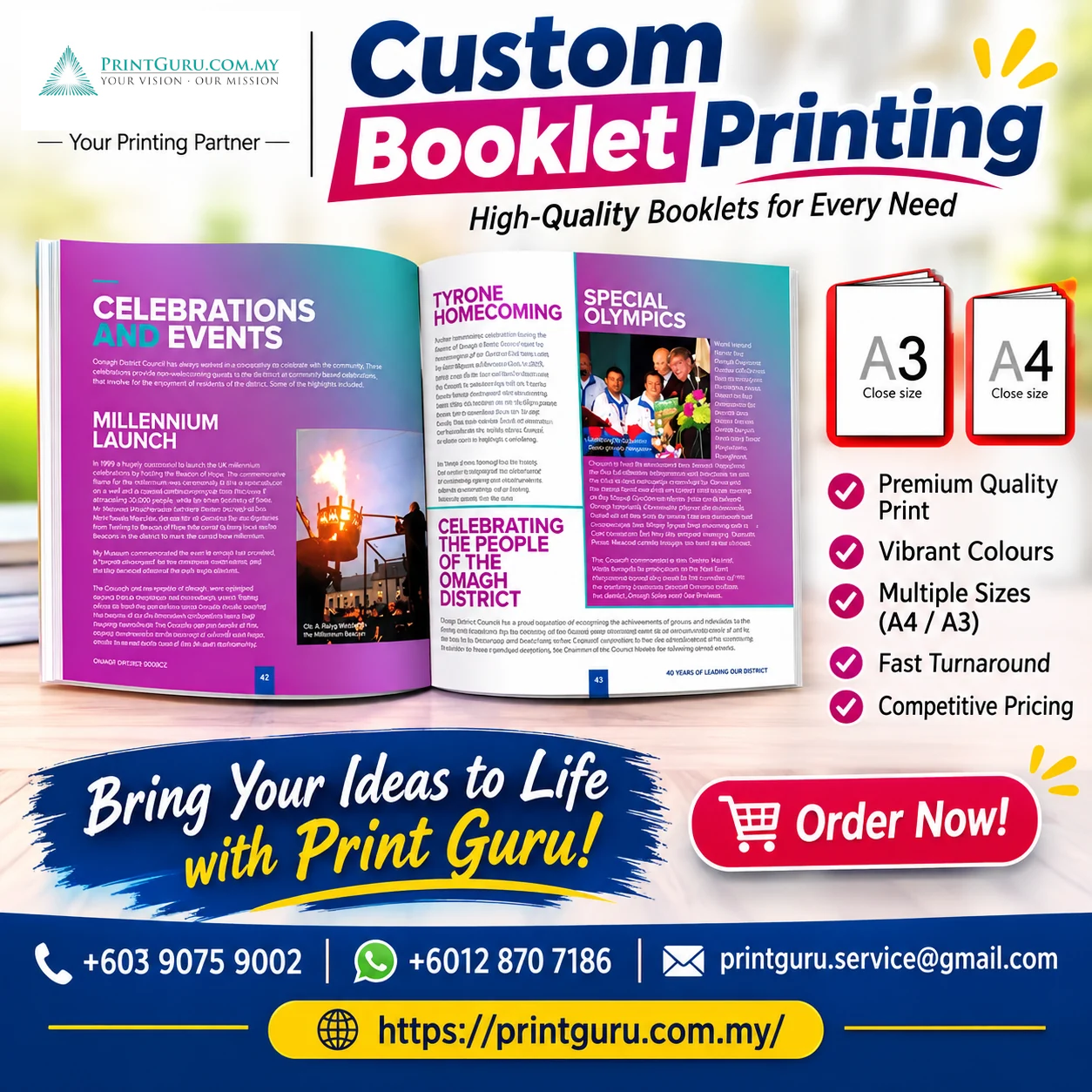
For event organisers and corporate teams in Malaysia looking for a trusted print partner, Print Guru offers professional custom booklet printing tailored for conferences, seminars, and corporate events — with options across sizes, binding styles, and finishing to match any brief or budget.
Frequently Asked Questions
What is the best booklet size for a corporate event programme?
A5 is the most practical size for corporate event programmes. It is compact enough to carry throughout the day, yet spacious enough to display schedules, speaker profiles, and maps clearly without crowding the layout.
How many pages should a conference booklet have?
Most conference booklets run between 16 and 48 pages. The right length depends on your agenda, number of speakers, and sponsor content. Keep pages purposeful — every section should deliver value to the delegate, not just fill space.
What is the difference between saddle-stitched and perfect bound booklets?
Saddle-stitched booklets are stapled at the spine and suit shorter page counts of up to 48 pages. Perfect bound booklets use a glued flat spine and are better suited for thicker, more formal documents like company profiles or annual reports.
How far in advance should I order event booklets?
Order at least three to four weeks before your event. This allows time for design approval, print production, and quality checks. Tight deadlines increase the risk of errors and limit your paper and finishing options.
Can I include customised content for different delegate groups in the same booklet print run?
Yes, with variable data printing it is possible to personalise specific pages — such as delegate names or session selections — within the same print run. Discuss this with your printer early in the planning process to confirm technical feasibility and cost.
What paper finish is recommended for a premium corporate booklet?
Matte lamination on the cover gives a refined, professional finish suited to executive events. Gloss lamination works well when vivid imagery is central to the design. Soft-touch coating is ideal for high-end corporate booklets where tactile quality reinforces brand prestige.