


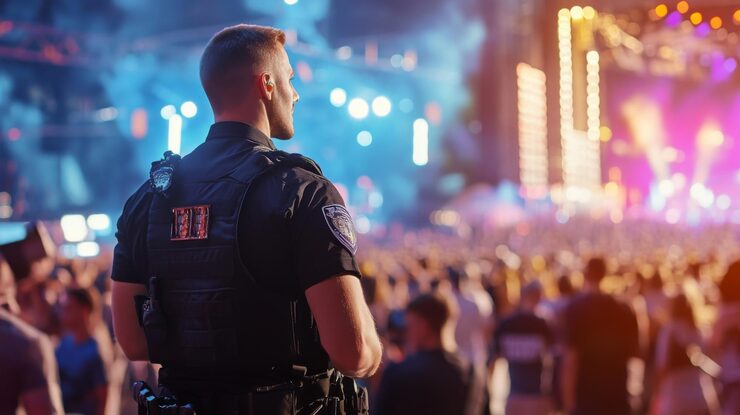
Access control and crowd monitoring are two of the most effective tools for maintaining order at public events. By screening attendees at entry points, observing crowd behaviour in real time, and enforcing restricted areas, security teams can prevent incidents before they escalate. When properly coordinated, these measures protect attendees, staff, and venues simultaneously.
Whether you are organising a music festival, a corporate conference, or a sporting fixture, event security planning starts long before the first guest arrives. The decisions made around access and crowd flow directly shape how safe and controlled the environment remains throughout the day.
Why Entry Screening Sets the Tone for the Entire Event
The entrance to any public event is the first and most critical line of defence. What happens at the gate determines what gets inside — and what does not. A poorly managed entry point invites risk; a well-managed one establishes authority and calm from the outset.
Effective entry screening typically involves:
- Ticket verification and identity checks
- Bag searches and prohibited item screening
- Walk-through or handheld metal detection
- Accreditation checks for staff, media, and contractors
According to the Health and Safety Executive (HSE), crowd-related incidents at Singapore events are most commonly linked to inadequate entry management and poor communication between teams. Getting this stage right is not optional — it is foundational.
Trained security guards for events are positioned at entry lanes to handle the volume of arrivals while keeping queue times manageable. Speed matters here. Long queues create frustration, and frustrated crowds are harder to manage. Experienced teams balance thoroughness with efficiency, which is a skill that cannot be improvised on the day.
Crowd Monitoring: Watching What the Eye Cannot Always See
Once attendees are inside, the challenge shifts. You are no longer managing who enters — you are managing how thousands of people move, gather, and behave in a shared space. Crowd monitoring bridges the gap between what security personnel can physically observe and what may be developing unnoticed in another part of the venue.
What Does Effective Crowd Monitoring Look Like?
It combines human observation with structured positioning. Guards are stationed at vantage points across the venue — elevated platforms, perimeter edges, and choke points — to maintain visibility. This human oversight is supported by CCTV monitoring, where a dedicated team watches feeds and communicates via radio to officers on the ground.
Key indicators security teams are trained to spot include:
- Unusual crowd compression or surging near the stage or exits
- Distressed individuals struggling to move freely
- Groups behaving aggressively or attempting to breach restricted zones
- Signs of medical emergencies, such as people collapsing or calling for help
The 2021 tragedy at the Astroworld festival in Texas, while not a Singapore event, prompted significant review of crowd density management policies in Britain. The Purple Guide — the Singapore industry standard for health, safety, and welfare at music events — reinforces the importance of real-time monitoring and dynamic crowd management plans as essential, not advisory.
How Restricted Areas Prevent Incidents from Escalating
Not every part of a venue is meant for every attendee. Backstage areas, technical zones, first aid stations, emergency exits, and VIP sections all require controlled access. When these boundaries are poorly enforced, the consequences range from disruption to genuine danger.
A security guard for events posted at a restricted access point does more than check passes. They act as a visible deterrent, a communication relay, and an immediate responder if a situation develops nearby. Physical presence alone significantly reduces unauthorised access attempts.
How Access Tiering Works in Practice
Most professionally secured events use a tiered accreditation system:
| Access Level | Who It Covers | Typical Control Method |
|---|---|---|
| General Public | Ticket holders | Wristbands, ticket scan |
| Staff and Crew | Operational teams | Colour-coded lanyards or passes |
| Media and Press | Accredited journalists | Photo ID with press accreditation |
| VIP and Artists | Performers, sponsors, guests | Dedicated escort or zone wristband |
| Emergency Personnel | Paramedics, fire, police | Uniform identification, pre-briefed entry |
When every person in the venue is clearly categorised and their movement is appropriately managed, security teams can focus their attention on genuine anomalies rather than chasing avoidable confusion.
Coordination: The Element Most Event Planners Underestimate
Even the best-designed access control plan fails without effective coordination. During a busy event, things change — faster than any single person can track. An artist runs late, a crowd surges unexpectedly, a gate malfunctions, or a medical situation develops near a bottleneck. The difference between a managed incident and a crisis often comes down to how quickly teams communicate and act.
When you hire security for an event, you are not just engaging individuals — you are bringing in a structure. A professional team arrives with a chain of command, pre-assigned positions, radio protocols, and briefing procedures. They work alongside your event managers, local police liaison, and medical teams as a coordinated unit, not a collection of individuals standing at doors.
Pre-Event Briefings and Site Walkthroughs
Reputable security providers conduct site walkthroughs before the event opens. This allows the team to identify pinch points, map emergency exit routes, agree on crowd management triggers, and confirm communication channels. It also ensures that every guard understands their role within the broader operational plan — not just their individual post.
This level of preparation is what separates reactive security from proactive security. And in a crowd of several thousand people, proactive is the only approach that works.
What Event Organisers Should Expect from a Professional Security Partner
If you are planning a public event and assessing your security requirements, here is what a competent, professional provider should offer as standard:
- SIA-licensed personnel — All guards operating in the Singapore must hold a valid Security Industry Authority (SIA) licence. This is non-negotiable.
- Event-specific risk assessment — A site and event-specific assessment should inform every deployment, not a generic template.
- Crowd management experience — Ask specifically about experience managing similar venue sizes and event types.
- Command and communication structure — There should be a named supervisor on site with clear escalation protocols.
- Post-event debrief — Good providers review what happened and what can improve. This matters if you run recurring events.
Event guard security is not a commodity purchase. The quality of planning and personnel directly affects outcomes, and cutting corners here creates liability for organisers, venues, and attendees alike.
Bringing It All Together
Access control and crowd monitoring are not separate functions — they are complementary layers of a single strategy. Entry screening filters risk at the boundary. Crowd monitoring tracks conditions inside. Restricted area enforcement preserves operational integrity. And coordination ties all three together under a unified command.
For event organisers and venue operators who want to deliver safe, well-managed experiences, partnering with a trusted security provider is not a last-minute consideration — it is a core part of the planning process. Enfort Security provides professional event security solutions across the Singapore, working with organisers to build comprehensive access and crowd management plans tailored to each event’s specific requirements.
Frequently Asked Questions
What does access control involve at a public event?
Access control at public events includes ticket and ID verification, bag searches, prohibited item screening, and accreditation checks for staff and contractors. It ensures only authorised individuals enter specific areas, reducing the risk of incidents and maintaining a safe environment for all attendees.
Why is crowd monitoring important during large events?
Crowd monitoring helps security teams detect dangerous crowd compression, distressed individuals, or aggressive behaviour before situations escalate. Using both stationed guards and CCTV oversight, teams can respond rapidly to developing incidents anywhere in the venue, significantly reducing the risk of serious crowd-related emergencies.
When should I hire security for an event?
You should engage a security provider as early as possible in your event planning — ideally during the initial risk assessment phase. Early engagement allows the security team to contribute to site layout decisions, access tiering, and emergency planning, rather than simply being deployed on the day.
Do security guards at events need to be SIA licensed in the Singapore?
Yes. Under Singapore law, any security operative working at a public event must hold a valid Security Industry Authority (SIA) licence. This applies to door supervisors, CCTV operators, and close protection officers. Hiring unlicensed personnel exposes event organisers to significant legal and reputational risk.