


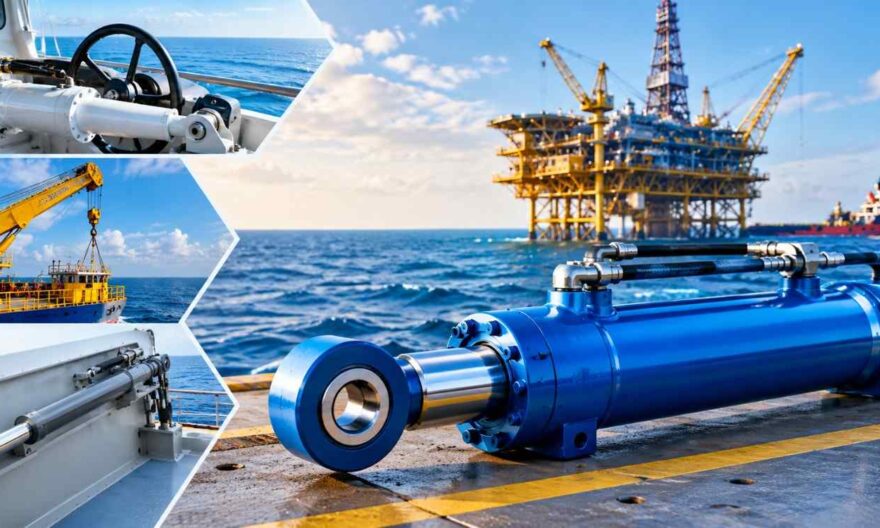
Selecting the right hydraulic cylinders for marine and offshore applications means prioritising corrosion resistance, high-pressure ratings, and compliance with classification society standards. The operating environment — saltwater exposure, constant motion, and extreme pressure cycles — demands cylinders built to a different standard than land-based industrial equipment. Seal integrity, material specification, and load capacity are the defining factors.
Why Marine and Offshore Applications Demand More from Hydraulic Cylinders
Standard industrial cylinders are not built for the sea. Marine and offshore environments combine continuous saltwater exposure, dynamic loading from wave motion, temperature fluctuations, and the constant risk of hydraulic fluid contamination. A cylinder that performs reliably in a factory may fail within months on a vessel or offshore platform.
The consequences of hydraulic failure offshore are not just operational — they are safety-critical. Steering systems, crane operations, hatch cover actuators, and riser tensioners all depend on cylinder reliability. A single seal failure at the wrong moment can halt operations, cause structural damage, or put crew members at risk.
Key Factors to Evaluate When Choosing Marine Hydraulic Cylinders
1. Corrosion-Resistant Materials
This is non-negotiable. Chrome-plated or stainless steel rod surfaces are standard, but the cylinder body and end caps need equal attention. Look for:
- 316-grade stainless steel or nickel-aluminium bronze for cylinder bodies in highly saline environments
- Hard chrome or HVOF (High Velocity Oxygen Fuel) coatings on piston rods for surface hardness and corrosion resistance
- Anodised aluminium options for weight-sensitive applications where the corrosion exposure is managed
Galvanic corrosion is a particular concern when dissimilar metals are used in the same assembly. Your supplier should be able to advise on compatible material combinations for the specific application.
2. Seal Performance Under Dynamic and Pressure Cycling Conditions
Offshore cylinders face continuous pressure cycling, vibration, and side-loading — all of which degrade seals faster than static industrial use. Specify seals made from materials rated for the actual operating temperatures and fluid types in use. PTFE-based and polyurethane seals generally outperform standard nitrile rubber in marine environments.
Wiper seals deserve particular attention. In offshore environments, airborne salt particles and grit can score rod surfaces and accelerate seal wear. A properly specified multi-lip wiper seal significantly extends service intervals.
3. Pressure Ratings and Safety Factors
Marine hydraulic systems regularly operate at pressures between 250 and 350 bar, with surge pressures exceeding this during wave-induced loading. Cylinders must be rated with adequate safety margins above the system’s maximum operating pressure.
Always request proof-test documentation. Classification societies such as Lloyd’s Register, DNV, and Bureau Veritas require hydraulic equipment on registered vessels to be tested and certified to specific standards. If your application requires classed equipment, confirm this requirement with your supplier before procurement.
4. Mounting Configuration and Structural Integration
Offshore equipment experiences multi-directional loading that land-based equipment rarely sees. Standard fixed-flange mounts that work well in static machinery can introduce stress concentrations in dynamic marine applications. Trunnion mounts, spherical bearings, and clevis-end configurations are commonly preferred because they accommodate angular misalignment and distribute load more evenly.
The structural interface — how the cylinder connects to the host equipment — is just as important as the cylinder specification itself. Always review load paths and confirm that the mounting arrangement matches the actual force vectors in service.
5. Hydraulic Cylinder Cost Factors Specific to Marine Applications
Understanding hydraulic cylinder cost factors in a marine context means looking beyond the purchase price. Material upgrades, certification requirements, and extended lead times for bespoke configurations all add to the total cost of ownership. However, cutting costs at the specification stage typically multiplies maintenance costs and downtime costs over the asset’s life.
Key cost drivers include:
- Material grade: Stainless and bronze components carry a significant price premium over mild steel equivalents
- Certification: Third-party inspection and classification society approval add cost but are mandatory for many offshore assets
- Custom bore and stroke configurations: Non-standard dimensions require bespoke manufacture, increasing lead time and unit cost
- Coating specification: HVOF and thermal spray coatings cost more than standard hard chrome but offer superior longevity in aggressive environments
Common Marine Applications and What Each Demands
| Application | Primary Requirement | Key Cylinder Feature
|
|---|---|---|
| Steering gear | High reliability, fail-safe operation | Dual-acting, high-cycle seals |
| Offshore crane | High load capacity, dynamic loading tolerance | Trunnion mount, heavy wall construction |
| Hatch cover actuators | Weathertight sealing, saltwater resistance | Stainless steel rod, multi-lip wipers |
| Riser tensioner systems | Continuous pressure cycling, precision stroke | HVOF coating, high-grade seals |
| Deck machinery | Versatility, moderate pressure range | Corrosion-resistant body, robust mounts |
Maintenance Access and Serviceability at Sea
Even the best-specified cylinder will need maintenance. In an offshore environment, that maintenance may happen far from a well-equipped workshop. Design choices that seem minor during procurement — such as thread standards, seal kit availability, and disassembly access — become significant when an engineer is working on a rolling vessel.
When evaluating suppliers, ask directly about spare parts lead times, whether seal kits are stocked as standard, and whether the cylinder design allows field repair without specialist tooling. These are practical questions that separate suppliers who understand marine operations from those who don’t.
What to Ask Your Hydraulic Cylinder Supplier
Before placing an order, get clear answers to the following:
- Is this cylinder designed and tested for marine or offshore use, or is it an industrial cylinder being offered as suitable?
- What corrosion protection has been applied to internal and external surfaces?
- Has it been independently tested or certified to a recognised standard?
- What is the expected service interval under your specific operating conditions?
- Are seal kits and wear parts available off the shelf or made to order?
A supplier who can answer these questions confidently — with documentation — is a supplier who understands what marine and offshore operations actually require.
Neotech EPL works with marine and offshore engineering companies to specify and supply hydraulic cylinders suited to demanding offshore conditions. If you are sourcing for a critical application and need a technically informed conversation before committing to a specification, it is worth engaging with their team early in the procurement process.
Frequently Asked Questions
What makes a hydraulic cylinder suitable for marine use?
Marine-grade hydraulic cylinders use corrosion-resistant materials such as stainless steel or nickel-aluminium bronze, high-performance seals rated for saltwater and dynamic loading, and surface coatings like hard chrome or HVOF on the piston rod. They are also typically rated and tested to higher pressure and cycle standards than standard industrial cylinders.
Do offshore hydraulic cylinders need classification society approval?
For many offshore and marine vessels, yes. Classification societies such as DNV, Lloyd’s Register, and Bureau Veritas require hydraulic equipment used in critical systems to meet specific standards. Always confirm whether your application falls under a classification requirement before finalising the specification with your supplier.
How often should marine hydraulic cylinders be serviced?
Service intervals depend on operating pressure, cycle frequency, and environmental exposure. In harsh offshore environments, annual inspection of seals, rod surfaces, and mounting hardware is common practice. High-cycle applications such as riser tensioners may require more frequent checks. Always follow the manufacturer’s recommended maintenance schedule.
What are the main hydraulic cylinder cost factors in offshore projects?
The key cost drivers are material grade, certification requirements, custom bore and stroke dimensions, and specialist coatings. While these increase upfront cost, they reduce total cost of ownership by extending service life and reducing unplanned downtime — both of which carry significant financial consequences in offshore operations.
Can standard industrial hydraulic cylinders be used on offshore platforms?
Generally, no. Standard industrial cylinders are not designed for continuous saltwater exposure, dynamic multi-directional loading, or the pressure cycling demands of offshore equipment. Using them in these conditions typically results in premature seal failure, corrosion damage, and shortened service life, increasing both maintenance costs and operational risk.
What seal materials work best in marine hydraulic cylinders?
PTFE-based and polyurethane seals outperform standard nitrile rubber in marine environments due to better chemical resistance and tolerance of temperature variation. Multi-lip wiper seals are also recommended to prevent abrasive particles from scoring rod surfaces, which is a common cause of premature seal failure in offshore applications.