

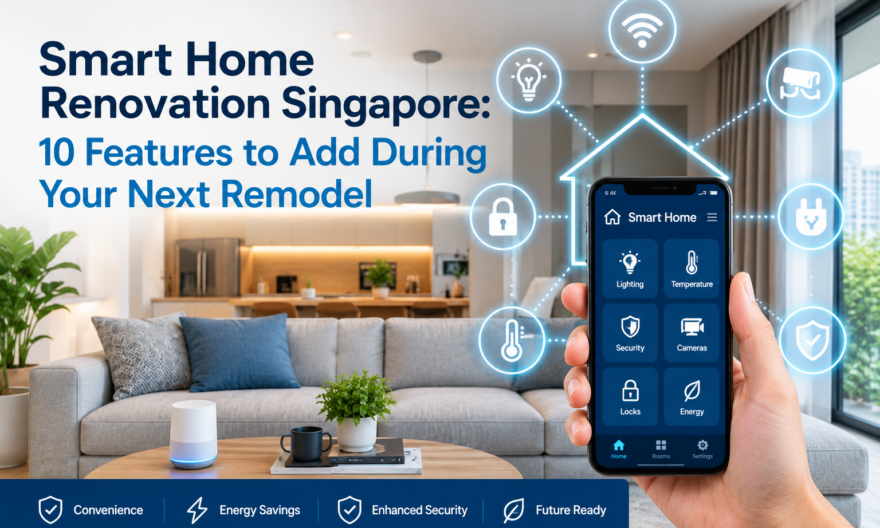
Planning a smart home renovation in Singapore means more than picking stylish fittings. It means embedding intelligence into your walls before they close up. The smartest renovations pre-wire for automation, plan device placement early, and choose systems that grow with technology. Done right, your home becomes more efficient, secure, and liveable — without visible clutter or costly retrofits later.
If you’re already exploring options for a smart home in Singapore, the best time to integrate automation is during the renovation itself — not after. Here are 10 features worth building into your next remodel.
Why Smart Features Belong in Your Renovation Plan, Not After
Most homeowners add smart devices as afterthoughts. Wall plugs, adhesive sensors, dangling cables — none of it is elegant. When you integrate smart features during a smart home renovation in Singapore, you gain clean aesthetics, proper load planning, and genuine future-proofing. Your ID and contractor can route conduit, plan switch positions, and size your DB box accordingly from day one.
According to the Infocomm Media Development Authority (IMDA), Singapore’s Smart Nation initiative actively encourages residential technology adoption, including energy management and home automation systems. Planning these systems at the renovation stage aligns with national infrastructure goals and may even qualify your home for energy efficiency schemes.
The 10 Smart Features to Include in Your Remodel
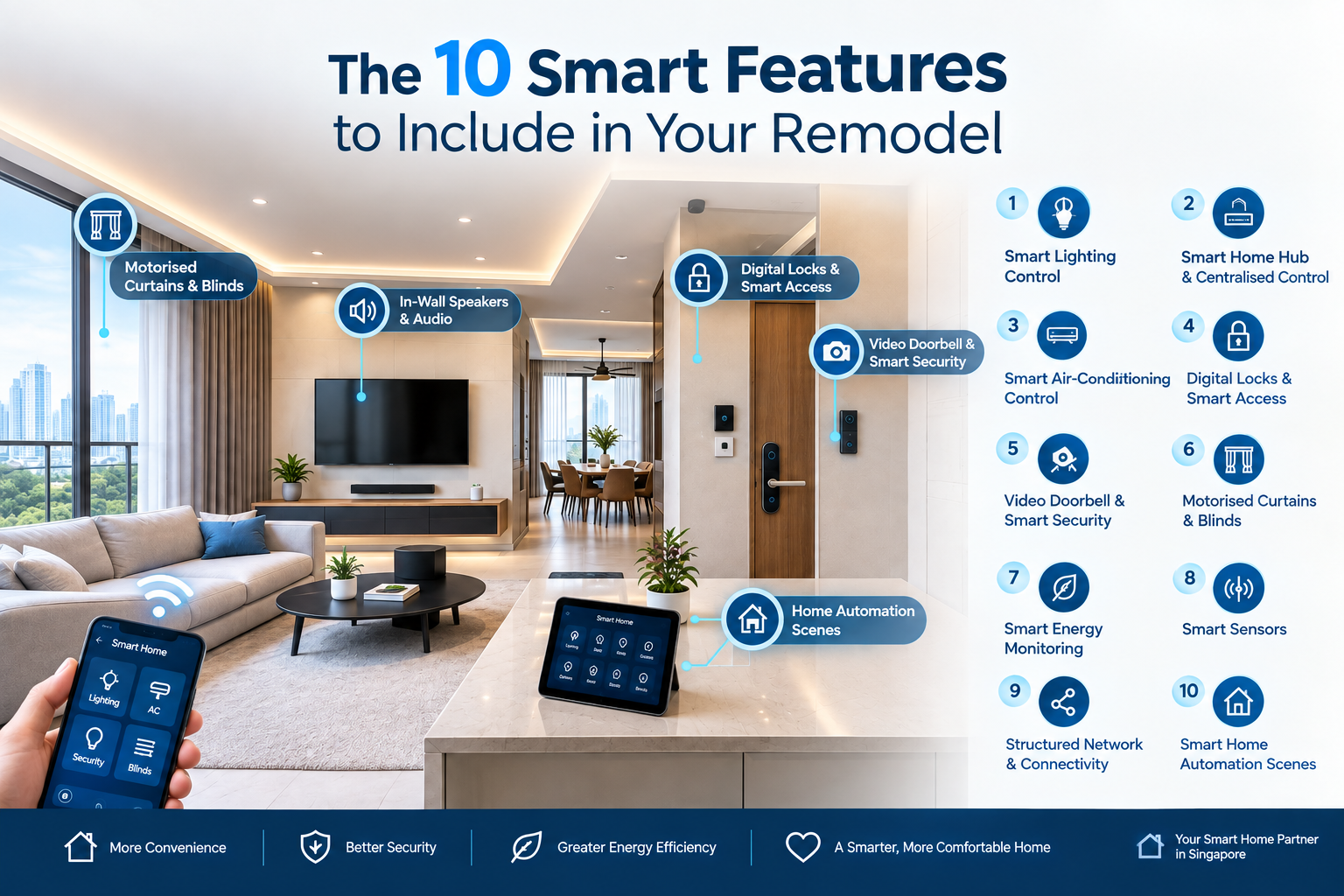
1. Smart Lighting Control
Smart lighting is one of the easiest ways to make a home more convenient.
Instead of controlling individual lights manually, homeowners can create lighting scenes for different situations.
For example, a Good Morning scene could turn on selected lights, while a Good Night scene could switch off unnecessary lights throughout the home.
Smart lighting can also be controlled through mobile applications or voice assistants, depending on the system used.
During renovation, discuss your lighting requirements with your electrician and smart home installer. Consider where smart switches, sensors and scene controllers should be positioned.
L3 Homeation offers smart lighting and remote-control lighting solutions as part of its smart home device range.
2. Smart Home Hub and Centralised Control
A smart home becomes much more useful when multiple devices can communicate through a central system.
A smart home hub or controller can act as the central point for automation. Depending on the system, it can connect devices such as lights, sensors, security equipment, air-conditioning controls and other smart products.
For example, instead of opening several different applications, homeowners may be able to control multiple functions through a single smart home platform.
When renovating, consider allocating an appropriate location for your hub, network equipment and other controllers.
3. Smart Air-Conditioning Control
Air-conditioning is an important part of everyday life in Singapore.
Smart air-conditioning control can make it easier to manage cooling according to your schedule and lifestyle.
For example, you could create routines that prepare the home before you arrive or reduce unnecessary operation when nobody is home.
Smart control can also be incorporated into broader home automation scenes.
When planning your renovation, discuss air-conditioning control with both your air-conditioning contractor and smart home installer. Proper coordination can make the final installation cleaner and easier to maintain.
4. Digital Locks and Smart Access
A digital lock can provide convenient keyless access while becoming part of a wider smart home system.
Depending on the selected product and integration, homeowners may be able to manage access through codes, cards, mobile devices or other authentication methods.
smart lock singapore can also work alongside other security features such as video doorbells and smart intercom systems.
L3 Homeation provides digital lock and smart security solutions as part of its range of smart home products.
Before selecting a smart lock, make sure the product is suitable for your door type and that installation complies with your property’s requirements.
5. Video Doorbell and Smart Security
Security is another important consideration when planning a smart home.
A video doorbell or video intercom can allow homeowners to see and communicate with visitors. Smart security systems can also provide remote monitoring and notifications through compatible devices.
Depending on the system, security cameras, doorbells, access control and other security devices can be integrated into a broader home automation setup.
Planning the location of security devices during renovation is important. Think about viewing angles, power requirements, network connectivity and accessibility for future maintenance.
L3 Homeation provides smart security solutions and has experience with products and systems for residential applications.
6. Motorised Curtains and Blinds
Motorised curtains and blinds can make a significant difference to daily convenience.
Instead of manually opening and closing curtains, homeowners can automate them according to time, lighting conditions or other routines.
For example, curtains could open in the morning and close in the evening as part of an automated schedule.
Renovation is an ideal time to plan motorised curtains because power requirements can be incorporated into the design.
Your interior designer, curtain supplier, electrician and smart home installer should coordinate the location of motors, power points and control systems before installation.
7. Smart Energy Monitoring
Energy monitoring can help homeowners understand how electricity is being consumed within the home.
Smart electricity monitoring solutions can provide information about energy usage and help identify patterns that may otherwise go unnoticed.
This can be especially useful for homeowners who want to improve energy efficiency and reduce unnecessary consumption.
L3 Homeation offers smart electricity meters and energy monitoring system singapore solutions as part of its smart home offering.
When planning your renovation, consider whether energy monitoring should be incorporated into your electrical system from the beginning.
8. Smart Sensors
Sensors are an important part of home automation because they allow the system to respond to what is happening inside the home.
Depending on your system, you can consider sensors for:
- Motion
- Door and window opening
- Temperature
- Light levels
- Water leaks
- Occupancy
For example, a motion sensor could trigger lighting in a selected area, while a door sensor could form part of a security or “Away” routine.
Sensors can also help make automation more natural because the home can respond automatically rather than relying entirely on manual commands.
Related Post: Upgrading Your Door Lock? Why Singapore Homeowners Choose Smart Locks
Smart Home Renovation Timeline: What Happens When
|
Renovation Stage |
Smart Home Tasks to Complete |
|---|---|
| Hacking & Demolition | Confirm conduit routes, plan hub/comms cabinet location |
| First Fix (Electrical & Plumbing) | Pull CAT6, speaker wire, neutral wires for smart switches, PoE camera runs |
| Carpentry Works | Embed blind power points in pelmets, plan in-ceiling speaker positions |
| Second Fix (Tiling, Painting) | Confirm water leak sensor access points, finalise DB box layout for energy monitor |
| Final Fit-Out | Install smart switches, hub, video doorbell, smart lock, cameras, motorised blinds |
| Handover | Commission hub, set up automations, test all integrations |
Pre-Wiring Checklist Before Your Walls Close Up
- Neutral wire pulled to every smart switch position
- CAT6 to all bedrooms, living room, kitchen, and camera positions
- Dedicated power circuit for comms/hub cabinet with UPS provision
- Speaker cable routed to living room ceiling and master bedroom
- Power point inside each blind pelmet
- PoE cable runs to entrance, corridor, and balcony camera points
- FCU control wires labelled and service points accessible
- Water leak sensor access points left open near pipe junctions
Choosing Systems That Stay Compatible
The single biggest mistake in home automation renovation is buying devices that only work within one closed ecosystem. Stick to open standards where possible — Matter, Zigbee, and Z-Wave all allow cross-brand compatibility. Avoid systems that require proprietary hubs with annual subscription fees unless the feature set justifies the ongoing cost.
Future-proofing isn’t about predicting every device you’ll own in five years. It’s about running the infrastructure — conduit, cable, and power — so adding new devices later costs almost nothing.
Working With Your ID and Contractor
Most interior designers in Singapore are receptive to smart home integration when briefed early. Share your feature list before design development begins so switch positions, pelmet depths, and cabinet layouts reflect your automation plan. Ask specifically whether their preferred electrical contractor has experience with smart switch wiring — neutral wire routing is a common gap in standard residential electrical work.
For homeowners who want a single point of coordination across design and smart technology, L3 Homeation specialises in exactly this — integrating home automation planning directly into the renovation process so nothing gets missed before your walls close.
FAQ
What is the best time to install smart home features during a renovation in Singapore?
The best time is during the first fix stage, when walls are open and electrical works are underway. This allows proper conduit routing, neutral wire installation, and cable pulls for cameras and networking — all of which are difficult and costly to add after walls are plastered and painted.
Do smart home systems in Singapore require a professional installer?
Electrical works — including smart switch wiring — must be carried out by a licensed electrician under Singapore’s regulations. Device configuration and hub setup can often be done by homeowners, but complex integrations involving lighting control systems or structured wiring benefit from professional commissioning to ensure reliability and safety compliance.
Which smart home protocol is most future-proof for Singapore homes?
Matter is currently the most future-proof protocol, supported by Apple, Google, Amazon, and Samsung. It enables cross-brand compatibility and local control without cloud dependency. Zigbee remains a strong option for its low power consumption and wide device availability across Singapore retailers and online platforms.
Can I add smart home features to an HDB flat in Singapore?
Yes. Smart switches, video doorbells, motorised blinds, smart locks, and home automation hubs are all suitable for HDB flats. Structural or electrical modifications must comply with HDB guidelines, and any licensed electrical work must follow BCA and SP Group requirements. Most smart home features can be installed without structural changes.