

An HDB fire rated door is purpose-built to withstand fire and smoke for a specified duration — typically 30 to 60 minutes — giving residents time to evacuate safely. Standard HDB doors offer no such protection. The key differences lie in core materials, certification requirements, smoke-sealing capabilities, and compliance with Singapore’s fire safety regulations. Choosing the right door depends on your unit type, renovation requirements, and safety priorities.
If you’re renovating or replacing your main door and wondering whether to upgrade to a HDB fire rated door, this comparison breaks down everything you need to know — from construction and compliance to cost and practical value.
What Makes a Fire Rated Door Different From a Standard Door?
The typical HDB main door is designed for privacy, security and esthetics. It usually consists of a hollow-core or solid timber build and adheres to the Building and Construction Authority’s (BCA) basic guidelines for HDB flats – but it is not tested or certified to resist fire.
A fire rated door, however, is subject to rigorous third-party testing to standards such as SS 332 (Singapore Standard for Fire Doors) or the equivalent BS 476 test. It shall be able to demonstrate that it will prevent the passage of flame, heat and smoke for the period of time for which it is rated without structural failure.
Core Construction Differences
| Feature | Standard HDB Door | HDB Fire Rated Door
|
| Core Material | Hollow or solid timber | Fire-resistant mineral board, vermiculite, or steel infill |
| Door Frame | Standard timber or metal frame | Steel or reinforced frame with intumescent strips |
| Smoke Sealing | None | Intumescent and smoke seals on all edges |
| Fire Resistance Rating | None | FD30 (30 min) or FD60 (60 min) |
| Certification | Not required | SS 332 or SCDF-accepted equivalent |
| Self-Closing Mechanism | Optional | Mandatory (door closer required) |
| Cost Range (approx.) | SGD 300 – SGD 800 | SGD 800 – SGD 2,000+ |
Why HDB Fire Rated Doors Are Required in Certain Units
Singapore Civil Defense Force (SCDF) requires fire rated doors for certain types of HDB units and locations. If your flat is right next to a communal corridor, staircase or fire escape route, a fire rated door is not an option, it is a legal requirement.
This requirement is because the main door is the first line of defense in containing a fire in your unit. Without the protection, smoke and flames can quickly spread into shared corridors, putting neighbours at risk and blocking escape routes.
SCDF’s fire safety guidelines for residential buildings also highlight that fire doors should be kept in good working order and not be wedged open or altered in any way that damages their integrity.
Who Needs a Fire Rated Door?
- HDB flat owners replacing a fire rated main door (like-for-like replacement is required)
- Units whose existing main door opens directly onto a common corridor or stairwell
- Homeowners undergoing HDB renovation who need to comply with updated BCA requirements
- Owners of older HDB units being retrofitted for fire safety compliance
The Role of Intumescent Seals — And Why They Matter
One feature that clearly separates fire rated doors from standard doors is the intumescent seal. This strip is embedded along the door’s edges and expands when exposed to heat — sealing gaps between the door and frame to block smoke and flames from passing through.
Smoke inhalation is responsible for the majority of fire-related fatalities, not direct flame contact. A door without a proper smoke seal can allow toxic fumes into a corridor within minutes, even if the door itself hasn’t ignited. This is why the seal is a non-negotiable component of any certified fire rated door.
Can You Customise an HDB Fire Rated Door?
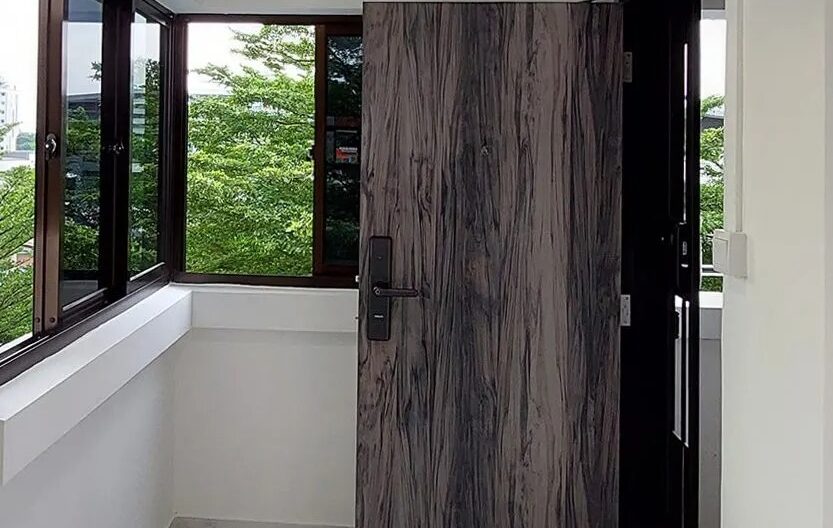
Yes — and this surprises many buyers. Fire rated doors have evolved significantly from the heavy, industrial-looking slabs of the past. Today’s options come in a range of timber veneers, laminate finishes, and panel designs that suit modern HDB interiors without sacrificing safety performance.
However, any customisation must not compromise the door’s certification. This means:
- Drilling, cutting, or adding locks must follow the manufacturer’s approved specifications
- The door closer mechanism must remain functional and unobstructed
- Any added glazing panels must use fire-resistant glass that maintains the FD30 or FD60 rating
- Surface finishes must not interfere with the intumescent strip performance
Working with a reputable HDB doors supplier ensures that any aesthetic customisation is done within certified tolerances — so your door looks good and remains compliant.
Standard HDB Door: When Is It Still Acceptable?
Not every HDB main door position requires a fire rated replacement. If your current door is a standard door and it was originally installed as one, replacing it with another standard door may be permissible — subject to HDB renovation guidelines and your contractor’s assessment.
Standard doors are typically used in:
- Internal bedroom or bathroom doors within the unit
- Units where the main door does not open onto a protected fire escape route
- Scenarios where fire rating is not a regulatory requirement for that specific unit layout
If you’re unsure, always check with your HDB renovation contractor or consult the SCDF’s residential fire safety guidelines before making a purchase decision.
Cost vs. Long-Term Value: Is the Upgrade Worth It?
Fire rated doors cost more upfront — typically two to three times the price of a standard HDB door. But the comparison doesn’t end at the price tag.
Consider what a fire rated door actually provides:
- Evacuation time: A 30-minute rating gives occupants a meaningful window to exit safely
- Smoke containment: Limits toxic fume spread to corridors and neighbouring units
- Legal compliance: Avoids renovation non-compliance issues with HDB or BCA
- Insurance relevance: Some insurers factor in fire safety features when assessing home coverage
For most HDB buyers, the incremental cost is a reasonable trade-off for the safety and regulatory peace of mind it provides — especially in high-density residential buildings where a fire in one unit can affect dozens of households.
Choosing the Right Fire Rated Door Supplier in Singapore
Certification should be your first filter when sourcing a fire rated door in Singapore. Look for doors with third-party fire test certifications that comply with SS 332 or a SCDF- recognized equivalent. Ask for the test report, not just the label.
Beyond compliance, evaluate the supplier on:
- Range of fire rated designs and finishes
- Experience supplying and installing doors in HDB projects specifically
- After-sales support, including door closer adjustment and seal maintenance
- Transparent pricing with no hidden installation costs
Imperial Door’s curated range of fire rated main doors is for HDB compliance and modern aesthetics. Combining certified safety performance with finishes that suit contemporary Singapore homes. Visit Imperial Door for the entire collection.
Frequently Asked Questions
Is a fire rated door mandatory for all HDB flats in Singapore?
Your flat must have one if your existing main door is fire rated, or your flat opens directly onto a protected corridor or stairwell, but not every unit has to have one. For these instances, HDB and SCDF regulations mandate like-for-like replacement, and failure to comply may lead to renovation rejection or rectification orders.
How do I know if my existing HDB door is fire-rated?
Look for a fire rating label or certificate plate on the edge or frame of the door – often stating ‘FD30’ or ‘FD60’. You can also refer to your original HDB renovation permit or contact your HDB branch office to verify what was originally installed in your unit.
Do fire rated doors look like normal wooden doors?
Yeah. Modern fire rated doors are available in timber veneer and laminate finishes that look very similar to standard wooden doors. If your esthetic changes are within the manufacturer’s certified specifications, you can have the good looks without losing the door’s fire resistance rating or certification.
FD30 vs FD60 fire rated doors
FD30 doors provide 30 minutes of fire and smoke protection, whereas FD60 doors can last for up to 60 minutes. Most residential main doors of HDB are required to be FD30 standard. The FD60 is most often used in commercial or higher risk residential environments where longer containment times are required.
What maintenance is needed for a fire rated door?
Fire rated doors need periodic checks on the door closer mechanism, intumescent seals and frame integrity. Seals must not be painted over or damaged; self-closing function must remain operational. To maintain the certified fire resistance performance of the door over time, annual inspections are recommended.
Can I install a fire rated door myself to save money?
No. Fire rated doors must be installed by qualified contractors in accordance with the manufacturer’s certified installation method. If the installation is not carried out properly, e.g., the frame or seal is not fitted properly it can completely void the fire rating leaving the door non-compliant even if it appears visually complete and functional.