

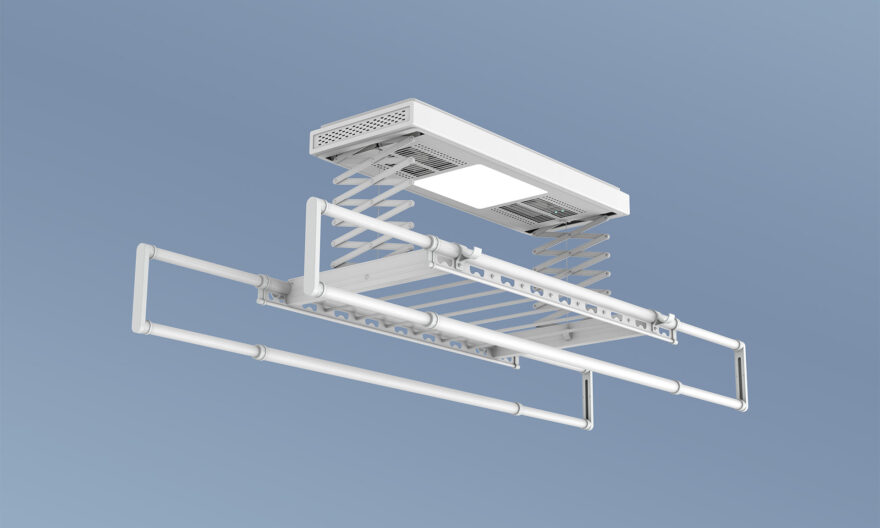
Automated laundry system that is lowered and raised with a switch or remote An automated clothes drying rack is a ceiling-mounted laundry system. It saves floor space, means no reaching overhead and dries clothes efficiently in small homes. For HDB residents living in small spaces, this is one of the most practical home upgrades around.
Why smarter laundry solutions for HDB flats
Most HDB flats in Singapore range from 45 to 110 square meters. In a three- or four-room flat the utility area or service yard is often less than 5 sq m. That little space has to have a washing machine, storage and a drying area all at once.
Permanent space-consuming, traditional bamboo poles or fixed floor racks. They are messy and they take up space making the laundry area feel small. Mounting it to the ceiling changes all that, by removing the drying zone completely off the floor.
What’s Different About a Ceiling Mounted Rack?
A clothes hanging rack ceiling system is attached directly to the overhead structure of your service yard or utility room. It does not take up floor space but the vertical space above head height, which is the one area in most HDB flats that is totally unused.
Then, when needed, you lower the rack to a comfortable working height. When it’s dry it will go back up to the ceiling, totally out of the way. The result: a service yard that looks clean, stays functional and does many things at once.
The main features of automatic drying racks are:
- Motorized lifting mechanism – Rack can be raised and lowered at the push of a button or remote control
- Adjustable hanging height – Set rack at the perfect height for loading and unloading
- Multiple bars or rails – Load full loads of laundry, including bedsheets and larger garments
- Weight capacity – Most quality systems can handle between 15 kg and 30 kg of laundry
- Built-In Lighting or Fan Options – Some models come with LED strips or a fan for drying purposes
Maximizing Limited Floor Space with Automated Drying Racks
This is the main benefit for HDB dwellers. The rack is flush with the ceiling when not in use. The floor beneath is completely empty. You can leave the items, put a laundry basket, or just walk right through without having to go around a drying rack.
That’s four to six square feet of usable floor space back in your service yard. That is a big saving in a HDB flat where every square feet matters.
Comparison: Automated Ceiling Rack versus Traditional Rack Feature
| Feature | Traditional Floor/Pole Rack | Automated Ceiling Rack
|
|---|---|---|
| Floor space used | 4–6 sq ft permanently | Zero when raised |
| Ease of use | Manual, requires bending or reaching | Motorised, one-button operation |
| Load capacity | Variable, often unstable when full | Fixed ceiling mount, stable under load |
| Aesthetics | Visible clutter, mismatched styles | Clean, integrated ceiling look |
| Suitable for elderly or mobility-limited users | Difficult to use at height | Fully accessible at any height |
Practical advantages of saving space
The main advantage is space, but not the only one. Automated drying racks also solve some of the daily frustrations of doing laundry in a compact Singapore home.
1. No more reaching up
Hanging clothes on a fixed ceiling pole involves awkward overhead reaching, especially for shorter household members or elderly residents.” An automatic rack drops down to waist or chest level, so it’s a lot easier and less physically demanding. This matters for homes with seniors or young kids helping with chores.
2. Better airflow and quicker drying
Ceiling-mounted racks hold clothes at an optimum height to catch natural airflow, particularly in service yards with ventilation openings. Some automated models have fans incorporated that blow air directly through the clothes, reducing drying time dramatically – handy during the wet and humid months in Singapore.
3. Cleaner clothes come off the dryer
Floor racks are at the same level as foot traffic, dust and pets. Laundry is stored high off the ground, away from ground-level contamination, in a ceiling-mounted system. This hygiene benefit is often under-appreciated until you live in them . HDB service yards are shared with other household activities .
4. Silent long term operation
Quality automated rack motors are built to run quietly, typically under 50 decibels, and are made to last for thousands of cycles. A properly installed system should last a household for years without significant maintenance.
Things to consider before installing one in your HDB
The first thing is ceiling height. The typical ceiling height of HDB service yards is 2.4m to 2.7m. Automated racks are made for this range but it is worth checking the specs before buying.
The material of the ceiling also matters. HDB ceilings are usually made of reinforced concrete and hence provide a solid fixing point for ceiling fixtures. Installation Installation normally requires drilling anchor bolts directly into the slab, so professional installation is highly recommended.
Motorized models need an electrical supply. Your installer will need a power point near the service yard or one will need to be installed at installation time. This is a typical electrical job, but plan ahead for it.
HDB Installation Guidelines to Remember
Singapore’s Housing & Development Board has rules about modification of common services and structural components. Drilling on the ceiling is generally permissible in service yards, as they are not structural walls. Still, it is always best to check the most recent HDB renovation guidelines or consult a licensed contractor before proceeding.
How to Choose the Right Automated Shelf for Your Home
Not all ceiling drying systems are the same. Consider these things when you are looking at options:
- Motor quality – Look for copper-wound motors with over-load protection
- Weight rating — Choose a system rated for at least 15-20 kg for full loads
- Bar Length & Count – More bars, longer rails, more hanging space
- Control type – Choose from remote, wall switch or smart app control to suit your preference
- Post sales support – Availability of local service and warranty coverage is key
If you are a HDB resident who wants to upgrade your laundry setup, but you don’t want to do a major renovation, Oikia has ceiling mounted automated drying rack solutions specifically designed for Singapore homes. Range designed to fit standard HDB dimensions. Includes professional installation support.
FAQ (Frequently Asked Questions)
Is an automated clothes drying rack able to be installed in any HDB flat?
Yes, most HDB service yards are compatible with ceiling-mounted automated racks. The systems are designed to accommodate standard HDB ceiling heights of 2.4 to 2.7 meters while standard concrete ceilings serve as a safe anchor point. Always check the ceiling height and the electrical access before you buy.
How much weight can a ceiling mounted drying rack hold?
Most good automated ceiling racks can carry 15 kg to 30 kg of laundry. This is sufficient for a full household wash load, including heavier items like jeans, towels and bed linens. Always check the rated capacity of the manufacturer before loading.
Does an automatic drying rack require professional installation?
Professional installation is recommended. The rack should be properly anchored into the ceiling slab and electrical connections should be up to safety standards. Improper DIY installation will void product warranty and compromise load bearing safety.
Does an automatic drying rack make clothes dry faster in Singapore’s humidity?
Ceiling racks allow for better air circulation around garments than floor racks. Units that come with drying fans work by continuously circulating air through the clothes, cutting down drying time – a handy feature during the wet season in Singapore or in enclosed service yards.
An automated ceiling rack can open up a lot of floor space.
Raised, an automated ceiling rack leaves no floor space. This usually gives back four to six square feet of usable service yard space, compared to a standard floor drying rack, which is a big gain in compact HDB flats where every square foot counts.
Do dry racks make noise when they work?
Quality motorized systems usually run at under 50 decibels, which is quieter than a normal conversation. The motor runs only when raising or lowering, which takes seconds, so the noise impact on daily household life is minimal.