

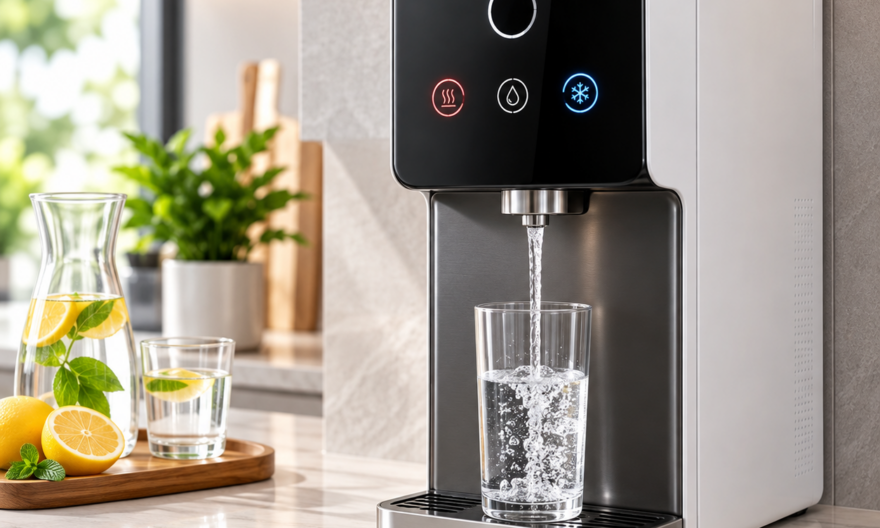
When choosing a hot and cold water dispenser for office use, the most important features to evaluate are filtration quality, temperature range, energy efficiency, ease of maintenance, and installation flexibility. A well-chosen unit reduces reliance on single-use plastic bottles, supports hydration across a team, and delivers consistent water quality day after day — without demanding constant attention from office staff.
Offices in Singapore are increasingly shifting away from bottled water coolers towards point-of-use dispensers that connect directly to the mains. The reasons are practical: lower ongoing costs, better hygiene control, and less logistical hassle. But not every dispenser is built the same way, and picking the wrong unit can mean poor water taste, high electricity bills, or maintenance headaches.
Here is what to look for before making a decision.
1. Filtration System: The Foundation of Water Quality
Filtration is arguably the most critical feature in any office water dispenser. Singapore’s tap water meets World Health Organisation standards and is safe to drink, but it can carry residual chlorine, sediment, and trace compounds picked up through ageing pipes in older buildings. A multi-stage filtration system removes these effectively before water reaches your cup.
Look for dispensers that use at least two stages of filtration:
- Sediment pre-filter — captures larger particles like rust and dust
- Activated carbon filter — removes chlorine, odours, and improves taste
- Ultrafiltration (UF) or reverse osmosis (RO) membrane — blocks bacteria, heavy metals, and fine contaminants
RO systems deliver the highest purity level but do waste a small amount of water during filtration. UF systems are a good middle-ground for offices where mains water quality is already reasonable. Ask vendors how often filter cartridges need replacing and whether that service is included in any maintenance contract.
What Certifications Should You Look For?
NSF International certification is a reliable indicator of filtration performance. Filters certified under NSF/ANSI Standards 42 and 53 have been independently tested to reduce specific contaminants. Some premium models also carry WQA (Water Quality Association) Gold Seal certification. These are worth checking before shortlisting any unit.
2. Temperature Options: More Than Just Hot and Cold
A basic hot & cold water dispenser gives you two settings. A well-designed office unit gives you more control — and that matters when you have a team with varying preferences.
Temperature options to look for:
- Ambient or room temperature — useful for those who prefer unchilled water or for preparing certain beverages
- Chilled (5°C–10°C) — ideal for drinking throughout the workday
- Hot (85°C–98°C) — sufficient for tea, instant coffee, and instant noodles
- Adjustable temperature settings — some models let you set precise temperatures, which is useful in offices that use the machine for a wider range of hot drinks
For offices with children’s areas or where safety is a concern, child-lock features on hot water taps are a practical addition. They reduce the risk of accidental scalding without making the machine difficult for adults to operate.
3. Energy Efficiency: A Feature That Pays for Itself
Dispensers run continuously in most offices. That means energy consumption directly affects your monthly utility bill — month after month, year after year. Energy Star-rated models and dispensers with smart sleep modes can significantly reduce standby power consumption.
What to look for:
- Eco or sleep mode — automatically reduces heating and cooling when the machine is idle (typically evenings and weekends)
- Insulated tanks — reduce how often the unit needs to reheat water to maintain temperature
- Instant heating technology — some newer models heat water on demand rather than maintaining a full hot tank, which can lower energy use considerably
In Singapore’s commercial context, the National Environment Agency (NEA) encourages businesses to adopt energy-efficient appliances. Selecting a dispenser with a strong energy performance profile aligns with Green Mark building requirements if your office is pursuing or maintaining that certification.
4. Ease of Use and Workflow Fit
The best dispenser is one your team actually uses. That sounds obvious, but it’s easy to overlook usability when evaluating technical specs.
Touchless and Button-Free Dispensing
Post-pandemic hygiene awareness in Singapore workplaces remains high. Touchless or sensor-activated dispensers reduce contact points, which matters in shared kitchen and pantry spaces. Some models use motion sensors or foot pedals — both practical in a busy office environment.
Countertop vs. Freestanding vs. Under-Counter
Your physical office layout will influence which form factor works best:
- Countertop models — compact, easy to install, work well in smaller pantries
- Freestanding units — larger capacity, ideal for offices with 20+ staff
- Under-counter dispensers — hidden from view, keep the pantry looking clean; require slightly more installation effort
Maintenance and Filter Change Indicators
Look for units that display filter life status and alert staff when a replacement is due. Without this, filters often go unchanged for too long — reducing water quality gradually without anyone noticing. Automated alerts take the guesswork out of maintenance scheduling.
5. Capacity and Output Rate: Matching the Machine to Your Team Size
A dispenser that takes 90 seconds to produce a hot cup of water creates a queue in a 50-person office. Assess both tank capacity and flow rate before purchasing.
| Office Size | Recommended Hot Tank Capacity | Recommended Cold Tank Capacity |
|---|---|---|
| Up to 15 staff | 2–3 litres | 3–5 litres |
| 15–40 staff | 3–5 litres | 5–8 litres |
| 40+ staff | 5+ litres or instant-heat model | 8+ litres or dual-unit setup |
For larger offices, instant-heating technology eliminates tank size as a bottleneck entirely, since water is heated at the point of draw rather than stored in a reservoir.
6. Installation Requirements and Ongoing Service
Most point-of-use dispensers in Singapore require a direct mains water connection and a standard power socket. Installation is typically handled by the vendor and takes under an hour. What matters more is the ongoing service arrangement.
Before committing, confirm:
- Filter replacement frequency and cost
- Whether the vendor offers a service contract or maintenance plan
- Response time for breakdowns or water quality issues
- Whether sanitisation is included and how often it is performed
Monthly or quarterly servicing is standard for office-grade dispensers in Singapore. Some vendors include this in a rental or lease arrangement, which removes the upfront capital cost and bundles maintenance into a predictable monthly fee — a useful option for businesses managing tight operating budgets.
Making the Right Choice for Your Office
The right dispenser is not simply the one with the most features — it is the one that fits your office size, water quality expectations, budget, and maintenance capacity. Prioritise filtration quality and energy efficiency as non-negotiables. Then layer in usability features, temperature flexibility, and service terms based on your specific operational context.
Happie offers a range of office water dispensers designed specifically for Singapore workplaces, with options covering filtration quality, smart energy modes, and flexible rental plans suited to businesses of different sizes. If you are comparing options or ready to specify a unit, their team can help you identify the right fit without the guesswork.
Frequently Asked Questions
What is the best type of filtration for an office water dispenser in Singapore?
For most Singapore offices, a multi-stage system combining a sediment filter, activated carbon filter, and an ultrafiltration or reverse osmosis membrane provides sufficient purification. RO systems offer the highest contaminant removal, while UF systems are effective and waste less water — making them a practical choice for offices with standard mains connections.
How often should office water dispenser filters be replaced?
Filter replacement frequency depends on usage volume and the specific filter type, but most office dispensers require cartridge changes every three to six months. High-usage offices may need more frequent replacements. Dispensers with filter life indicators simplify this process and help ensure water quality is never compromised without staff realising it.
Is it more cost-effective to rent or buy a hot and cold water dispenser for the office?
Renting is often more cost-effective for small to mid-sized offices because it spreads the cost, includes maintenance, and removes the burden of servicing. Purchasing outright suits larger organisations with in-house facilities management. Either way, factor in filter costs and servicing fees when comparing the true total cost of ownership.
What capacity dispenser does a 30-person office need?
A 30-person office typically needs a hot tank of at least 3–5 litres and a cold tank of 5–8 litres to handle peak demand during morning and lunchtime hours. Alternatively, a model with instant heating technology eliminates tank capacity constraints entirely and ensures consistent hot water output regardless of concurrent demand.