

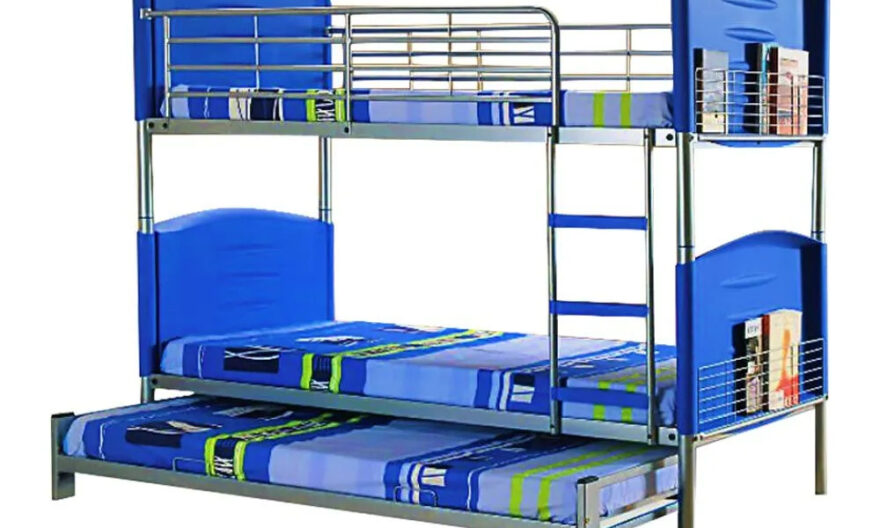
The double decker bed takes up a lot less floor space than if you had two single beds next to one another, so it is a better option if you have a shared room and limited square footage. Single beds are more comfortable for each person and more easily accessible but take up almost twice as much floor space. In most shared living situations, from children’s bedrooms to student hostels, the double decker bed is the more practical and space-efficient solution.
Why Space Is The Real Decision Maker
Where every inch counts – in Malaysia, urban apartments and hostel rooms are often 100 to 200 square feet per occupant. The size of a standard single bed is around 91cm x 190cm. Two single beds side by side take up about 182 cm in width alone – not counting the walking space in between.
A double decker bed, though, stacks two sleeping surfaces on top of each other within the footprint of a single bed. That means you free up nearly half the room for desks, wardrobes or just breathing space. That extra space is really nice to have, especially when sharing a room with two or more people.
Double Decker Bed vs Single Bed: A Straight Comparison
| Feature | Double Decker Bed | Single Bed
|
|---|---|---|
| Floor Space Used | Footprint of 1 bed for 2 sleepers | Separate footprint per person |
| Room Suitability | Ideal for small shared rooms | Better for larger private rooms |
| Privacy | Limited — shared unit | Higher individual privacy |
| Safety Features | Requires guardrails and sturdy ladder | Lower risk, easier access |
| Cost Efficiency | One purchase for two sleepers | Two separate purchases needed |
| Best For | Children’s rooms, hostels, student quarters | Guest rooms, private adult bedrooms |
Who Should Opt for a Double Decker Bed?
Parents Sharing a Bedroom with Children
If you have 2 kids sharing a room, then a bunk bed is almost always the smarter call. It makes room for a study desk, toy storage, or play space — all of which become more important as children get older. Check for models with good guardrails on the top bunk (at least 16 cm high above the mattress surface) and a wide, stable ladder.
In Malaysia, the Department of Standards Malaysia recommends furniture safety standards under MS ISO guidelines for children products. Always make sure a bunk bed you are buying meets the requirements for structural loads and guardrail height.
Hostel owners are dealing with occupancy costs
Shared room furniture is a direct revenue lever for hostel owners. You can double the capacity of a room that can fit four single beds using four bunk beds. This is why demand for bunk beds in Malaysia has grown with the increase in budget accommodation and student housing in cities like Kuala Lumpur, Penang and Johor Bahru.
In addition to providing more sleeping space, bunk beds also make housekeeping easier, since there’s less furniture to move around and clean.
Students living on campus or in rented rooms
Student accommodation in Malaysia usually has a smaller design. A double decker bed gives two housemates their own sleeping area, but still leaves space for desks, chairs and storage. Many students also appreciate the subtle boundary a bunk arrangement provides – the upper and lower berths naturally divide space between the two occupants.
When One Bed Makes More Sense
Single beds aren’t the wrong answer, they’re just the right answer for other situations. Consider a single bed if:
- The room has space for a bigger bed and is occupied by one person
- The user is elderly, or has limited mobility, and it would not be safe to get on a ladder
- The room is a guest bedroom, used at times, not a permanent shared space.
- Ceiling height too low to safely fit a top bunk (standard recommendation is 90cm minimum clear space above the upper mattress)
It really comes down to one question regarding the bunk bed vs single bed debate: Will this room be doing one person well, or two people practically? Answer that, and the choice is obvious.
Double Decker Beds Safety Tips
A bunk bed is only as good as it’s built. Here’s what to look for before you buy:
- Guardrail height: Should be a minimum of 16 cm above the upper mattress top on all sides
- Ladder stability: Removable ladders are not as safe as fixed ladders for daily use
- Weight Capacity: Each bunk must state the maximum load it can take, typically 80 kg to 150 kg per berth for good frames
- Material quality: Steel frames don’t warp and are easier to clean; solid wood is durable with a warmer aesthetic
- Age Appropriateness: Paediatric safety guidelines recommend that children under 6 years old should not use the top bunk
Does a Double Decker Bed Really Feel Cramped?
That is fair, and a common concern. The top bunk can feel a bit claustrophobic, especially in rooms with low ceilings. Many modern designs solve this with open-frame structures, angled ladders and even built-in shelving that creates its own sense of defined space for each berth.
Bunk beds in hostels… The adults need to have a thick mattress. A mattress that is too thick on the upper bunk reduces headroom. And most hostel-grade bunk beds are only made for a mattress of 15 cm thickness max on the upper bunk.
Practical tips for sharing a room with a bunk bed
- To make it stable and to reduce the chance of someone falling out the side, put the bunk bed against a wall.
- Clip a personal reading light to each berth so both users have their own light and don’t disturb the other.
- Utilise the space beneath the bottom bunk for luggage or seasonal items or add in under-bed storage drawers.
- select a neutral coloured frame to complement various bedding styles – each occupant can personalise their bunk without it clashing
The Verdict: Which is better for shared rooms?
In truly shared accommodation – be it a family home, student hostel or budget accommodation facility – the double decker bed is the hands down winner for space efficiency, cost per sleeper and room functionality. Single beds are way more comfortable in isolation, but they just can’t compete when two people have to share a limited footprint.
If you are furnishing a shared room in Malaysia, and are looking for quality options that are built for durability and daily use, Sin Hup Fatt offers a variety of double decker beds that are suitable for children’s rooms, student quarters and commercial hostel setups. Browse their full selection to find something that works for your space and budget.
FAQ
Are double decker beds safe for young children?
With the right guardrails and a strong ladder, double decker beds are usually safe for children age 6 and up. Safety guidelines for paediatrics recommend that the top bunk is not used by children under the age of 6. Make sure the frame meets structural safety standards before you buy.
In Malaysia the minimum size of a room for a double decker bed is 4 x 6 feet.
A standard double decker bed fits within a footprint of around 100 cm x 200 cm. A shared room of at least 100 square feet can easily fit a bunk bed and leave space to walk around. The ceiling should be at least 2.4 meters high to ensure a safe clearance above the upper bunk.
Is a double decker bed comfortable for an adult?
Yes, many bunk beds are designed for adult users, with weight capacities in the range of 100 kg to 150 kg per berth. Heavy-duty steel-frame bunk beds are the mainstay for hostels and student accommodation. Ensure the top bunk has adequate clearance and the ladder is wide and fixed for daily use by an adult.
Are bunk beds cheaper than buying two single beds?
In general, yes. A good bunk bed will usually be cheaper than buying two single bed frames and two mattresses. Hostel owners or parents furnishing shared rooms get more value per sleeper with bunk beds. Bunk beds also save on floor space and room clutter.
Bunk bed or two single beds for a hostel? Which is better?
If you want to maximize occupancy and revenue per room, then bunk beds are the way to go. Single beds are good for private or semi-private situations where guest comfort is the priority. Bunk beds are more common in budget hostels and student accommodation in Malaysia, as they save space and reduce the total price.
What is the best material to use for a double decker bed in a humid place like Malaysia?
Powder coated steel frames are perfect for Malaysia’s humid climate as they are rust-resistant and easy to clean. If properly treated, solid hardwood is also a good option. Don’t use low-grade particleboard for bunk beds. It’s likely to lose strength when exposed to humidity and repeated loading over time.