

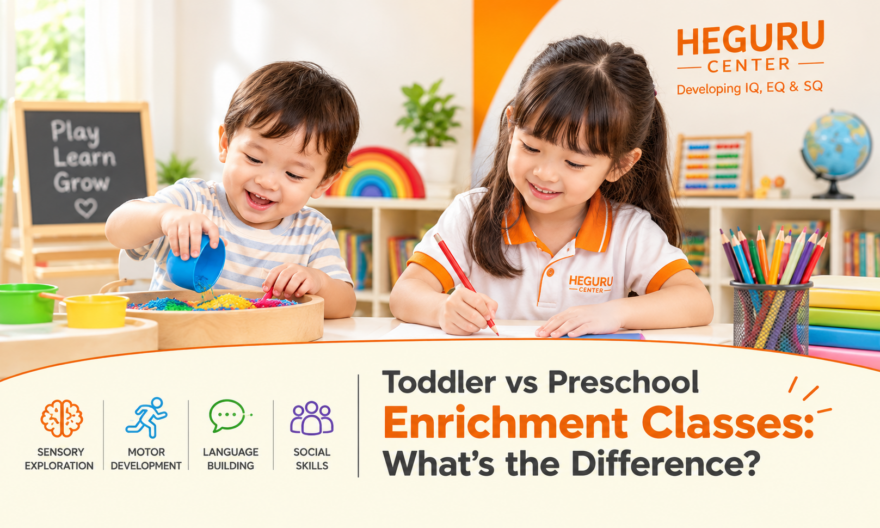
Toddler enrichment classes (ages 18 months to 3 years) focus on sensory play, motor development, and early socialisation. Preschool enrichment classes (ages 3 to 6) shift towards structured learning, early literacy, numeracy, and critical thinking. The key difference lies in developmental readiness — what a toddler needs to explore, a preschooler is ready to build upon.
Choosing the right programme for your child can feel overwhelming, especially when every class promises big outcomes. But age really does matter here. If you’re exploring preschool enrichment classes in Singapore, understanding how toddler and preschool learning differ will help you make a far more confident decision for your child.
Why Age-Appropriate Learning Matters in Early Childhood
The early years of a child’s life are marked by rapid brain development. According to the Ministry of Social and Family Development (MSF) Singapore, children’s brains develop most rapidly between birth and age six, making the type of stimulation they receive at each stage critically important.
A programme designed for a 2-year-old will look — and should look — very different from one built for a 5-year-old. Matching the learning environment to a child’s developmental stage isn’t just best practice. It’s the foundation of effective early education.
What Do Toddler Enrichment Classes Look Like?
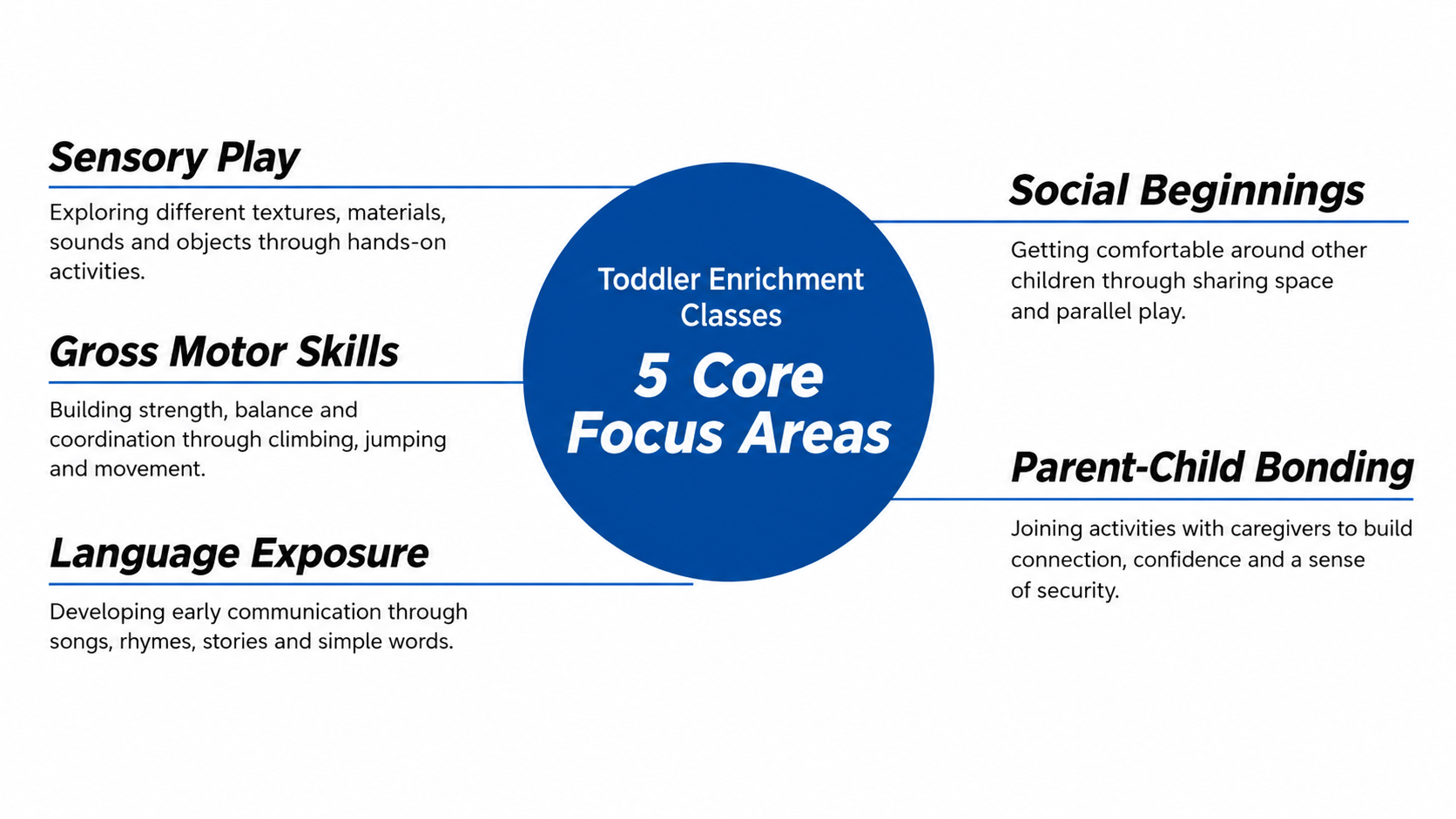
Toddler classes (roughly 18 months to 3 years) are built around exploration, not instruction. Children at this stage learn through their senses and bodies, not through sitting still and listening.
Core Focus Areas for Toddlers
- Sensory play: Touching, smelling, and manipulating different textures and materials
- Gross motor skills: Climbing, jumping, balancing, and movement-based activities
- Language exposure: Songs, rhymes, repetitive stories, and simple vocabulary building
- Social beginnings: Learning to share space with other children (parallel play, not cooperative play)
- Parent-child bonding: Many toddler classes are co-participation sessions, where caregivers join in
The classroom setup in a toddler programme tends to be open-ended. There are no worksheets, no right answers, and no formal assessments. The goal is to stimulate curiosity and build foundational confidence.
What Do Preschool Enrichment Classes Look Like?
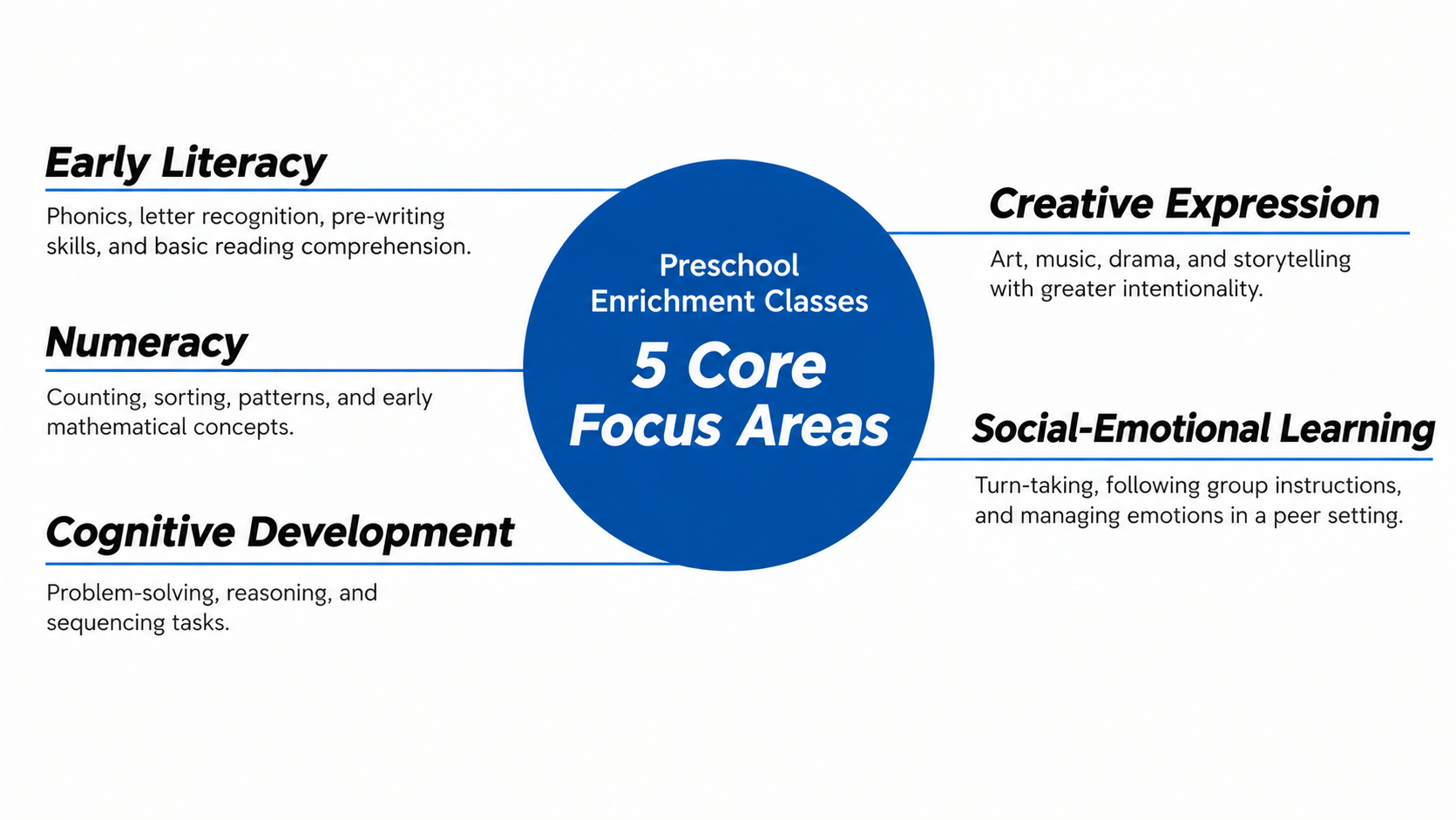
By age 3, most children have developed enough language, attention span, and self-regulation to benefit from more structured learning experiences. Preschool enrichment programmes build on the natural curiosity toddlers develop and channel it into purposeful skill-building.
Core Focus Areas for Preschoolers
- Early literacy: Phonics, letter recognition, pre-writing skills, and basic reading comprehension
- Numeracy: Counting, sorting, patterns, and early mathematical concepts
- Cognitive development: Problem-solving, reasoning, and sequencing tasks
- Creative expression: Art, music, drama, and storytelling with greater intentionality
- Social-emotional learning: Turn-taking, following group instructions, and managing emotions in a peer setting
The structure here is more defined. Children work in small groups, follow activity sequences, and gradually take on more independent tasks. The learning environment becomes a bridge between play and formal schooling.
Toddler vs Preschool Enrichment: A Side-by-Side Comparison
|
Feature |
Toddler Classes (18m–3 yrs) |
Preschool Classes (3–6 yrs) |
|---|---|---|
| Learning Style | Sensory-led, exploratory | Structured, skill-based |
| Classroom Setup | Open play zones, tactile stations | Activity tables, group areas |
| Parental Involvement | Often required or encouraged | Child attends independently |
| Key Skills Targeted | Motor skills, language exposure | Literacy, numeracy, reasoning |
| Session Length | 30–45 minutes | 45–90 minutes |
| Assessment | Observational, no formal testing | Progress tracking, light assessments |
How to Choose the Right Enrichment Programme for Your Child
The best programme is one that matches where your child currently is — not where you hope they’ll be in six months. Here are the key questions to ask before enrolling.
1. Is the class designed for your child’s actual age band?
Avoid programmes that group a wide age range together. A 2-year-old and a 4-year-old are developmentally worlds apart. Look for classes with clearly defined age brackets and differentiated activities within them.
2. Does the teaching approach match your child’s temperament?
Some children thrive in structured environments early on. Others need more time in open-ended play before they’re ready for guided learning. Watch a trial class if possible — your child’s engagement level will tell you a lot.
3. What are the class objectives — and are they realistic?
Be cautious of programmes that promise academic acceleration at toddler age. Strong preschool enrichment programmes in Singapore focus on building the foundational skills that make formal learning easier later — not rushing children through developmental stages.
4. How do educators track and communicate progress?
For preschool-aged children especially, consistent feedback between educators and parents matters. A quality programme will keep you informed about your child’s development, not just their attendance.
What Singapore Parents Should Know About Enrichment at Each Stage
Singapore’s early childhood education landscape is one of the most developed in Asia. The Early Childhood Development Agency (ECDA) sets frameworks that guide quality benchmarks for programmes serving children from birth to age 6.
Many enrichment providers in Singapore align with ECDA’s Nurturing Early Learners (NEL) framework, which emphasises holistic development across six learning areas: aesthetics and creative expression, discovery of the world, language and literacy, motor skills development, numeracy, and social-emotional development.
Understanding this framework helps parents evaluate whether a class is genuinely developmental — or simply keeping children busy.
A Note on Preschool Enrichment Programmes Beyond the Classroom
The best outcomes in preschool enrichment programmes come when learning is reinforced at home. Whatever your child practises in class — phonics patterns, counting games, social scripts — repeating these in daily routines deepens the impact significantly.
Enrichment is not a substitute for quality time and conversation at home. It’s a complement to it. Parents who stay informed about what their child is working on, and who build on those themes during everyday moments, see the strongest developmental gains.
At Heguru Center, programmes are designed with these developmental distinctions at their core — ensuring each child is engaged, challenged, and supported at exactly the right level for their age and stage.
Frequently Asked Questions
At what age should I start my child in enrichment classes in Singapore?
Most enrichment providers in Singapore offer classes from 18 months onwards. Starting around age 2 to 3 is common, as this is when children begin to respond well to structured group settings. The most important factor is your child’s readiness, not a fixed age.
What is the difference between toddler enrichment and preschool enrichment?
Toddler enrichment focuses on sensory exploration, motor skills, and early language exposure through play. Preschool enrichment introduces structured skill-building in literacy, numeracy, and reasoning. The shift reflects the child’s growing ability to focus, follow instructions, and engage with guided activities independently.
Are preschool enrichment classes in Singapore worth it?
Yes, when the programme is age-appropriate and well-structured. Quality preschool enrichment classes in Singapore build foundational skills that ease the transition into Primary 1. Look for programmes aligned with ECDA’s Nurturing Early Learners framework to ensure genuine developmental value.
How many enrichment classes should a preschooler attend per week?
One to two sessions per week is generally sufficient for most preschool-aged children. Overscheduling can lead to fatigue and reduce the quality of engagement. Prioritise depth over volume — one well-matched class done consistently will outperform three mismatched ones.
Should parents attend toddler enrichment classes with their child?
For children under 3, most toddler enrichment classes in Singapore are structured as parent-child sessions. Parental presence provides emotional security and reinforces learning at home. By age 3 to 4, most children are developmentally ready to attend classes independently as their confidence grows.