


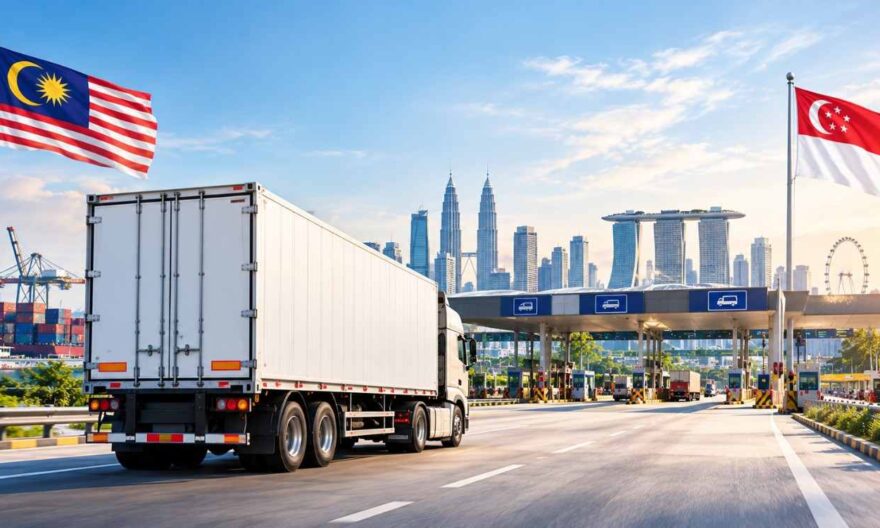
Trucking services from Malaysia to Singapore support just-in-time (JIT) delivery by providing scheduled, border-ready freight movement across the Johor-Singapore land corridor. With precise customs documentation, pre-cleared cargo, and coordinated departure windows, road freight can reliably meet tight production and retail schedules — often within the same business day.
For manufacturers and retailers operating on lean inventory models, late deliveries are not just inconvenient — they shut down production lines and empty shelves. The Malaysia-Singapore corridor is one of the busiest land freight routes in Southeast Asia, and understanding how to use it effectively is the difference between a supply chain that performs and one that constantly firefights. If your business relies on precision timing, trucking services from Malaysia to Singapore need to be built around more than just moving boxes — they need to be built around your schedule.
What Is Just-In-Time Delivery and Why Does It Matter for This Corridor?
Just-in-time delivery is a supply chain strategy where goods arrive exactly when needed — not days before, not hours after. Originating from Toyota’s manufacturing philosophy, JIT eliminates the cost of holding excess inventory by synchronising supplier deliveries with production or sales demand.
For businesses sourcing components or finished goods from Malaysia, the land route into Singapore is a practical backbone for JIT. The Johor Bahru–Singapore crossing handles an enormous volume of commercial trucks daily. When managed correctly, it allows predictable transit times that air freight can rarely match in cost and sea freight can never match in speed for short distances.
Key Factors That Make Cross-Border Trucking JIT-Ready
Not every trucking provider can support JIT. It demands specific operational capabilities that go well beyond basic haulage.
1. Pre-Clearance and Documentation Accuracy
Customs delays at the Causeway or Second Link are the most common reason JIT shipments fail. Accurate, pre-submitted documentation — including the Customs In-Payment (K1) permit via Singapore Customs’ TradeNet system and Malaysia’s e-Customs declarations — is non-negotiable. Errors in HS codes, declared values, or consignee details can hold a truck for hours.
Experienced cross border logistics companies maintain in-house customs teams or work directly with licensed customs agents who submit declarations ahead of truck departure. This dramatically reduces border dwell time.
2. Scheduled Dispatch Windows
JIT is built on predictability. Trucks should depart at confirmed windows aligned to your production or delivery schedule — not when a vehicle becomes available. This requires a provider with dedicated fleet allocation rather than shared, ad hoc capacity.
3. Real-Time Shipment Visibility
Manufacturing planners and warehouse managers need to know exactly where a shipment is at any given moment. GPS-tracked vehicles, live status updates, and proactive exception alerts allow teams to make real-time decisions if a delay occurs — rather than discovering the problem at the loading dock.
4. Dual-Route Flexibility: Causeway vs. Second Link
The Johor-Singapore Causeway and the Tuas Second Link each have different congestion patterns depending on time of day and day of the week. A JIT-capable carrier actively monitors both crossings and routes trucks accordingly. This alone can shave one to three hours off a delivery during peak periods.
How the Malaysia-Singapore Land Corridor Compares for JIT Logistics
| Factor | Road Freight (Truck) | Sea Freight | Air Freight
|
|---|---|---|---|
| Transit Time (JB to Singapore) | 2–6 hours | 12–24+ hours | 4–8 hours (door-to-door) |
| Cost for Small–Mid Loads | Low–Medium | Medium | High |
| Schedule Flexibility | High | Low (vessel schedules) | Medium |
| Customs Complexity | Moderate | Moderate–High | High |
| JIT Suitability | Strong | Weak | Cost-prohibitive |
For most manufacturing and retail businesses moving goods between peninsular Malaysia and Singapore, road freight is the only mode that can realistically support JIT at scale.
Regulatory Compliance: What Businesses Need to Know
Cross-border trucking between Malaysia and Singapore is governed by the Goods Vehicles Licence (GVL) requirements under Singapore’s Road Traffic Act, as well as Malaysia’s Commercial Vehicle Licensing Board (CVLB) regulations. Trucks must carry valid cross-border permits, and drivers require the appropriate endorsements for international haulage.
Singapore Customs mandates that all imports be declared via TradeNet before or at the point of entry. For JIT shipments, this means your logistics partner must be lodging permits ahead of truck movement — not at the checkpoint queue. Businesses can verify permit requirements directly through the Singapore Customs official portal.
Practical Steps to Align Your Supply Chain with JIT Trucking
If you are looking to implement or tighten a JIT model using the Malaysia-Singapore land route, these steps will give you a structured starting point:
- Map your critical delivery windows — Identify which shipments are time-sensitive and what the actual tolerance is (e.g., ±2 hours vs. ±1 day).
- Audit your documentation process — Confirm that your supplier in Malaysia and your logistics provider are aligned on document submission timelines relative to truck departure.
- Agree on escalation protocols — Define what happens when a delay is detected. Who is notified? What alternative options exist?
- Request dedicated fleet capacity — For consistent JIT runs, avoid shared or consolidated loads where your shipment competes for space or timing.
- Review performance metrics monthly — On-time delivery rate, border dwell time, and exception frequency should be tracked and reviewed with your provider regularly.
Industry-Specific Use Cases on the Malaysia-Singapore Corridor
Electronics and Semiconductor Manufacturing
Singapore remains a global hub for semiconductor assembly and testing. Many component suppliers are based in Penang, Kuala Lumpur, and Johor. Daily truck runs from these locations directly feed Singapore fabrication and testing facilities on JIT schedules, where a missed delivery can halt an entire production shift.
Food and Beverage Retail
Supermarket chains and food service distributors in Singapore frequently source fresh and ambient products from Malaysian suppliers. Shelf-life constraints mean these shipments cannot tolerate a 24-hour delay. Temperature-controlled and standard trucks operating on fixed daily windows keep retail shelves stocked without inflating safety stock.
Automotive Parts and Assembly
The automotive supply chain between Malaysia and Singapore depends on tight sequencing. Parts must arrive in the order they will be used on the assembly line. Even a two-hour delay forces a production stoppage. JIT trucking on this corridor requires not just speed but sequence accuracy.
What to Look for in a Cross-Border Trucking Partner
Choosing the right provider is as important as choosing the right strategy. When evaluating carriers for JIT runs, look for:
- In-house or closely integrated customs clearance capability
- A dedicated fleet — not purely subcontracted vehicles
- Proven experience on both the Causeway and Second Link routes
- Live tracking and exception notification systems
- Transparent pricing without hidden cross-border surcharges
- A track record with clients in your specific industry
FSL Express offers cross-border trucking solutions built specifically for the Malaysia-Singapore corridor, combining operational expertise with the customs knowledge that JIT supply chains demand. For businesses where delivery timing is not flexible, working with a logistics partner that treats your schedule as a commitment — not a target — makes a measurable difference. Visit FSL Express to learn more about their full range of logistics services.
Frequently Asked Questions
How long does a truck delivery from Malaysia to Singapore typically take?
Door-to-door transit time generally ranges from two to six hours, depending on origin point in Malaysia, time of crossing, and border queue lengths. Pre-cleared documentation and route optimisation between the Causeway and Second Link can significantly reduce variability in delivery timing.
What documents are required for cross-border trucking into Singapore?
Required documents include a Singapore Customs import permit (lodged via TradeNet), commercial invoice, packing list, and bill of lading or delivery order. The Malaysian side requires an export declaration. Your logistics provider should handle permit lodgement ahead of truck departure to avoid checkpoint delays.
Can just-in-time delivery work reliably on the Malaysia-Singapore land route?
Yes, when managed by a carrier with dedicated fleet capacity, pre-cleared documentation processes, and active route monitoring. The land corridor’s short distance and multiple crossing points make it one of the most JIT-compatible cross-border routes in Southeast Asia for manufacturing and retail supply chains.
What is the difference between the Causeway and the Second Link for freight?
The Johor-Singapore Causeway in Woodlands handles higher daily truck volumes and can experience significant congestion during peak hours. The Tuas Second Link in western Singapore generally has shorter queues during off-peak periods. Experienced carriers monitor both crossings in real time and route shipments accordingly.
How do cross border logistics companies handle customs delays?
Reputable providers submit customs declarations before truck departure, maintain close relationships with licensed customs agents, and have escalation procedures when permit queries arise. Proactive document preparation and compliance accuracy are the primary tools used to prevent delays at the Malaysia-Singapore border checkpoints.
Is road freight cost-effective for small and mid-sized shipments between Malaysia and Singapore?
Yes. For loads that do not fill an entire container, less-than-truckload (LTL) options allow businesses to share vehicle capacity while maintaining fixed delivery schedules. This makes road freight competitive in cost compared to air freight while preserving the timing reliability that JIT supply chains require.