


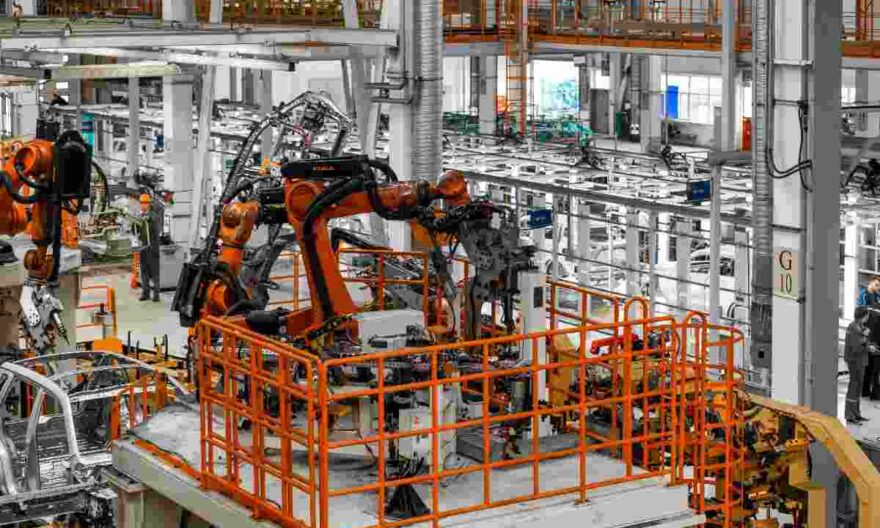
Malaysian manufacturers that invest in production automation will enjoy improved output consistency, labor efficiency, and long-term cost reduction. Automation eliminates repetitive human errors, reduces cycle time, and allows factories to scale without proportional increases in headcount. For both SMEs and large-scale operations, the ROI becomes apparent within two to four years of deployment.
The State of Manufacturing in Malaysia: Why Automation Is No Longer a Choice
The Department of Statistics Malaysia said that manufacturing in Malaysia contributes to about 23% of the country’s GDP. However, many factories—especially SMEs—still rely heavily on manual labor for key production activities. The risk is twofold: rising minimum wages, inconsistent quality of output, and a more competitive regional landscape.
The government’s National Investment Aspirations (NIA) framework is actively encouraging manufacturers to move toward high-value, technology-driven production. Among the incentives introduced under the PEMERKASA and PENJANA stimulus packages are grants and tax relief for manufacturers to embrace automation and smart manufacturing technologies.
The question today is not whether to automate, but how fast you can do it without disrupting the business as usual.
What Are the Main Operating Benefits of Manufacturing Automation?
Automation changes production from a cost center to a strategic asset. This is what manufacturers consistently say after implementation:
-
Higher throughput. Automated lines don’t tire and can run continuously, massively improving output per shift.
-
Reduced defect rates: The accuracy of robots minimizes human error, which reduces rework costs and material waste.
-
Labor reallocation: Workers are moved from repetitive tasks to higher-value tasks such as quality inspection, maintenance, and process oversight.
-
**Predictable production cycles—**Automated systems provide consistent timing, which increases reliability of delivery and customer satisfaction.
-
Lower operational costs over the long term: The capital expenditure is high, but the cost per unit decreases with overtime because of lower overtime, fewer mistakes, and better energy efficiency.
How does automation solve Malaysia’s labor problem?
In 2023, Malaysia increased its minimum wage to RM1,500 per month. This squeezes margins directly for labor-intensive manufacturers. And then there is the ongoing problem of reliance on foreign workers and workforce instability post-pandemic. The argument for automation is very strong.
Automation doesn’t eliminate people entirely—it takes them out of physically demanding or repetitive jobs where the injury rates are higher and turnover is constant. This enables manufacturers to create a more skilled, leaner workforce that is easier to retain.
Sectors such as electronics, food processing, and automotive components—all big in Malaysia—have turned to automation to help factories keep up production despite serious labor shortages.
Automation in Warehousing and Logistics—Beyond the Production Line
Why Warehousing Automation Is as Important as Floor Automation
Many manufacturers invest in automation for production lines but overlook inefficiencies downstream. A well-designed storage racking system combined with automated retrieval technology can provide savings in warehouse labor costs of up to 40% and a dramatic reduction in picking errors.
Manual inventory management leads manufacturers to inventory inaccuracies, delayed order fulfillment, and safety hazards from incorrect material handling. Automated storage and retrieval systems (AS/RS) provide the solution to all three.
Conveyor Systems: The Heart of Automation
An automation conveyor system is the circulatory system of a modern factory between production stages. They transport materials from workstation to workstation on a fixed timing basis, thus reducing bottlenecks and avoiding the need for manual transport inside the facility.
A 10% reduction in inter-station transfer time can translate into substantial daily output gains for high-volume operations. Conveyor automation also reduces the risk of work injuries caused by manual lifting and carrying—a major plus point given the Occupational Safety and Health (DOSH) compliance requirements in Malaysia.
Packaging Automation: The Last Mile Efficiency
For many manufacturers, packaging is an afterthought. But inconsistent packaging can lead to damaged goods, customer complaints, and expensive returns. The loop of a fully automated production chain is closed by partnering with an experienced packaging solution provider that integrates the automated systems—sealing, labeling, wrapping, and palletizing.
Automation in packaging also allows for quicker SKU changeovers, which is especially important for manufacturers that supply a variety of retail or export markets with different packaging needs.
ROI Timeline: What Malaysian Manufacturers Can Expect in Reality
| Area of Investment | Average Recovery Period | Primary Benefit |
|---|---|---|
| Assembly machine robot | 2 to 4 years | High output, consistent quality |
| Conveyor systems—automated | 1.5-3 yrs | Fewer injuries, shorter transfer time |
| Storage racking AS/RS | 2-3 years | inventory accuracy, space optimization |
| Automated packing lines | 1–2.5 years | Faster, consistent, and fewer returns. |
These figures are generic benchmarks. The real payback times are dependent on the production volume, the current wage costs, and the degree of integration in the plant. Malaysian manufacturers can further reduce these timelines by tapping into government incentives through MIDA (Malaysian Investment Development Authority) with capital allowances and automation grants.
SMEs or big manufacturers: is the size of the investment different?
There is a common misconception that automation is only for large-scale operations. SMEs can also benefit from modular automation solutions. The main difference is the starting point:
-
**Phased automation is key for SMEs—**automate one bottleneck process, prove ROI, then scale. Robotic arms, semi-automated conveyors, and basic racking systems—these are all cost-effective ways to begin.
-
Large manufacturers can pursue full-line automation, with integrated data systems, real-time monitoring, and predictive maintenance—building toward Industry 4.0 compliance.
Both approaches can produce meaningful results when executed with the right systems partner. The investment must be commensurate with the size of the operational problem being addressed.
How to Choose the Right Automation Partner in Malaysia
It’s not just the technology but the implementation as well. A systems integrator with significant domain knowledge will review your current layout, recommend phased deployment, and provide post-installation support. Look for partners who can provide end-to-end coverage—from robotic systems to material handling and packaging automation—so that your entire production chain benefits from a coherent design.
Buildtech provides robotic and automation solutions for manufacturers in Malaysia, including production line robotics, conveyor integration, and warehousing systems. They focus on practical deployment rather than technology for technology’s sake—which is the right priority for manufacturers operating under real budget and operational constraints.
FAQ
What is Production Automation? How Does it Work in Manufacturing?
Production automation uses machinery, robotics, and software to carry out manufacturing tasks with little or no human intervention. It replaces or helps manual labor in repetitive, precise, or dangerous processes—improving speed, consistency, and quality of output down the production line.
Is production automation economically viable for Malaysian SMEs?”
Yes. Modular, phased automation solutions allow SMEs to establish one process, prove ROI, and scale. Additional incentives from the government, such as MIDA and SME Corp Malaysia, help in reducing the initial capital barrier further, thus making automation a reality even for smaller operations.
Automation conveyor systems improve factory efficiency in a number of ways.
Automation conveyor systems transport materials between workstations at a constant rate, minimizing the time taken to transport materials manually and reducing bottlenecks. They also reduce the risk of workplace injuries and improve production timing. All of these directly contribute to improved daily output and better DOSH compliance.
What is the part of a storage racking system in automated manufacturing?
An automated retrieval system integrated into a storage racking system increases inventory accuracy, reduces the need for labor in the warehouse, and optimizes use of floor space. It ensures that materials are available exactly when needed on the production line, preventing costly downtime due to delays or misplaced stock.
How long does it take to see ROI on a manufacturing automation investment in Malaysia?
Most Malaysian manufacturers expect to see ROI within two to four years, depending on production volume and current labor costs. Automated packaging and conveyor systems typically have a faster payback – often within one to two-and-a-half years – from immediate savings in labor and cost of error.
What is the government support for Malaysian manufacturers investing in automation?
Manufacturers implementing automated equipment are eligible for investment tax allowances and automation capital allowances through MIDA. SME Corp Malaysia also offers grants for different digitalization and modernization programs. Manufacturers are encouraged to contact MIDA to find out the latest incentives available to their sector.