

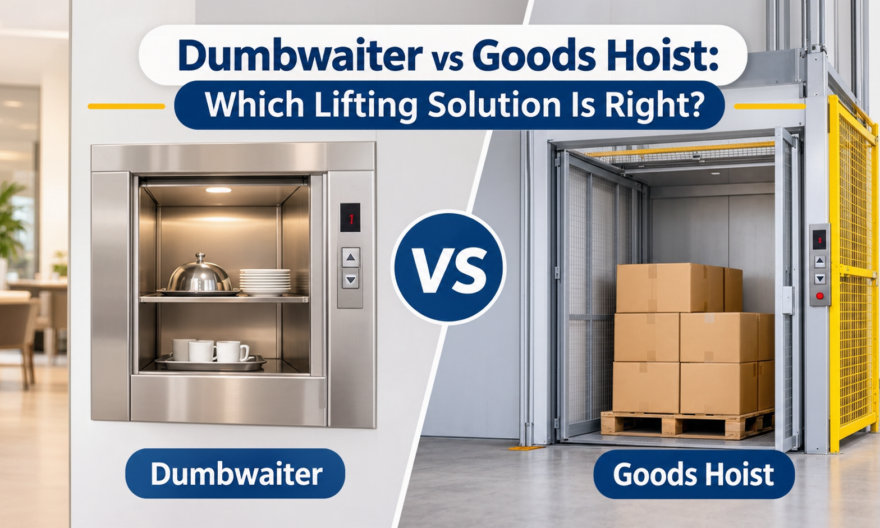
A dumbwaiter lift is a small, enclosed lift designed to move light loads — typically up to 300 kg — between floors in restaurants, hotels, and retail spaces. A goods hoist is a heavier-duty vertical transport system built for industrial and warehouse environments, handling loads from 500 kg to several tonnes. The right choice depends on your load weight, frequency of use, available space, and site classification.
If you’re evaluating a dumbwaiter vs goods hoist for your facility, the decision isn’t just about budget — it’s about operational fit. The wrong system creates bottlenecks, safety risks, and unnecessary maintenance costs. This guide breaks down the key differences so you can make an informed purchase.
What Is a Dumbwaiter?
A dumbwaiter is a compact service lift, originally designed to move food, laundry, or documents between floors without requiring a full passenger or freight elevator. Modern commercial dumbwaiters are electrically driven, with car sizes typically ranging from 0.3 m² to 1.2 m² and load capacities between 50 kg and 300 kg.
They’re common in:
- Restaurants and commercial kitchens
- Hotels and hospitality venues
- Retail stockrooms and boutiques
- Hospitals and care facilities
- Residential multi-storey properties
Dumbwaiters operate quietly, fit into tight floor plan layouts, and require relatively modest structural modifications. In Singapore, dumbwaiters installed in commercial premises must comply with the Building and Construction Authority (BCA) regulations and relevant Singapore Standards for lift installations.
What Is a Goods Hoist?
A goods hoist — also called a goods lift or commercial goods elevator — is a heavy-duty vertical transport system engineered specifically for industrial, warehouse, and manufacturing environments. Load capacities typically start at 500 kg and can reach 5,000 kg or more depending on the design.
Goods hoists are purpose-built for:
- Warehouses and logistics centres
- Manufacturing plants and factories
- Automotive workshops
- Construction material handling
- Multi-level industrial facilities
Unlike dumbwaiters, goods hoists are designed to handle palletised loads, heavy machinery components, and fork-entry platforms. They operate at slower speeds but are built for high-cycle, heavy-load use over extended periods.
Dumbwaiter vs Goods Hoist: Head-to-Head Comparison
Here’s how the two systems compare across the factors that matter most to operators and facility managers:
| Feature | Dumbwaiter | Goods Hoist |
|---|---|---|
| Typical Load Capacity | 50 kg – 300 kg | 500 kg – 5,000 kg+ |
| Car/Platform Size | Compact (0.3 m² – 1.2 m²) | Large (1.5 m² – 6 m²+) |
| Typical Speed | 0.15 m/s – 0.5 m/s | 0.1 m/s – 0.3 m/s |
| Primary Use Case | Food, documents, light goods | Pallets, machinery, bulk materials |
| Installation Footprint | Small — suits tight spaces | Large — requires structural planning |
| Typical Industries | F&B, hospitality, retail, healthcare | Warehousing, manufacturing, logistics |
| Regulatory Class (Singapore) | BCA-regulated service lift | BCA-regulated goods lift / hoist |
| Relative Installation Cost | Lower | Higher |
Load Capacity: The Most Critical Factor
Getting load capacity wrong is costly. Overloading a dumbwaiter damages the drive mechanism and poses safety risks. Under-specifying a goods hoist for light-duty applications wastes capital expenditure.
As a practical rule:
- If you’re moving trays, files, parcels, or small stock items — a dumbwaiter is sufficient.
- If you’re moving full pallets, machinery, or bulk inventory — you need a goods hoist.
- If your load sits in the 300 kg – 500 kg grey zone, assess peak loads, not average loads. Always spec to your maximum, not your typical use.
Space and Structural Requirements
Dumbwaiters Suit Existing Buildings
One of the main advantages of a dumbwaiter is its compact footprint. A standard commercial unit can be integrated into an existing building with minimal structural disruption — often installed within a masonry shaft or a purpose-built steel enclosure. This makes retrofitting into older shophouses or conservation buildings in Singapore more practical.
Goods Hoists Require More Planning
A goods hoist demands a larger shaft, reinforced floor structures capable of supporting platform weight plus rated load, and adequate headroom above the top landing. For new industrial builds, this can be planned into the structural design. For retrofits in existing warehouses or facilities, an engineering assessment is typically required before installation begins.
Operating Environments and Safety Considerations
In Singapore, all lifts and hoists installed in commercial and industrial premises fall under the jurisdiction of the BCA and must comply with the Lifts and Escalators Act. Regular inspections and maintenance are mandatory — not optional.
Key operating differences to consider:
- Dumbwaiters are unattended by design — no person should travel in them. They typically use automatic doors and simple call-and-send controls.
- Goods hoists may allow an operator to ride with the goods in certain configurations, but this is subject to specific regulatory classification and safety fitout.
- Both systems require annual inspections and periodic servicing to maintain compliance and operational safety.
Industry-Specific Guidance: Which System for Which Business?
F&B and Hospitality
A dumbwaiter is the standard choice for restaurants, hotels, and food courts. It moves meals, crockery, and supplies efficiently between kitchen and service floors. The compact design doesn’t interfere with dining or service areas.
Warehousing and Logistics
Warehouse operators and logistics providers almost always require a goods hoist in Singapore. With pallet weights frequently exceeding 800 kg – 1,200 kg, a dumbwaiter simply isn’t engineered for the job. A goods hoist with fork-entry capability ensures safe, efficient pallet movement between mezzanine levels and ground floors.
Retail and Shophouses
Retailers managing multi-storey shophouses or storerooms benefit from a dumbwaiter for moving stock, boxes, and display items. The installation is less invasive, and the operational cost is lower than a full goods hoist.
Manufacturing and Industrial Facilities
Heavy manufacturing environments with large components, equipment, or raw materials require a goods hoist. The ability to handle high cycle rates and heavy loads makes it the only viable option for most industrial applications.
Cost Considerations
Installation costs vary based on shaft construction, number of landings, load rating, and site conditions. As a general guide in the Singapore market:
- Dumbwaiters: Lower capital cost, simpler installation, lower ongoing maintenance expenditure.
- Goods hoists: Higher capital investment, requires structural work, but delivers long service life under heavy-use conditions.
Total cost of ownership — not just purchase price — should drive the decision. A dumbwaiter installed where a goods hoist is needed will fail prematurely and require costly replacement.
For businesses in Singapore evaluating lifting solutions, Asiateck supplies, installs, and maintains both dumbwaiters and goods hoists across commercial, hospitality, and industrial sectors. Their team can assess your site requirements and recommend the right system for your operational needs — taking the guesswork out of specification.