

Digital attendance tracking gives organisations a reliable, automated way to record employee working hours, manage shift schedules, and generate payroll-ready reports. Unlike manual registers or spreadsheets, modern systems reduce human error, flag discrepancies in real time, and integrate directly with HR and payroll platforms making workforce management measurably more accurate and efficient.
For HR professionals and payroll teams managing a growing workforce, a well-implemented time attendance system is no longer optional. It is a foundational tool that directly affects payroll accuracy, labour compliance, and overall operational visibility.
Why Manual Attendance Methods Fall Short
Paper-based registers and static spreadsheets were workable when teams were small and schedules were simple. They are not built for the complexity of modern workplaces multiple shifts, remote staff, flexible hours, and strict payroll cut-offs.
Common problems with manual tracking include:
- Time theft through buddy punching (a colleague clocking in on someone else’s behalf)
- Errors in overtime calculations leading to payroll disputes
- No audit trail when discrepancies arise
- Delayed reporting that slows payroll processing
In Singapore, where the Ministry of Manpower (MOM) requires employers to maintain proper employment records including hours worked and overtime, the stakes of inaccurate tracking are regulatory, not just administrative.
Core Attendance Tracking Methods Explained
Different workplaces have different needs. Understanding the available tracking methods helps HR teams and business owners select the most appropriate solution.
Biometric Attendance Systems
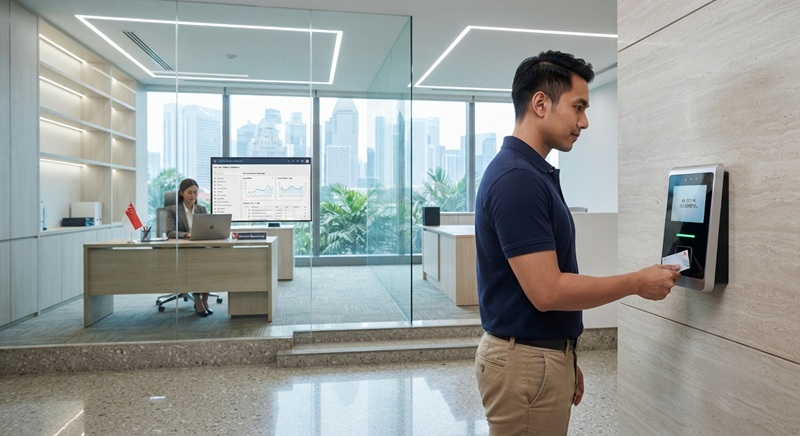
A biometric attendance system uses unique physical identifiers fingerprints, facial recognition, or iris scans to verify employee identity at clock-in and clock-out. This completely eliminates buddy punching and is widely used in manufacturing, healthcare, and logistics environments where headcount accuracy is critical.
Biometric systems also store data locally or on the cloud, allowing HR teams to retrieve records without manual cross-referencing. For businesses managing shift workers across multiple locations, this is a significant operational advantage.
Card-Based and PIN Systems
RFID card readers and PIN-entry terminals remain common in office environments. They are cost-effective and easy to deploy. The limitation is that physical cards can be shared or forgotten, introducing the same buddy punching risks that biometric systems solve. These are best suited to low-risk, controlled environments where strict identity verification is less critical.
Mobile and Cloud-Based Tracking
For remote teams, field staff, or businesses with hybrid work arrangements, mobile attendance apps with GPS geo-fencing allow employees to clock in from authorised locations only. Cloud-based platforms consolidate attendance data across sites in real time, which is particularly useful for businesses operating across multiple outlets or offices in Singapore.
How Attendance Data Improves Payroll Accuracy
The direct link between attendance data and payroll is where most errors and most savings occur. When time and attendance systems feed directly into payroll software, the calculation of regular hours, overtime, public holiday pay, and leave adjustments becomes automated and auditable.
Consider a retail business with 40 part-time staff on varying shift patterns. Without automated tracking, payroll officers must manually reconcile shift schedules against hours worked. With an integrated system, that reconciliation happens automatically and exceptions such as late arrivals or unauthorised overtime are flagged before payroll is processed.
Key payroll accuracy benefits include:
- Automatic overtime calculation based on pre-set thresholds
- Real-time leave balance updates linked to attendance records
- Exportable reports formatted for payroll software integration
- Reduction in payroll disputes and retrospective corrections
What Accurate Reporting Actually Looks Like
Reporting is where the value of employee attendance tracking becomes most visible to management. A capable system should deliver more than just raw clock-in data.
Look for systems that provide:
- Daily and weekly summaries — showing hours worked, late arrivals, and absences by department or individual
- Overtime reports — broken down by employee and period, ready for payroll input
- Absence trend analysis — identifying patterns such as frequent Monday absences or recurring late arrivals
- Audit logs — timestamped records of all edits, approvals, and exceptions for compliance purposes
These reports allow HR teams to move from reactive record-keeping to proactive workforce planning identifying staffing gaps before they become operational problems.
Integration: Connecting Attendance to the Broader HR Ecosystem
A time attendance machine that operates in isolation delivers limited value. The real efficiency gains come from integration connecting attendance data with payroll, HR management systems, and scheduling platforms.
When evaluating integration capability, consider:
- Does the system offer API connectivity or file export formats compatible with your payroll software?
- Can it sync with your existing HR platform for leave and scheduling management?
- Is the integration two-way so that schedule changes in HR flow back into the attendance system automatically?
Seamless integration reduces double-entry, lowers administrative overhead, and ensures that the data HR teams rely on is consistent across all platforms.
Key Considerations When Choosing a System
Selecting the right solution involves more than comparing hardware specifications. Here are the practical factors that matter most for Singapore-based businesses:
| Consideration | What to Evaluate |
|---|---|
| Workforce size and structure | Shift workers, remote staff, or fixed-hours office employees each have different tracking needs |
| Verification method | Biometric for high-accuracy needs; card or mobile for flexibility |
| Scalability | Can the system grow with your headcount without a full replacement? |
| Local compliance | Does it support MOM record-keeping requirements for hours worked and overtime? |
| Vendor support | Is local technical support available? What is the response time for hardware issues? |
| Data security | Biometric data requires robust storage and access controls under Singapore’s PDPA |
It is also worth asking whether the vendor provides onboarding support and training, as even the most capable system underperforms when staff are not properly trained to use it.
Getting the Most From Your Attendance System After Deployment
Implementation is only half the work. Businesses that extract the most value from their attendance systems do a few things consistently:
- Set clear clock-in and clock-out policies and communicate them to all staff
- Review exception reports weekly rather than waiting for payroll cycles
- Conduct regular audits of system data against physical rosters or schedules
- Update employee profiles promptly when shifts, roles, or employment status change
These habits turn attendance data from a passive record into an active management tool one that supports better scheduling decisions, faster payroll processing, and clearer accountability across the organisation.
For businesses in Singapore looking to upgrade or implement a reliable solution, Efficient Systems offers a range of time and attendance systems suited to different workforce sizes and operational environments. Explore their product range to find a system that aligns with your HR and payroll requirements.
Frequently Asked Questions
What is a time attendance system and how does it work?
A time attendance system records when employees start and end their working hours using hardware terminals or software applications. Data is stored digitally and can be exported for payroll processing, shift management, and compliance reporting.
What is the difference between a biometric attendance system and a card-based system?
A biometric attendance system uses physical identifiers like fingerprints or facial recognition to verify identity, eliminating buddy punching entirely. Card-based systems are more flexible and cost-effective but carry a higher risk of misuse since cards can be shared or forgotten.
Can a time attendance machine integrate with payroll software?
Yes, most modern time attendance machines support data export in formats compatible with common payroll platforms. Some offer direct API integration, allowing attendance data to flow automatically into payroll calculations without manual input.
What should HR teams look for in employee attendance tracking reports?
Effective reports should cover daily and weekly hours worked, overtime breakdowns, absence trends, and timestamped audit logs. These outputs help HR teams process payroll accurately and identify workforce patterns before they become larger operational issues.
Is biometric data collection compliant with Singapore’s PDPA?
Biometric data is classified as sensitive personal data under Singapore’s Personal Data Protection Act (PDPA). Employers must obtain proper consent, store data securely, and limit access to authorised personnel only. Choosing a vendor with clear data security practices is essential.
How do time and attendance systems support MOM compliance in Singapore?
Singapore’s Ministry of Manpower requires employers to keep detailed records of hours worked and overtime for covered employees. A digital attendance system creates an automatic, auditable record that satisfies these requirements and reduces the risk of non-compliance during inspections.