

Modern dance for kids goes far beyond learning steps and routines. Through improvisation, expressive movement, music interpretation, and group choreography, children develop the ability to communicate emotions they often struggle to put into words. These experiences build genuine self-confidence — the kind that carries into the classroom, friendships, and everyday life.
Why Emotional Expression Matters in Childhood Development
Children between the ages of 4 and 12 are still developing the vocabulary and emotional awareness to process complex feelings. Frustration, excitement, shyness, and joy don’t always translate neatly into words — but they can absolutely translate into movement.
Dance gives children a structured yet open-ended outlet. When a child learns to move in response to music or a feeling, they begin connecting their inner world with physical expression. That connection is powerful. It teaches self-awareness before it teaches self-presentation.
According to research supported by arts education bodies, children who participate in movement-based learning demonstrate stronger emotional regulation and improved social communication compared to those who don’t engage with the performing arts. In Singapore, where academic pressure can be intense from an early age, this kind of emotional outlet becomes especially valuable.
What Makes Modern Dance Different From Other Dance Styles
Not all dance forms prioritise expression equally. Ballet, for example, focuses heavily on precise technique and discipline. While valuable, it can feel restrictive for younger children who are still figuring out their bodies and feelings.
Modern dance, by contrast, was built on the idea that movement should come from within. It encourages individuality, interpretation, and creative risk-taking. There’s no single “correct” way to express a phrase of music — and that freedom is exactly what helps children open up.
Key differences that make modern dance uniquely beneficial for children:
- Improvisation over imitation: Children explore movement on their own terms before mirroring an instructor
- Emotion-led choreography: Routines are built around themes and feelings, not just technical sequences
- Inclusive physicality: No specific body type or prior training is required to participate and thrive
- Creative agency: Children often contribute ideas to group pieces, giving them ownership and pride
How Modern Dance for Kids Builds Confidence — Step by Step
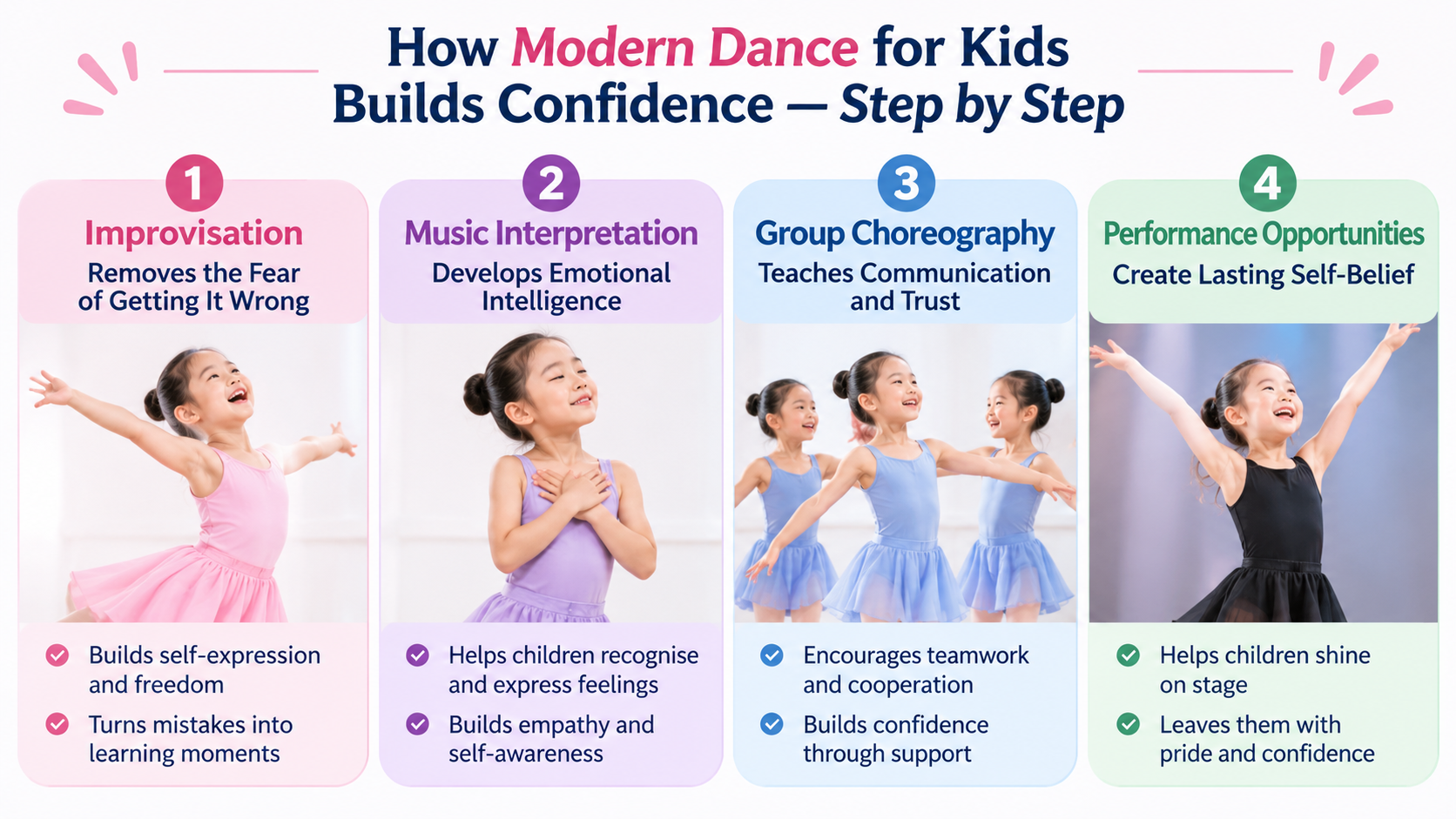
Confidence isn’t something a child is simply born with. It’s built through repeated experiences of trying something, struggling, and succeeding. Modern dance creates exactly that cycle — just in a way that feels like play rather than pressure.
1. Improvisation Removes the Fear of Getting It Wrong
In a well-structured modern dance class, children are regularly given open movement prompts: “Move like you’re very heavy,” or “Show me what angry looks like in your arms.” There’s no wrong answer. This removes the performance anxiety that often inhibits children in academic settings.
Over weeks and months, this repeated experience of “trying without failing” builds a genuine sense of creative safety. Children become more willing to take risks — not just on the dance floor, but in social situations and schoolwork too.
2. Music Interpretation Develops Emotional Intelligence
Asking children to interpret music — slow versus fast, heavy versus light, sad versus joyful — requires them to first identify an emotion and then find a physical way to express it. This two-step process is a core building block of emotional intelligence.
Children who regularly practise this kind of interpretation become more attuned to emotional nuance. They start to notice how they feel, name it, and respond to it — skills that directly support mental wellbeing in and outside of school.
3. Group Choreography Teaches Communication and Trust
Many modern dance programmes involve collaborative creation — children working together to build a short piece of choreography. This isn’t just fun. It teaches listening, negotiation, compromise, and the confidence to contribute an idea in front of peers.
When a child sees their movement idea incorporated into a group performance, the confidence boost is real and lasting. It’s the experience of being heard and valued — something not every classroom environment can consistently deliver.
4. Performance Opportunities Create Lasting Self-Belief
Even informal in-class sharing moments — where children perform for each other — have a measurable impact on confidence. The experience of standing in front of others, being seen, and receiving genuine applause shifts something internally.
Children who regularly perform in dance recitals or end-of-term showcases consistently report higher confidence in public speaking, group presentations, and social interactions. The stage becomes a training ground for life.
Signs Your Child May Be Ready for a Beginner Dance Class
You don’t need to wait for a child to show obvious “talent” to enrol them in a kids beginner dance class. In fact, children who seem shy, emotionally sensitive, or reluctant to join group activities are often the ones who benefit most.
Look out for these signs that dance might be a great fit:
- They move spontaneously when music plays at home
- They find it hard to articulate feelings with words
- They enjoy imaginative or role-play activities
- They’re looking for a social activity that isn’t sports-focused
- They’ve shown interest but feel nervous about trying something new
Starting young doesn’t mean starting serious. A good beginner programme meets children exactly where they are — with warmth, patience, and plenty of creative play.
Related Guide: What Age Should Children Start Ballet Classes? A Parent’s Guide
What to Look for in a Quality Modern Dance Programme for Children
Choosing the right class matters. The environment a child learns in shapes how quickly they open up and grow. When evaluating programmes, consider:
- Qualified instructors: Teachers who are trained in both dance and child development create safer, more effective learning spaces
- Small class sizes: Children get more individual attention and feel less intimidated
- Age-appropriate curriculum: Content and expectations should match developmental stages, not just age groups
- Positive reinforcement culture: Look for studios that celebrate effort over perfection
- Performance opportunities: Even small showcases give children something to work towards and feel proud of
The Long-Term Impact of Dance on a Child’s Confidence
The benefits of modern dance don’t stop at the studio door. Research consistently links arts participation in childhood with stronger self-esteem, better emotional regulation, and improved resilience into adolescence. A child who learns at age six that their feelings are valid — and that they have a beautiful, physical way to express them — carries that lesson forward for years.
Dance doesn’t just teach children how to move. It teaches them how to inhabit themselves with confidence. That’s a skill no examination can measure, but every parent can see.
If you’re in Singapore and looking for a nurturing environment where your child can grow through movement, Elevate Dance Academie offers thoughtfully designed programmes that blend creativity, technique, and emotional development — giving children the tools to thrive both on and off the stage. Explore their dance classes for beginners and children to find the right fit for your child.
Frequently Asked Questions
At what age can children start modern dance classes?
Most studios offer modern dance programmes for children from age 3 or 4 onwards. Younger children benefit from movement-play-based classes, while older beginners aged 6 to 10 can typically join structured beginner programmes that build technique alongside creative expression.
Does my child need prior dance experience to join a beginner class?
No prior experience is needed for a kids beginner dance class. These programmes are specifically designed for children who are new to movement. Qualified instructors introduce concepts gradually, ensuring every child feels comfortable, included, and able to progress at their own pace.
How does modern dance help shy or introverted children?
Modern dance is particularly effective for shy children because it offers expression without requiring words. Through improvisation and guided movement, introverted children discover ways to communicate and connect with peers in a low-pressure, non-verbal environment — often surprising parents with the confidence they develop over time.
How long does it take to see confidence improvements in children through dance?
Many parents notice changes within the first 8 to 12 weeks of consistent attendance. Children often become more willing to try new things, speak up in class, and express their feelings at home. The progression is gradual but steady, especially in supportive, well-structured programmes.
What should my child wear to a modern dance class?
Comfortable, stretchy clothing that allows free movement is ideal — leggings, fitted tops, or dancewear all work well. Most modern dance classes are practised barefoot or in soft dance shoes, so heavy footwear is not required. Check with the specific studio for their dress guidelines.