

Most players improve fastest with two to three Private tennis lessons in Singapore per week, combined with independent practice sessions. Beginners benefit most from higher frequency to build muscle memory early. Intermediate and advanced players can space lessons further apart, focusing on tactical refinement. Your goals, age, and current skill level all determine the ideal schedule.
Why Lesson Frequency Matters More Than You Think
Showing up once a month and expecting rapid progress is one of the most common mistakes new tennis players make. Skill development in tennis — especially stroke mechanics, footwork, and court awareness — depends heavily on repetition within a short time window.
Research in motor learning consistently shows that skills practiced frequently over a short period are retained far better than skills spaced too far apart. In tennis, this means that what you learn in one lesson starts to fade if you wait two weeks before the next one.
How Often Should You Take Lessons Based on Your Skill Level?
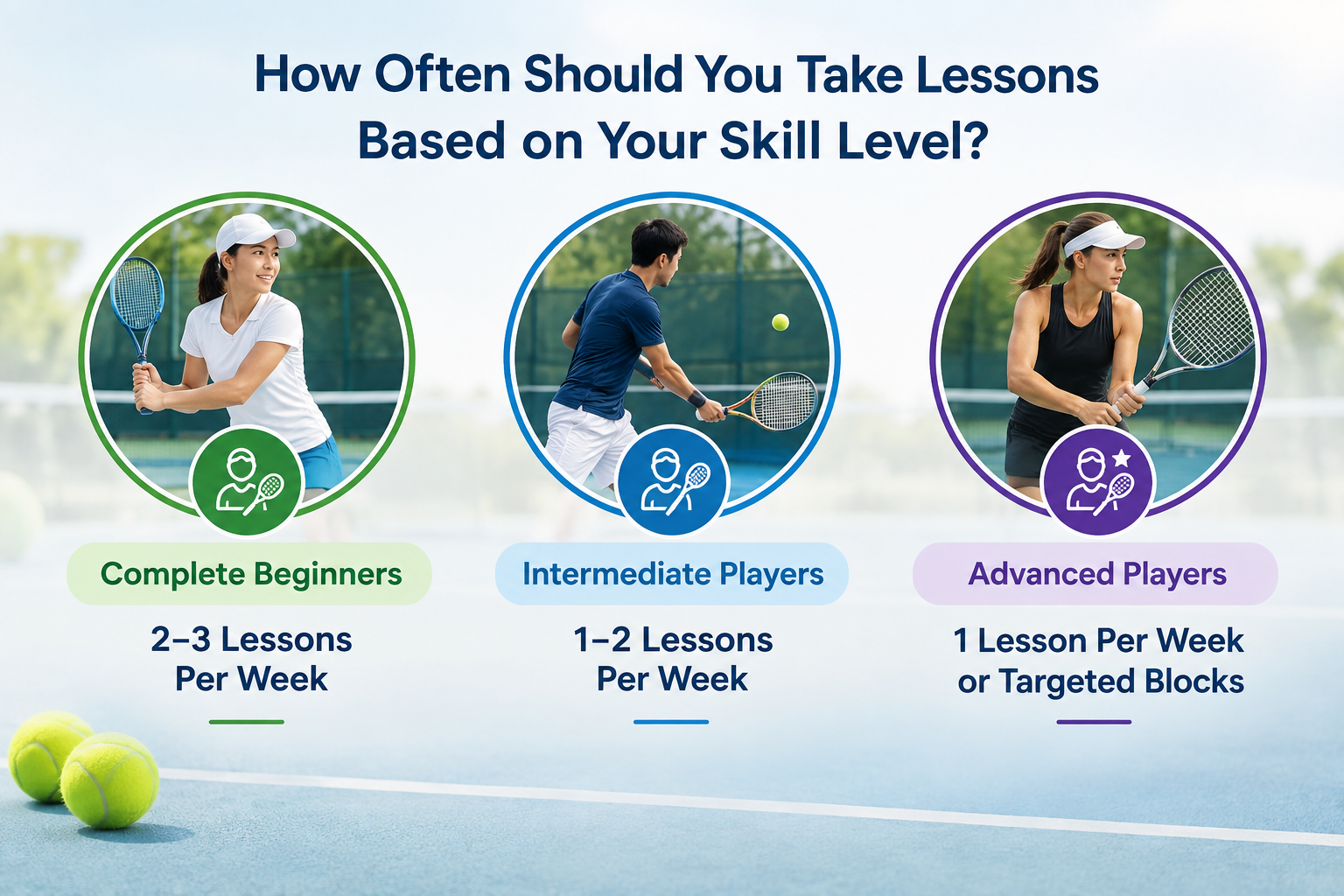
Complete Beginners: 2–3 Lessons Per Week
If you are just starting out, frequency is everything. Your brain and body need repeated exposure to build the motor patterns behind a forehand, backhand, and serve. Missing days between lessons at this stage means you spend half of each session re-learning what you covered before.
A solid starting schedule for beginners:
- Two to three structured lessons per week with a coach
- At least one self-practice session hitting against a wall or ball machine
- Short sessions of 45–60 minutes to avoid fatigue-related bad habits
Intermediate Players: 1–2 Lessons Per Week
Once you have consistent ground strokes and understand rally play, the focus shifts from learning basics to drilling technique and building patterns. One strong lesson per week, supplemented by two practice sessions, is usually enough to see steady improvement over a few months.
If you are preparing for a club league or a local amateur tournament in Singapore, bumping up to two lessons per week for six to eight weeks before the event makes a measurable difference in match performance.
Advanced Players: 1 Lesson Per Week or Targeted Blocks
Advanced players typically have sound technique. Their gap is usually tactical — shot selection, positioning under pressure, and serve strategy. At this level, one deep session per week with a high-quality coach often delivers better results than two shallow ones.
Many advanced players in Singapore also use block scheduling — intensive lessons for three to four consecutive days before a competition, then a rest phase. This approach is well-suited to busy professionals who cannot commit to a fixed weekly schedule.
How Age Affects the Right Lesson Frequency
Children and Juniors (Under 16)
Younger players develop faster when they train more often, but shorter sessions work better than long ones. Two to three lessons per week of 45 minutes each is more productive for a child than one two-hour session. Their attention spans, physical recovery, and motor learning all favour shorter, more frequent contact with the sport.
Singapore’s junior tennis pathway, supported by Tennis Singapore, encourages consistent structured coaching from an early age to build a strong technical foundation before competitive play begins.
Adults (17–50)
Adult learners bring more cognitive ability to the court but less physical adaptability. You can understand what the coach is asking faster, but your body takes longer to ingrain new movement patterns. One to two lessons per week works well for most adult recreational players, provided you are also practising in between.
Seniors (50+)
For older players, recovery time matters more. One lesson per week is often ideal, with an emphasis on technique over power. The goal shifts toward sustainable play, injury prevention, and enjoyment rather than aggressive skill acquisition. A good coach will adapt drills to suit mobility and energy levels at this stage.
Also Read: How to Choose the Right Tennis Instructor for Your Goals
Private Tennis Lessons in Singapore: What a Realistic Schedule Looks Like
Here is a practical breakdown based on common player profiles in Singapore:
|
Player Profile |
Frequency | Additional Practice |
Expected Progress Timeline |
|---|---|---|---|
| Total beginner (adult) | 2–3 lessons/week | 1 solo session/week | Playable rallies in 6–8 weeks |
| Recreational intermediate | 1–2 lessons/week | 2 practice sessions/week | Noticeable game improvement in 2–3 months |
| Junior competitive | 3–4 lessons/week | Match play + fitness | Tournament-ready in 6–12 months |
| Busy working adult | 1 lesson/week | Weekend rallying | Steady improvement over 4–6 months |
| Senior recreational | 1 lesson/week | Light hitting sessions | Technique refinement over 3–4 months |
Practice Between Lessons Is Non-Negotiable
Even the best coach cannot replace practice between sessions. A tennis lesson Singapore provides instruction and correction, while regular practice helps consolidate skills and build muscle memory.
A useful rule of thumb: for every lesson hour, aim for at least two hours of independent practice during the week. This does not have to be a full match. Wall hitting, serving drills, or even shadow footwork at home counts toward reinforcing what you have learned.
Signs You Need to Increase Your Lesson Frequency
- You keep making the same errors your coach corrected two sessions ago
- You feel like you are re-learning basics every lesson rather than building on them
- Your match performance is not reflecting your practice quality
- You have a specific event or goal within the next two to three months
- You recently changed your grip, stance, or serve and need faster re-patterning
What to Look for in a Coach Before Committing to a Schedule
Frequency means little if the coaching quality is inconsistent. Before locking in a weekly schedule, confirm that your coach can:
- Assess your current level and set a personalised improvement plan
- Adjust drill difficulty as you progress, not just repeat the same exercises
- Offer structured feedback after each session, not just generic encouragement
- Work with your availability and tailor lesson length to your fitness level
In Singapore, finding a coach with experience across multiple skill levels — and ideally a recognised coaching qualification — makes a significant difference in how quickly you develop.
Getting the Most From Every Tennis Lesson in Singapore
Whether you are squeezing in one lesson per week between work commitments or training three times a week as a junior, the key is consistency over intensity. Showing up regularly, practising in between, and working with a coach who knows your game will always outperform sporadic bursts of training.
If you are ready to build a structured lesson plan tailored to your goals and schedule, Top Tennis Hub offers experienced coaches who work with players at every level — from complete beginners to competitive adults — across convenient locations in Singapore.
Frequently Asked Questions
How many private tennis lessons does a beginner need before playing a real match?
Most beginners can handle casual social play after eight to twelve lessons, provided they also practice between sessions. Formal match play typically becomes comfortable after four to six weeks of consistent two-to-three-lessons-per-week training, when basic strokes and scoring rules feel natural.
Is one tennis lesson per week enough to improve?
One lesson per week can produce steady improvement if you practice two to three times independently between sessions. Without additional practice, one weekly lesson is often not enough to build lasting muscle memory, especially for beginners who are still ingraining fundamental stroke mechanics.
How long should each private tennis lesson be?
For most players, sixty-minute lessons strike the right balance between productive drilling and physical endurance. Beginners and juniors often benefit from forty-five-minute sessions to maintain focus and avoid fatigue. Advanced players working on match tactics may benefit from ninety-minute sessions occasionally.
What is the best age to start private tennis lessons in Singapore?
Children as young as five or six can begin structured tennis lessons with age-appropriate equipment and drills. Starting between ages six and ten gives juniors the best window for developing coordination, footwork, and stroke habits before competitive habits become harder to correct.