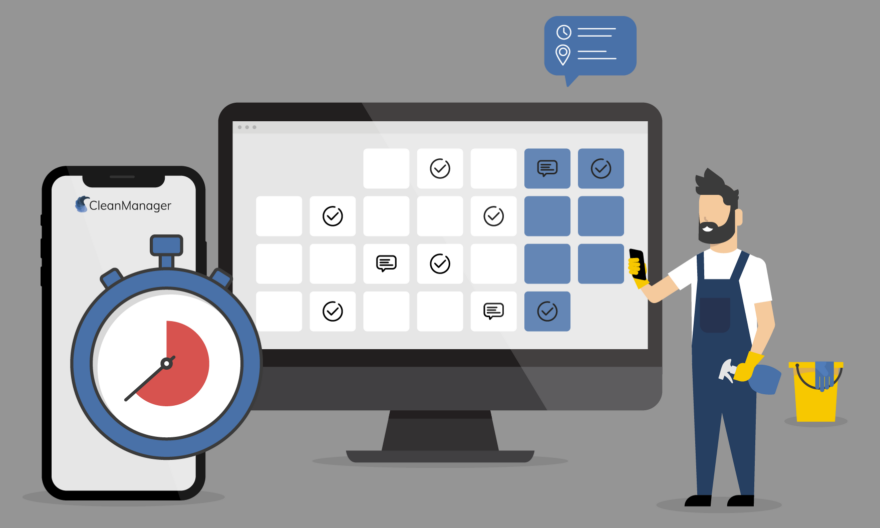
Cleaning management software simplifies workforce management by automating shift scheduling, tracking employee hours in real time, streamlining task assignments, and centralizing communication. It reduces manual admin work, minimizes scheduling conflicts, and gives operations managers clear visibility into team performance — all from a single platform.
Why Workforce Management Is a Major Pain Point for Cleaning Businesses
Running a cleaning operation isn’t just about mops and products. It’s a people-first business — and managing people at scale is where most cleaning companies hit a wall. You’re dealing with shift coverage across multiple sites, last-minute callouts, varying client requirements, and a largely mobile workforce that rarely sits behind a desk.
Manual spreadsheets and group chats don’t scale. They create miscommunication, missed shifts, and compliance gaps that cost real money. That’s precisely where a dedicated cleaning services management system changes the game.
1. Automated Scheduling That Eliminates the Guesswork
One of the most immediate benefits of cleaning management software is intelligent scheduling automation. Instead of manually building rosters each week, managers can set recurring shift templates, define staff availability, and let the system match the right worker to the right job.
This matters more than it might seem. According to the Society for Human Resource Management (SHRM), employee scheduling errors and last-minute changes are among the top drivers of workforce dissatisfaction and turnover. In an industry already challenged by high staff churn, reducing these friction points directly impacts retention.
Key scheduling features typically include:
- Drag-and-drop shift builders with availability filters
- Automatic conflict detection (double-bookings, overtime alerts)
- Recurring schedule templates for ongoing client contracts
- Mobile notifications so staff always know where they’re working
For a cleaning company managing 30+ cleaners across multiple commercial sites, this alone can cut scheduling admin by several hours per week.
2. Real-Time Labor Tracking Across Multiple Sites
Knowing who is on-site, when they arrived, and when they left is critical — both for client accountability and payroll accuracy. Traditional paper timesheets are easy to manipulate and slow to process. A cleaning services management system replaces them with GPS-verified clock-in/clock-out, live attendance dashboards, and automated timesheets.
What Real-Time Tracking Looks Like in Practice
Imagine a multi-site cleaning contractor servicing office buildings, schools, and retail spaces simultaneously. With live labor tracking, the operations manager can see in one view which locations are staffed, flag any sites running short, and reassign available workers before a client ever notices a gap. That level of operational visibility simply isn’t possible with manual tools.
It also strengthens payroll integrity. Hours are captured automatically, reducing disputes and errors. Some platforms integrate directly with payroll systems, which means pay runs that once took hours now take minutes.
3. Task Assignment and Quality Control in One Place
Beyond scheduling, workforce management includes making sure the right tasks get done — correctly and on time. Cleaning management software typically includes task checklist tools that supervisors can build, assign, and monitor per site or shift.
Staff complete checklists on their mobile devices and can attach photos as proof of completion. Supervisors get instant visibility into task status without needing to be on-site. When an issue is flagged — a missed area, a maintenance problem, a client complaint — it’s logged and traceable.
This creates a quality assurance loop that’s entirely documented. For clients who require service-level reporting, this kind of digital trail is increasingly expected, not just appreciated.
4. Centralized Communication That Keeps Teams Aligned
A dispersed cleaning workforce is particularly vulnerable to miscommunication. Someone misses an update in a group chat. A site instruction never reaches the cleaner. A last-minute change gets lost in an email thread.
Cleaning management platforms solve this with in-app messaging, automated alerts, and shift-specific instructions tied directly to each job. The right person gets the right information at the right time — without a manager manually following up with ten different people.
Benefits for HR Supervisors Specifically
For HR supervisors, centralized communication also supports compliance. All conversations and instructions are logged. If a workplace incident occurs, there’s a clear record of what was communicated, when, and to whom. This is especially relevant given that in Australia, Work Health and Safety (WHS) regulations require employers to actively demonstrate safe communication of site-specific risks and procedures.
5. Leave Management and Compliance Tracking Made Simple
Leave requests, sick day coverage, and compliance documentation are often handled through a messy mix of emails, phone calls, and paper forms. Cleaning management software consolidates this into a structured workflow.
Staff submit leave requests through the app. Managers approve or decline with full visibility into coverage impact. The system automatically flags shifts that need backfilling, and available replacement staff are surfaced based on qualification, availability, and location.
From a compliance perspective, tracking certifications (first aid, equipment licenses, induction completions) within the same platform means supervisors are never caught off-guard by an expired credential. This is particularly valuable for companies servicing healthcare, hospitality, or government facilities where compliance requirements are non-negotiable.
6. Reporting and Insights That Drive Better Decisions
Data is only useful if you can act on it. The reporting capabilities in modern cleaning management software turn raw operational data into actionable insights for business owners and managers.
Typical reporting dashboards surface:
- Overtime trends and labour cost summaries
- Attendance rates by team, site, or supervisor
- Task completion rates and quality scores
- Client billing summaries linked to actual hours worked
These reports help owners identify inefficiencies, justify staffing decisions, and demonstrate service value to clients during contract renewals. They also make audits and compliance reviews significantly less stressful.
Comparing Manual Processes vs. Software-Driven Workforce Management
| Workforce Task | Manual Process | With Cleaning Management Software
|
|---|---|---|
| Shift Scheduling | Spreadsheets, phone calls | Automated templates, conflict detection |
| Time Tracking | Paper timesheets | GPS clock-in, real-time dashboards |
| Task Assignment | Verbal/written instructions | Mobile checklists with photo proof |
| Leave Management | Email/phone requests | In-app requests with coverage alerts |
| Compliance Tracking | Folders and manual reminders | Automated certification expiry alerts |
| Payroll Processing | Manual data entry | Automated timesheets, payroll integration |
Is Cleaning Management Software Worth It for Smaller Operations?
This is a fair question. A two-person operation cleaning residential properties probably doesn’t need enterprise software. But for any cleaning business managing five or more staff across multiple client sites, the operational overhead of manual management quickly outweighs the cost of a purpose-built platform.
The ROI shows up in reduced overtime costs, fewer missed shifts, faster payroll processing, and stronger client retention through consistent service delivery. For growing operations, the software also scales — adding new staff, sites, and services without adding admin headcount.
Putting It All Together
Workforce management in the cleaning industry isn’t complex because the work is complicated — it’s complex because of the sheer coordination required at scale. Scheduling, tracking, communicating, and reporting across a mobile workforce demands tools built for exactly that purpose.
If you’re evaluating solutions for your cleaning business, Genic Teams offers a platform purpose-built for field service and cleaning operations — combining scheduling, real-time tracking, task management, and workforce reporting in one connected system. It’s the kind of operational backbone that turns a reactive management style into a proactive one.
Common Questions
What is the purpose of cleaning management software?
For cleaning companies, scheduling, employee attendance, task allocations, customer communications, and compliance paperwork are all managed by cleaning management software. It gives managers real-time visibility into operations across all facilities and employees from a single dashboard by replacing manual spreadsheets and disjointed tools with a centralised digital platform.
How may scheduling be aided by a cleaning services management system?
By matching staff availability, abilities, and location to available shifts, a cleaning services management system automates shift scheduling. It automatically notifies employees of conflicts such as multiple reservations or overtime infractions before they happen. This greatly eliminates last-minute scheduling problems and the amount of time managers spend creating rosters.
Is it possible for cleaning management software to precisely measure personnel hours?
Indeed. GPS-verified clock-in and clock-out capabilities that record hours in real time are found on the majority of cleaning management platforms. Inaccurate paper timesheets are eliminated, payroll disputes are decreased, and an auditable attendance record is produced. Additionally, a lot of systems automatically transfer authorised hours for quicker, more precise pay processing by integrating directly with payroll software.
Does cleaning management software assist with needs for compliance?
By keeping track of expiration dates, preserving employee certifications, and delivering notifications before credentials expire, cleaning management software promotes compliance. Additionally, it records workplace conversations, task performance, and incident reports, producing a recorded record that supports requirements under Australian workplace health and safety legislation, especially for high-compliance settings like government and healthcare facilities.
In what ways can cleaning software enhance client site quality control?
Digital task checklists that are allocated to each shift and location are used to maintain quality control. Employees use their mobile devices to finish tasks, and they can provide pictures as evidence. Supervisors can immediately identify problems and keep an eye on completion rates from a distance. This enhances accountability and facilitates client reporting during contract reviews by producing an open, recorded service record.
Are small cleaning companies a good fit for cleaning management software?
Basic tools could be adequate for companies with fewer than five employees. However, specialised software is typically advantageous for cleaning firms that oversee several locations or shift personnel. The majority of contemporary platforms scale as the company expands without requiring substantial additional setup, and the decrease in scheduling errors, overtime expenses, and manual administration usually yields a quantifiable return on investment.