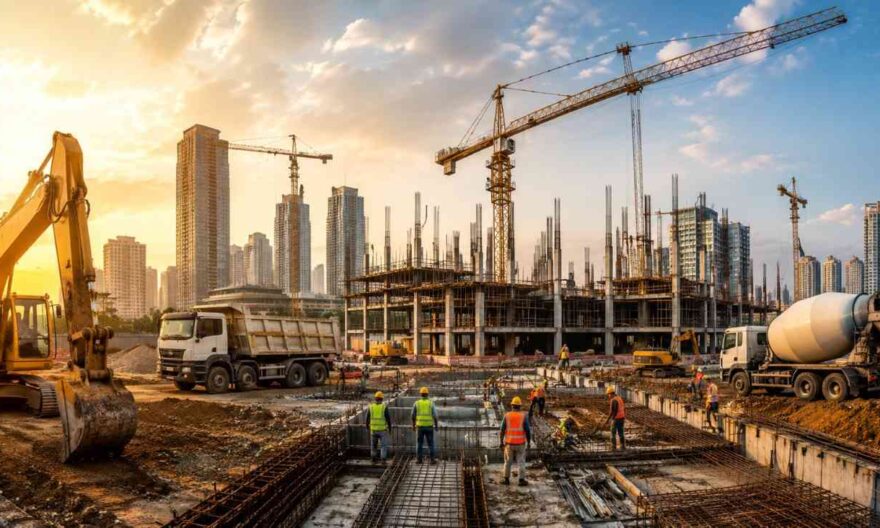
Civil engineering services form the backbone of every successful construction project — from site preparation and earthworks to drainage, structural foundations, and road infrastructure. These services ensure projects are built safely, efficiently, and in compliance with local regulations. For developers and industrial clients, selecting the right scope of civil work in Singapore is critical to project success.
Why Civil Engineering Services Matter for Every Build
Civil engineering in Singapore is highly regulated. Before, during and after construction, all civil and structural works are required to meet stringent standards under the Building and Construction Authority (BCA). As outlined in BCA’s Construction Industry Transformation Map, the built environment sector in Singapore plays a major role in the nation’s infrastructure, with annual investments of billions of dollars in public and private construction.
Whether you’re building an industrial facility, a mixed-use commercial building or a residential estate, getting the foundational civil work right prevents costly delays and structural failures down the line. These are not optional services – they are vital pillars of any credible construction project.
Core Civil Engineering Services Every Project Requires
1. Site Clearing and Earthworks
Every project starts with land. Site clearing involves clearing the ground of any vegetation, debris and existing structures. Earthworks are next. Cut and fill operations that shape the terrain to match engineering drawings and drainage requirements.
Earthworks in Singapore have to comply with NEA and BCA requirements, especially on slope stability and soil erosion control. Bad earthworks at the start can jeopardise the structural integrity for the entire project lifecycle.
2. Excavation and Shoring Works
Excavation creates the space for foundations for buildings, basements, and underground utilities. In high-density urban environments such as Singapore, deep excavation requires robust shoring systems, such as sheet piles, soldier piles or bored piles, to prevent soil movement and protect adjacent structures.
In areas with MRT lines or existing buildings nearby, shoring is especially important. This is one of the most risk sensitive services in civil construction having major structural incidents in this region due to wrong shoring design.
3. Foundation and Piling Works
Foundations transfer the entire load of a structure to the ground. The two primary types used in Singapore are:
- Shallow foundations — suitable for low-rise structures on stable soil
- Deep foundations (piling) — required for high-rise buildings, heavy industrial plants, and areas with weak subsoil
Driven piles, bored piles, and micro-piles are common solutions. The selection depends on load requirements, soil conditions, and noise constraints — a particularly relevant consideration in Singapore’s densely built environment.
4. Drainage and Sewerage Systems
Singapore’s Public Utilities Board (PUB) has strict requirements for stormwater management and sewerage connections. All developments will be required to incorporate adequately designed surface drains, box culverts and sewer connections in conformity with PUB’s Code of Practice on Surface Water Drainage.
Flooding, undermining of structures and rejection of the project on inspection occurs due to poor drainage. Experienced civil contractors design drainage systems during the design stage — not as an afterthought.
5. Road and Pavement Works
Logistics hubs, commercial developments and industrial parks need internal road infrastructure. This includes sub-base preparation, laying of asphalts or concrete, kerb and channel installation and road markings to LTA (Land Transport Authority) standards.
The pavement design must consider the heavy vehicle load requirements of the industrial clients. A standard commercial pavement specification is not designed to cope with repeated 40-tonne vehicle loads, a factor that determines long term maintenance costs.
6. Retaining Walls and Slope Protection
Changes in land elevation within a site require engineered retaining structures. Options include reinforced concrete retaining walls, gabion walls, and soil nailing systems, each suited to different height requirements and soil conditions.
Singapore’s hilly terrain in areas like Bukit Timah and the western industrial corridors makes slope protection a recurring requirement. These structures must be designed to handle both soil pressure and hydrostatic forces during heavy rainfall.
7. Underground Utilities Installation
Nothing goes up until the utilities go down. It includes water supply pipes, electrical ducting, telecommunications conduits, gas lines and sewer pipes. This needs coordination between multiple utility authorities such as PUB, SP Group, Singtel and others to prevent clashes and rework.
An experienced civil contractor handles utility submittals, as-built drawings, and inspection coordination, saving developers weeks of administrative back and forth.
8. Concrete Structural Works
The structural skeleton of most buildings and civil infrastructure in Singapore is reinforced concrete. These include ground beams, pile caps, slabs, columns and structural walls. BCA requires third party testing for quality concrete works which requires proper mix design, rebar placement and curing.
Concrete works defects are expensive to fix after the fact. No serious developer would even think of a contractor without proven quality control processes.
How Civil Work Supports Broader Infrastructure Development
Civil work in Singapore does not occur in a vacuum. It is directly related to the development of infrastructure in the estate and at the national level. Industrial developments shall be in accordance with land use and shall be coordinated with JTC Corporation. Commercial projects need to comply with LTA’s connectivity standards. URA guidelines on setbacks and site coverage often apply to public developments.
A good construction company understands this regulatory web and builds compliance into project planning from day one – reducing the risk of variation orders, stop-work orders and costly redesigns.
What to Look for in a Civil Contractor in Singapore
Not every contractor is equipped for complex civil work. When evaluating options, developers and industrial clients should verify:
- BCA registration and grading — CW01 (Civil Engineering) or CW02 (Minor Civil Engineering Works) depending on project value
- Track record — Demonstrated experience in similar project types (industrial, commercial, infrastructure)
- In-house equipment — Excavators, compactors, and piling rigs signal genuine operational capacity
- Safety record — bizSAFE certification is the minimum; higher-level certification indicates stronger safety culture
- Coordination capability — Experience managing multi-agency submissions and utility authority approvals
Comparing Civil Engineering Service Scopes
| Service | Applicable Project Types | Key Regulatory Body
|
|---|---|---|
| Earthworks and Site Clearing | All project types | BCA, NEA |
| Excavation and Shoring | High-rise, basement, MRT-adjacent | BCA, LTA |
| Piling Works | Industrial, commercial, residential | BCA |
| Drainage and Sewerage | All project types | PUB |
| Road and Pavement | Industrial parks, logistics, commercial | LTA, JTC |
| Underground Utilities | All project types | PUB, SP Group, Singtel |
| Concrete Structural Works | All project types | BCA |
Bringing It All Together for Your Project
The most efficient projects are those where civil engineering services are scoped, sequenced, and delivered by a team that understands the full construction lifecycle. Fragmented subcontracting across different civil trades creates coordination gaps, delays, and budget overruns. A contractor with broad civil capabilities delivers tighter timelines and cleaner handovers to structural and M&E teams.
For developers and industrial clients looking for a contractor with this depth of capability, Leak Eong brings proven experience across the full spectrum of civil work in Singapore — from earthworks and piling to drainage systems and infrastructure development.
Frequently Asked Questions
What is included in civil work for a construction project in Singapore?
Civil work in Singapore typically covers site clearing, earthworks, excavation, piling, drainage, road construction, underground utilities installation, and reinforced concrete structural works. The exact scope depends on project type, site conditions, and regulatory requirements from bodies such as BCA, PUB, and LTA.
How do I know if a civil contractor is qualified to work in Singapore?
Verify the contractor’s BCA registration under CW01 or CW02 workheads, check their bizSAFE certification level, and review their track record on similar projects. BCA’s online directory lists all registered contractors with their grading and financial capacity.
What is the difference between CW01 and CW02 registration in Singapore?
CW01 covers general civil engineering works including major infrastructure projects, while CW02 is for minor civil engineering works with lower contract value limits. For large industrial or commercial developments, contractors typically need CW01 registration to be eligible to tender.
Why is drainage planning critical in Singapore construction projects?
Singapore’s high annual rainfall makes stormwater management essential. PUB mandates compliance with its Surface Water Drainage Code, and inadequate drainage can cause flooding, structural damage, and project rejection during inspections — all of which result in significant cost and schedule impacts.
Can one contractor handle all civil engineering services for a project?
Yes, and it is generally more efficient to engage one contractor with broad civil capabilities. This reduces coordination risk, simplifies contract management, and ensures consistent quality across interconnected work scopes like earthworks, drainage, and foundation construction.
What regulations govern civil construction work in Singapore?
Civil construction in Singapore is governed by BCA’s building regulations, PUB’s drainage and sewerage codes, LTA’s road infrastructure standards, and NEA’s environmental requirements. Projects involving JTC land carry additional compliance requirements under JTC’s industrial development guidelines.