


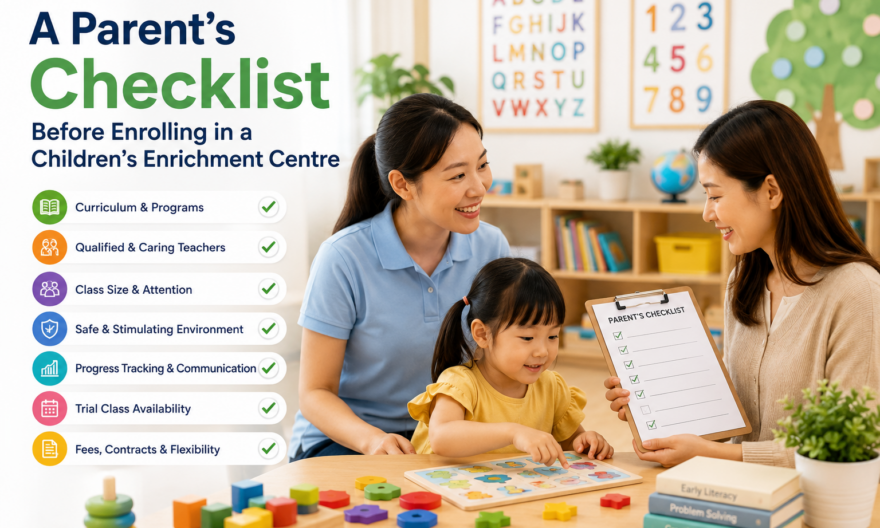
Before enrolling your child in an enrichment programme, evaluate the centre on five key factors: curriculum quality, teacher credentials, class size, environment safety, and alignment with your child’s developmental stage. A structured checklist helps you compare options objectively, ask the right questions, and avoid costly enrolment mistakes — especially for children between ages two and six.
Choosing the right children enrichment classes is one of the most important early decisions you will make as a parent. With hundreds of programmes available across Singapore, it is easy to feel overwhelmed. This checklist gives you a clear, practical framework to evaluate any enrichment centre before signing up — so you invest in learning that genuinely benefits your child.
Why a Checklist Matters for First-Time Parents
First time parents tend to use word-of-mouth or online referrals from social media. Though these evaluations can be useful, the information that you need, such as the ratio of teachers to students, their teaching philosophy, and how they deal with a difficult child, usually isn’t included.
A checklist allows your visit to each center to remain consistent. This allows you to leave your emotions behind and concentrate on what will affect your child’s learning process.
The Complete Checklist: What to Evaluate Before You Enrol
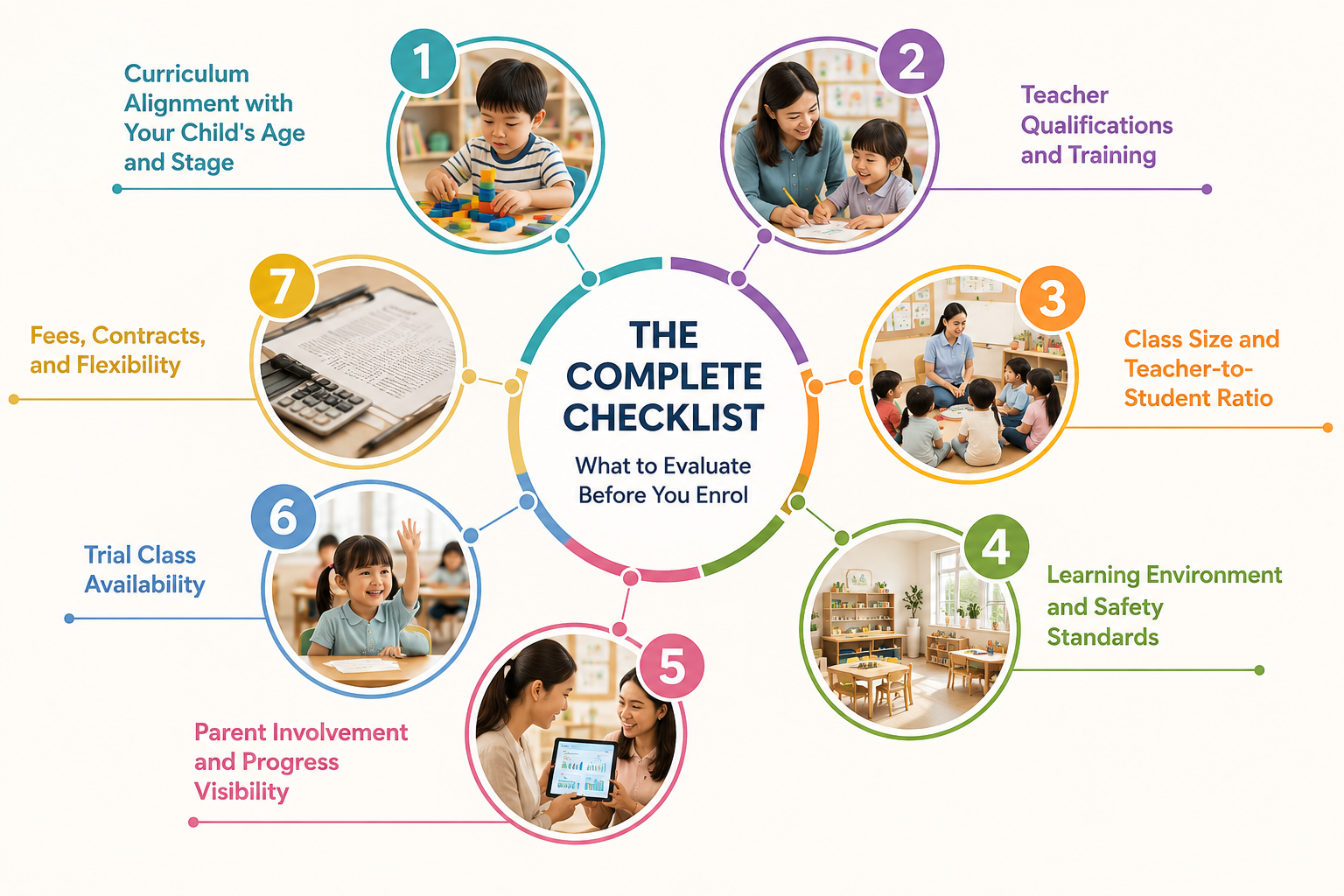
1. Curriculum Alignment with Your Child’s Age and Stage
Not all programmes are built the same. Ask whether the curriculum is designed specifically for your child’s age group. Enrichment classes for preschoolers, for example, should emphasise sensory learning, memory stimulation, and foundational cognitive skills — not rote academic drilling.
- Does the programme have a defined learning framework or methodology?
- Is it research-backed or developed from a recognised educational model?
- Are lessons adapted as the child progresses?
Right-brain education programmes, for instance, are specifically designed for children aged zero to six, targeting the neuroplasticity window when the brain is most receptive to learning.
2. Teacher Qualifications and Training
The educator in the room makes or breaks the experience. Ask about formal qualifications, methodology-specific training, and how long teachers have been with the centre. High turnover is a red flag.
- Are teachers certified in the programme’s methodology?
- Do they receive ongoing professional development?
- How do they manage a child who is disengaged or shy?
3. Class Size and Teacher-to-Student Ratio
Smaller classes mean more individual attention. For preschool-age children, a ratio of one teacher to five or six children is considered appropriate. Larger groups reduce the teacher’s ability to observe and respond to each child’s needs.
Ask whether a teaching assistant is present and what happens when a regular teacher is absent.
4. Learning Environment and Safety Standards
Visit the centre in person before enrolling. Observe how the space is laid out, whether learning materials are age-appropriate, and whether the environment feels calm and stimulating — not chaotic or cluttered.
- Is the centre licensed and compliant with local safety regulations?
- Are toilets and rest areas clean and child-friendly?
- Is access to the centre restricted to authorised adults?
If the enrichment centre is providing its services as a childcare center or student care center, it has to be licensed by the Early Childhood Development Agency (ECDA). While not all enrichment classes require a license from the ECDA, it would be pertinent to enquire how the centre is regulated.
5. Parent Involvement and Progress Visibility
Good enrichment centres keep parents informed. You should know what your child is working on each week, how they are responding to the lessons, and what you can do at home to reinforce learning.
- Does the centre provide regular progress updates?
- Are parents allowed to observe trial or demo classes?
- Is there a parent orientation or onboarding session?
6. Trial Class Availability
Always request a trial class before committing. A single session tells you more than any brochure. Watch how your child responds to the teacher, the environment, and the activities. A child who is curious and engaged after one class is a strong signal you are in the right place.
7. Fees, Contracts, and Flexibility
Understand the full cost before you sign anything. Ask about registration fees, material charges, and whether fees increase termly. Also check the cancellation and deferment policy — life with a young child is unpredictable.
- Is there a long-term contract or a monthly rolling arrangement?
- What is the make-up class policy if your child is unwell?
- Are there sibling discounts or referral programmes?
Quick Reference: Enrichment Centre Evaluation Table
| Checklist Factor | What to Ask | Green Flag | Red Flag |
|---|---|---|---|
| Curriculum | Is it age-appropriate? | Structured methodology | No clear framework |
| Teacher Quality | Are teachers certified? | Ongoing training | High staff turnover |
| Class Size | What is the ratio? | 1:5 or 1:6 | More than 10 per class |
| Safety | Is the centre regulated? | ECDA-compliant or equivalent | No visible compliance |
| Progress Reporting | How are parents updated? | Regular written or verbal updates | No parent communication |
| Trial Class | Can we try before enrolling? | Trial available | Immediate commitment required |
What Makes an Enrichment Centre Genuinely Effective?
In addition to the list, there are some features in the best enrichment centers that cannot be quantified but are easily noticeable when you enter the center. Teachers are highly enthusiastic, children look forward to attending, and parents are seen as partners and not just paying clients.
There should be purpose in the programme with one activity leading to another with a specific end result that has something to do with the development of your child. It is something important to consider if a center cannot justify what it does.
Related Post: How Preschool Enrichment Programs Prepare Your Child for Primary School
Choosing an Enrichment Centre in Singapore: Local Context
The enrichment industry in Singapore offers a wide variety of options. Whether you choose STEM enrichment, language immersion, or right brain enrichment, there are options. Most importantly, you should be mindful of what your child needs today and not what will sound good or what other parents have signed up for in your circles.
Some of the enrichment centers Singapore in the enrichment centers singapore offers internationally recognized methods of learning that have been adopted for Singaporeans. One thing to ask yourself when you choose an enrichment program is how long it has been running.
If your child is between two and six years old and you are exploring right-brain development programmes, Heguru Singapore is a well-established option worth evaluating against this checklist. With a structured methodology, trained educators, and a focus on whole-brain learning during the early childhood window, it addresses many of the criteria first-time parents should prioritise.
FAQ: Children’s Enrichment Classes in Singapore
Q1: At what age should I enrol my child in enrichment classes?
Enrichment classes generally welcome kids as young as six months to two years of age, depending on the program. Early childhood, especially ages zero to six, is generally accepted as an important period in developing the child’s cognition and senses. Therefore, early enrolment in a suitable program will be advantageous to the child.
Q2: How do I know if an enrichment centre in Singapore is legitimate?
Ensure that the centre is based on an established educational curriculum and inquire about qualifications of the staff members. Childcare centers should have a license from Singapore’s Early Childhood Development Agency (ECDA). When it comes to enrichment programs only, you can look out for curriculum transparency, verifiable credentials, and trial classes.
Q3: What is the difference between enrichment classes and tuition?
Enrichment programs emphasize development of broader mental, creative, and physical skills including memorization techniques, music, and languages. Tuition programs emphasize academic subjects. In case of preschoolers, enrichment classes would be a better choice compared to tuition programs as they promote overall development of children.
Q4: How many enrichment classes should a preschooler attend per week?
One to two classes a week are normally enough for children under age six. Excess scheduling may cause fatigue and lower the child’s ability to learn. Depth in one or two good programs is better than over-scheduling.