

Transparent LED glass and traditional LED displays serve different purposes. Transparent LED glass allows light to pass through while displaying content, making it ideal for storefronts, glass facades, and architectural installations. Traditional LED displays offer higher brightness and full-panel coverage, suited for stadiums, control rooms, and outdoor advertising. Your choice depends on visibility needs, space constraints, and budget.
If you’re evaluating signage options for a retail space, corporate lobby, airport, or large-scale venue, this comparison breaks down what actually matters — transparency, installation complexity, cost structure, and real-world performance. No fluff, just the details buyers and consultants need to make a confident decision.
What Is Transparent LED Glass?
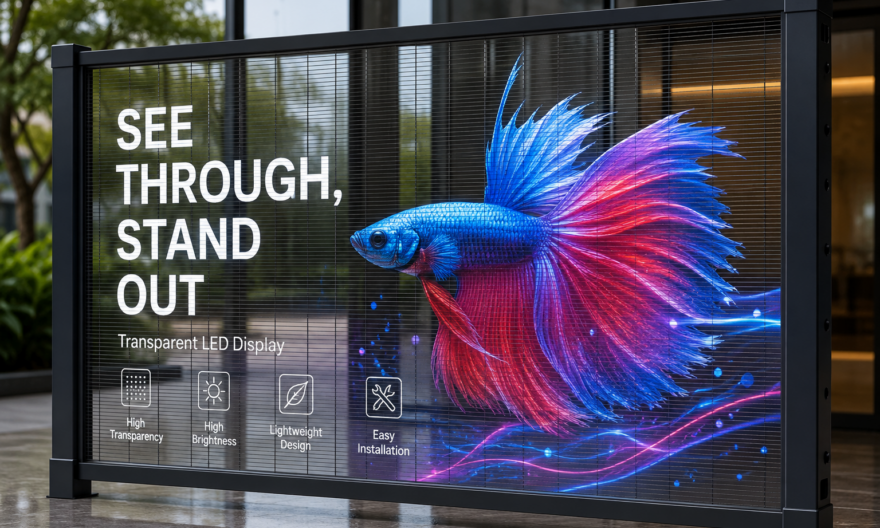
Transparent LED glass is a display technology that embeds LED strips or mesh into a glass panel, allowing viewers to see both the displayed content and the physical space behind it. Transparency rates typically range from 60% to 90%, depending on pixel pitch and strip density.
It’s widely used in:
- Retail storefront windows
- Glass building facades and curtain walls
- Museum and exhibition displays
- Airport and transit terminals
- Luxury showrooms and car dealerships
The defining value isn’t just aesthetics. It’s the ability to use glass surfaces as active display real estate without blocking natural light or sightlines.
What Is a Traditional LED Display?
A traditional LED display — often referred to as an LED video wall or direct-view LED panel — is an opaque, high-density array of LEDs mounted on a solid backing. These panels are designed for maximum brightness, contrast, and color accuracy across large formats.
Common use cases include:
- Outdoor billboards and roadside advertising
- Stadium scoreboards and live event screens
- Control rooms and command centers
- Indoor arenas and entertainment venues
- Corporate AV installations
Traditional LED panels prioritize visual impact over subtlety. They block what’s behind them entirely, which is a feature, not a flaw, when the goal is full-screen content delivery.
Transparent LED Glass vs Traditional LED Display: Side-by-Side Comparison
| Feature | Transparent LED Glass | Traditional LED Display
|
|---|---|---|
| Transparency | 60%–90% | 0% (fully opaque) |
| Brightness | 1,000–3,500 nits | 3,000–10,000+ nits |
| Pixel Pitch Range | P3.9–P15.6 (typical) | P0.9–P16 (wide range) |
| Installation Type | Glass-mounted, frame-based, or adhesive film | Wall-mounted, floor-standing, hanging rigs |
| Weight | Lightweight (8–12 kg/m²) | Heavier (20–40+ kg/m²) |
| Maintenance | Front-access; modular strip replacement | Front or rear-access; cabinet servicing |
| Cost per m² | Higher upfront | Lower upfront for standard models |
| Best For | Architectural, retail, glass facades | High-impact advertising, arenas, events |
Transparency: When Visibility Through the Screen Matters
This is the most fundamental difference. A transparent LED screen lets natural light pass through and maintains visual connection between indoor and outdoor spaces. For a luxury retail brand with a glass storefront, blocking that visibility to install a solid screen would be counterproductive.
Transparency rates above 70% are achievable with wider pixel pitches. However, higher transparency means fewer LEDs per square meter, which reduces brightness and content density. It’s a direct trade-off, and understanding it is essential before specifying a project.
Traditional panels have zero transparency. They’re built to command attention, not blend into architecture. For venues where immersion and brightness take priority over spatial openness, that’s exactly what’s needed.
Installation: Structural and Spatial Considerations
Transparent LED Glass Installation
Transparent LED systems are significantly lighter than traditional cabinets. Many solutions use aluminum frame systems that attach directly to existing glass structures or curtain wall systems. Some products come as adhesive film that bonds to existing glazing, reducing structural modification requirements.
This makes transparent LED glass an attractive option for retrofit projects in commercial buildings where adding heavy display infrastructure isn’t structurally or aesthetically viable.
Traditional LED Display Installation
Traditional LED video walls require more robust structural support, especially at larger scales. Steel rigs, wall reinforcement, and careful cable management are standard requirements. Indoor fine-pitch panels used in control rooms or broadcast studios often need raised flooring or rear-access corridors for maintenance.
Installation lead times tend to be longer, and civil or structural engineering assessments may be required for large outdoor or permanent installations.
Cost: Upfront Investment vs Long-Term Value
Cost comparisons in this category require more nuance than a simple price-per-square-meter figure.
- Transparent LED glass carries a higher unit cost due to the precision engineering involved in maintaining transparency while embedding LEDs. However, it can eliminate the need for separate signage structures, saving on fabrication and real estate.
- Traditional LED panels are more competitively priced at scale, especially for outdoor or large-format deployments. But installation costs, structural engineering, and ongoing power consumption can add up significantly.
For buyers evaluating ROI, the transparent glass LED display often justifies its premium in high-footfall retail environments where the dual-purpose use of glass — architecture and advertising — delivers compounding value. For volume deployments like highway billboards or stadium perimeter boards, traditional LED remains the cost-efficient standard.
Performance: Brightness, Resolution, and Viewing Conditions
Traditional LED displays outperform transparent options in raw brightness. Outdoor LED panels routinely reach 6,000–10,000 nits, enabling clear visibility in direct sunlight. Transparent LED glass typically tops out around 3,000–3,500 nits, which works well for indoor or semi-shaded environments but can struggle in harsh direct sunlight.
Resolution is also a factor. With finer pixel pitches available in traditional formats (down to P0.9 and below), high-resolution content like detailed charts, 4K video, or small-text readouts are better served by solid-panel displays.
That said, for ambient content — brand animations, product imagery, dynamic lighting effects — transparent LED screens deliver a visual impact that no opaque panel can replicate. The floating, holographic appearance creates a premium perception that converts in retail and hospitality settings.
Which One Should You Choose?
There’s no universal answer, but there are clear decision rules:
Choose transparent LED glass if:
- You’re working with a glass facade, storefront window, or architectural glazing
- Natural light or sightline preservation is a requirement
- The installation is in a retail, hospitality, or luxury commercial space
- Visual aesthetics and brand experience carry as much weight as content delivery
Choose a traditional LED display if:
- Maximum brightness is required (outdoor, direct sunlight environments)
- You need fine-pitch resolution for detailed content
- The application is a stadium, arena, broadcast studio, or control room
- Budget efficiency at scale is the primary driver
Real-World Application Examples
Retail flagship store in a major shopping district: A glass LED display installed in the storefront window allows passersby to see the store interior while dynamic content plays — driving foot traffic without sacrificing the open, inviting feel of the space.
Sports arena perimeter boards: A traditional LED video wall around the pitch delivers high-brightness sponsor content visible to 40,000+ spectators and broadcast cameras. Transparency is irrelevant here; impact and brightness are everything.
Corporate headquarters lobby: A transparent LED screen suspended in a glass atrium creates a striking branded welcome without blocking the architectural feature. It doubles as wayfinding and brand communication.
Outdoor highway billboard: A traditional LED display running at 8,000 nits remains legible in peak afternoon sun. No transparent solution currently competes at this brightness level outdoors.
A Note for Consultants Specifying These Systems
When writing specifications, always define the ambient light conditions, viewing distance, minimum brightness requirement, and structural load limits upfront. These four parameters will eliminate most of the ambiguity in choosing between transparent and traditional formats.
Also consider content strategy. If the client plans to run text-heavy or data-intensive content, lean toward traditional panels with finer pitch. If content is primarily visual and brand-driven, transparent glass displays offer a differentiated canvas that justifies the investment.
For sourcing and product consultation on both transparent and traditional display formats, Visual King provides a range of solutions tailored to architectural, retail, and large-format applications — with technical support for specification and installation planning.
Frequently Asked Questions
What is the main difference between transparent LED glass and a traditional LED display?
Transparent LED glass allows light and visibility to pass through the panel while displaying content, with transparency rates of 60%–90%. Traditional LED displays are fully opaque and optimized for maximum brightness and resolution. The core difference is whether preserving sightlines and natural light matters for your installation environment.
Can transparent LED screens be used outdoors?
Yes, transparent LED screens can be used in outdoor-facing or semi-outdoor environments such as storefront windows or glass facades. However, their brightness — typically up to 3,500 nits — limits performance in direct sunlight compared to traditional outdoor LED panels, which can reach 10,000 nits. Shaded or covered outdoor settings work better for transparent displays.
How much does a transparent LED glass display cost compared to a traditional LED panel?
Transparent LED glass displays generally cost more per square meter than traditional LED panels due to their specialized construction. However, they can reduce ancillary costs by integrating into existing glass structures. Traditional LED panels offer better cost efficiency at large scale. Total cost of ownership should factor in installation, structural support, and energy consumption.
What pixel pitch is recommended for a transparent LED screen?
For transparent LED displays, pixel pitches between P3.9 and P7.8 are commonly used for retail and architectural applications where viewing distances range from 3 to 10 meters. Finer pitches increase LED density and improve image clarity but reduce transparency. The right pitch balances content legibility with the desired transparency level for the specific space.
Is a glass LED display suitable for retail storefronts?
A glass LED display is one of the most effective solutions for retail storefronts. It transforms passive glass into active advertising space without blocking interior views or natural light. Brands in fashion, automotive, luxury retail, and electronics commonly use transparent LED window displays to engage foot traffic while maintaining an open, welcoming storefront appearance.
What maintenance does a transparent LED screen require?
Transparent LED screens are generally low-maintenance due to their modular strip-based design. Faulty LED strips can be replaced individually from the front without dismantling the entire panel. Cleaning requires standard glass-safe solutions applied carefully to avoid LED contacts. Compared to traditional LED cabinet systems, transparent displays typically offer simpler on-site servicing with less structural disruption.