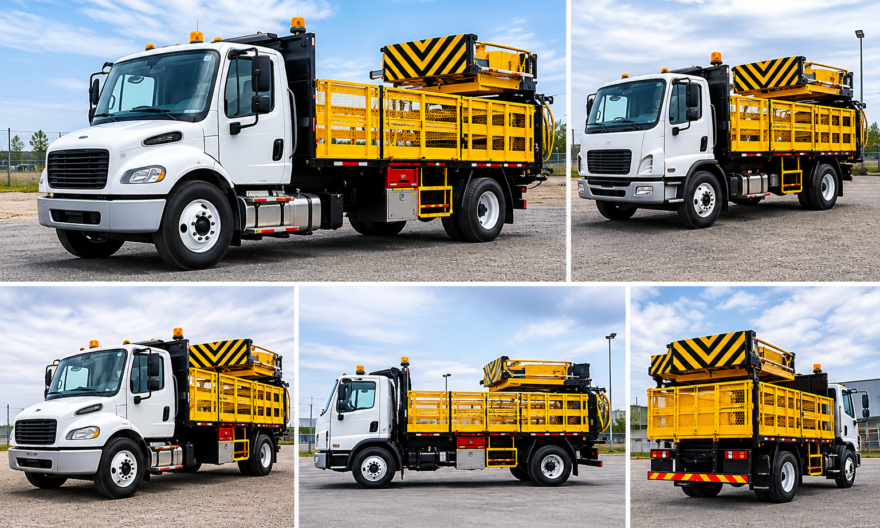
When attached to the back of a host vehicle they serve as a mobile crash buffer. TMAs are among the most effective tools available in temporary traffic management to protect road crews and the traveling public.
Road construction and maintenance crews face one of the most hazardous working environments in any industry. Moving traffic, compressed lane widths, and limited visibility create a constant collision risk. For traffic management companies and road contractors in Singapore, deploying the right protective equipment is not optional — it is a professional and regulatory responsibility. TMA rental in Singapore has become a critical part of how contractors meet that responsibility without the overhead of owning and maintaining heavy equipment.
This article explains what TMA trucks do in live work zones, what makes them effective and why contractors are increasingly choosing rental over ownership.
What Is a Truck-Mounted Attenuator and How Does It Work?
A Truck Mounted Attenuator is a crash cushion device mounted on the rear of a slow moving or stationary host truck. The system works by absorbing and dissipating kinetic energy through a controlled deformation process when an out-of-control vehicle impacts the attenuator. Instead of abruptly stopping the impact vehicle, the system gradually decelerates it.
This controlled deceleration greatly reduces the maximum force transferred to the occupants of both vehicles. Rear end crashes into a work zone vehicle without a TMA can have catastrophic consequences. Having one in place makes that same collision so much more survivable.
Key components of a TMA system typically include:
-
A steel or aluminium energy-absorbing cartridge mounted at the rear of the truck
-
A mounting frame designed to redirect and cushion impact forces
-
Arrow boards or warning signage integrated into the unit for lane guidance
-
Rear lighting and reflective markings to maximise visibility
Why TMAs Are Essential in Temporary Traffic Management
Temporary traffic management (TTM) arrangements – lane closures, contraflow systems, rolling road blocks – all create situations where vehicles and workers share space at speed. There’s not much room for error.
Under the Workplace Safety and Health (WSH) Act in Singapore, employers and contractors are legally obliged to eliminate or minimize risks in work sites, including road construction areas. If appropriate protective measures are not implemented, enforcement actions, suspension of the project or prosecution under the WSH framework may result.
A TMA truck provides the following layers of protection in TTM scenarios:
-
Shadow vehicle protection: The TMA truck travels ahead of or behind work crews, shielding them from rear-end impacts
-
Static zone protection: Parked TMA units guard stationary equipment and workers in active lane closures
-
Rolling road block support: TMAs are deployed as part of multi-vehicle convoys during highway maintenance to manage traffic flow safely
-
Incident buffer: Positioned at taper points, they reduce the consequences of driver inattention or late lane merges
TMA Deployment: Where It Makes the Biggest Difference
Expressway and Highway Maintenance
On expressways like the PIE, AYE or CTE in Singapore, vehicles are driven at 80-90 km/h and sudden changes of lanes are experienced due to lane closures which may not be expected by drivers. A TMA used as a shadow vehicle provides the work team with a vital buffer zone – generally 30 to 60m of protection depending on the attenuator specification and posted speed.
Urban Road Works and Lane Restrictions
City road works are dangerous due to distracted drivers, narrow lanes and unpredictable pedestrian movement. TMAs at the start of lane closures minimize the risk of rear-end crashes and assist in directing vehicles to the proper merge path with integrated arrow boards.
Night Works and Low-Visibility Conditions
Good lighting, reflective tape and an illuminated arrow board on a TMA unit greatly increases the conspicuity of the work zone, providing an earlier warning and more time for approaching drivers to slow down.
TMA Rental in Singapore: Why Contractors Prefer It Over Ownership
Owning a TMA fleet involves a lot of capital expenditure, storage, maintenance scheduling and compliance management. The rental route is more practical and cost effective for the majority of road contractors and TTM companies operating on a project-to-project basis.
Here is how the two options compare:
| Factor | TMA Rental | TMA Ownership
|
|---|---|---|
| Upfront cost | Low — pay per deployment | High capital investment |
| Maintenance responsibility | Handled by rental provider | Contractor’s responsibility |
| Compliance and inspection | Provider manages certifications | Contractor must track and manage |
| Availability for short-term projects | Flexible, on-demand | Fixed asset, may be underutilised |
| Upgrade to newer models | Easier — switch units as needed | Costly to replace or upgrade |
Proximity and availability are important for contractors looking for TMA rental near me. Working with a Singapore-based provider means faster rollout, local technical support and compliance with Land Transport Authority (LTA) road works requirements.
Choosing the Right TMA Rental Provider in Singapore
When evaluating options, traffic management companies and road contractors should look at the following:
-
Equipment specification: Confirm the attenuator meets the required crash test rating (e.g., NCHRP 350 or MASH standards) for the posted speed limit of your work zone
-
Vehicle condition: The host truck must be roadworthy, properly weighted, and comply with LTA regulations for road occupation
-
Operator training: Drivers operating shadow vehicles require specific training in TTM procedures and positioning
-
Turnaround and availability: For emergency and short-notice works, confirm the provider’s response capacity
-
Support documentation: The rental provider should supply necessary deployment records and compliance documentation to support your work zone safety plan
The Real Cost of Not Deploying a TMA
Some contractors view TMA deployment as an optional add-on, not a baseline safety requirement. But that math rarely holds up under scrutiny.
Under Singapore’s WSH Act, contractors who fail in their duty of care at road work zones can be fined, have their projects stopped and in serious cases, the responsible parties can be charged criminally. One unmitigated collision can result in worker fatalities, equipment destruction, project delays and reputational damage that far outweigh any short-term saving on a TMA rental, in addition to legal consequences.
The economics are simple: the cost of renting a TMA for a project is a fraction of the cost of one serious incident response, investigation and compensation process.
Integrating TMA Trucks Into Your Work Zone Safety Plan
A TMA doesn’t do it all on its own. It functions as part of a broader TTM plan that should incorporate traffic cones and delineators, advance warning signs, variable message signs (VMS), flagmen or traffic marshals, and appropriate taper lengths based on posted speed.
The typical guidance on where to place a TMA shadow vehicle is to maintain a minimum distance between the attenuator and the nearest worker or equipment. The distance shall be based on the 85th percentile approach speed and deceleration characteristics of the attenuator model in use.
Coordinate with LTA requirements and alignment to the Code of Practice for Traffic Control at Work Sites to ensure your TMA deployment is compliant and operationally effective.
Final Thoughts
TMA trucks are more than just rental equipment, they’re a commitment to taking work zone safety seriously. In Singapore, road contractors and traffic management companies are required to deploy TMA in all suitable projects, both by regulation and common practice.
If you are planning a road works project and need reliable and compliant TMA units with local support, Enfort Security can provide TMA rental solutions that are suitable for the Singapore road works environment – from short-term to long-term project periods and equipment that can withstand the rigors of live traffic conditions.
Frequently Asked Questions
What does a Truck-Mounted Attenuator do in a road work zone?
A TMA absorbs the impact of an errant vehicle striking the rear of a work zone vehicle, protecting road workers behind it. It decelerates the impacting vehicle in a controlled manner, significantly reducing injury severity compared to an unprotected collision with a standard truck or barrier.
Is TMA deployment required under Singapore road works regulations?
Under Singapore’s WSH Act and the LTA Code of Practice for Traffic Control at Work Sites, contractors must implement appropriate traffic safety measures, which include attenuator deployment on expressways and high-speed road works. Non-compliance can result in enforcement action or project suspension.
How do I find a reliable TMA rental near me in Singapore?
Look for Singapore-based providers with properly maintained equipment, LTA-compliant host vehicles, and documented crash-test ratings for their attenuator units. Local providers offer faster response times, on-site support, and familiarity with local compliance documentation requirements.
What is the difference between a shadow vehicle and a stationary TMA?
A shadow vehicle is a moving TMA truck that travels immediately behind a work crew, shielding them in real time. A stationary TMA is parked at the entry of a lane closure to absorb rear-end impacts at a fixed protection point. Both configurations serve different work zone needs.