


One of the most sources of misunderstanding while shopping for emerald engagement rings is the language. “Emerald cut” and “emerald gemstone” seem to have a lot in common – but they are two totally distinct things. Emerald cut vs Emerald gemstone An emerald cut is the shape of the diamond or gemstone and is rectangular with facets, whereas an emerald gemstone is the green precious stone itself. Understanding this difference will help you make a confident, informed choice.
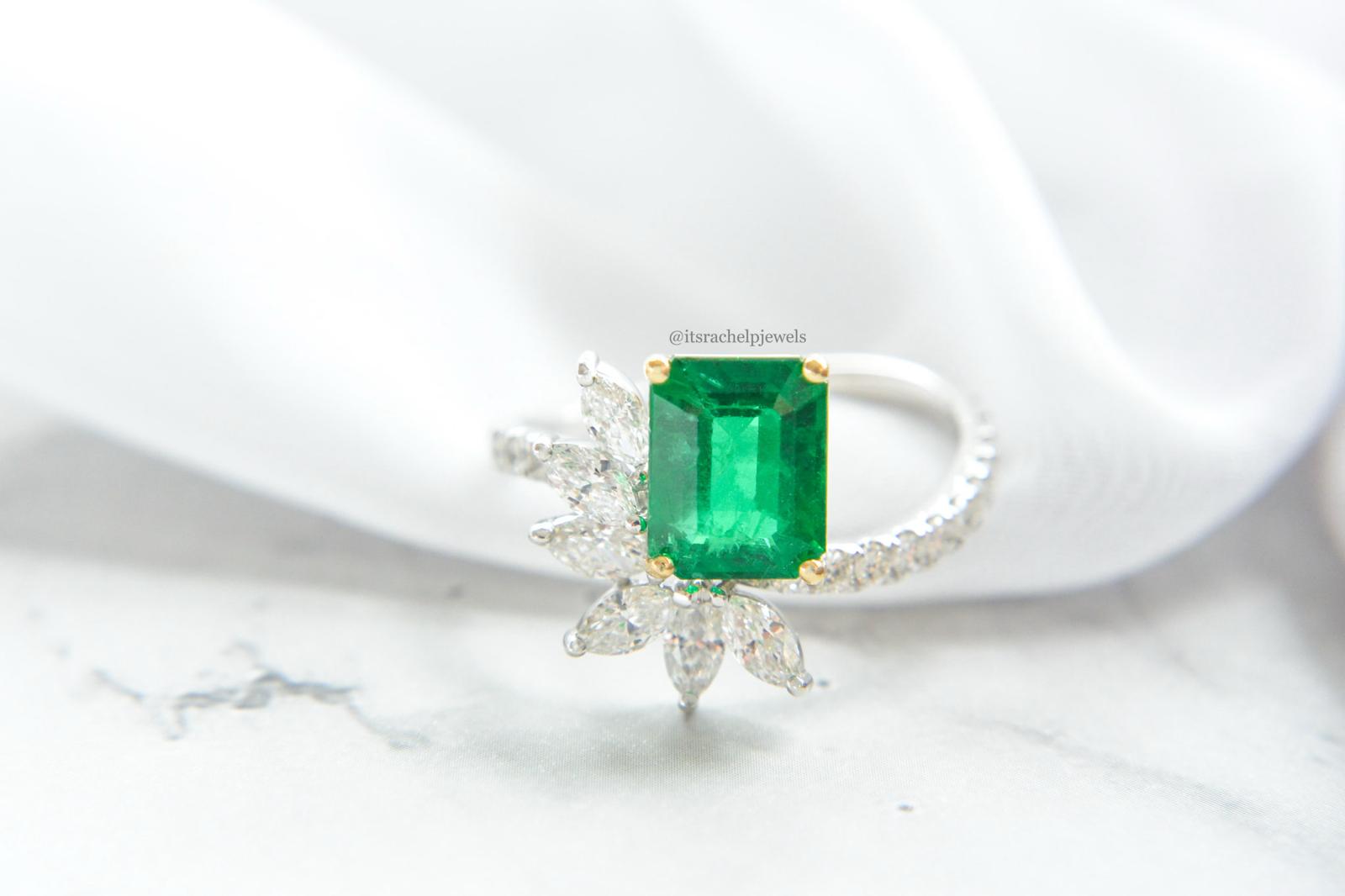
What Is an Emerald Cut?
An emerald cut is a form, not a type of stone. It has a rectangular shape with cropped corners and lengthy facets, parallel to each other, that are step cut. These aspects produce a “hall of mirrors” effect that produces a deep, elegant glow, not the sparkle you’d see in a round brilliant cut.
It was first created to prevent chipping when cutting real emeralds and then the form was used for diamonds and other stones. Today, the emerald cut diamond is one of the most popular options for engagement rings thanks to its elongating shape and timeless beauty.
Key Visual Traits of an Emerald Cut
- Rectangular shape with clipped corners
- Step-cut facets (not brilliant-cut)
- Open, wide table that highlights clarity
- Subtle, sophisticated shimmer — not fiery sparkle
- Elongates the appearance of the finger
Because the large open table reveals the interior of the stone so clearly, an emerald cut diamond demands higher clarity grades. Inclusions and colour tints are far more visible in this shape than in a round brilliant cut.
What Is an Emerald Gemstone?
An emerald gemstone is a precious stone — a variety of the mineral beryl, coloured green by trace amounts of chromium and sometimes vanadium. It belongs to the same mineral family as aquamarine and morganite, but its vivid green colour makes it uniquely distinctive.
Emeralds have been valued for thousands of years. Cleopatra was famously fond of them, and they remain one of the four precious gemstones alongside diamonds, rubies, and sapphires. In an emerald ring, the stone itself is the focal point — rich, lush green with a depth that no other gemstone quite replicates.
What Makes an Emerald Gemstone Unique?
- Belongs to the beryl mineral family
- Rated 7.5–8 on the Mohs hardness scale
- Natural inclusions (called “jardin”) are considered part of its character
- Vivid green colour ranges from yellowish-green to deep bluish-green
- Often treated with cedar oil to enhance clarity — a widely accepted industry practice
Unlike diamonds, emeralds are typically not graded on a standardised scale by a single global body. Colour is the most important quality factor — and for an emerald gemstone ring, the richer and more saturated the green, the more valuable the stone.
Emerald Cut vs Emerald Gemstone: Side-by-Side Comparison
Here is a quick comparison to make the distinction completely clear:
| Feature | Emerald Cut | Emerald Gemstone |
|---|---|---|
| What it refers to | A shape/cut style | A type of gemstone (beryl family) |
| Common stone used | Diamond, moissanite, sapphire, etc. | Emerald (green beryl) |
| Colour | Depends on the stone used | Green (yellowish to bluish-green) |
| Facet style | Step-cut, rectangular facets | Can be cut in any shape |
| Appeal | Elegant, elongated, vintage feel | Colourful, bold, rich symbolism |
| Hardness concern | Depends on the stone used | More prone to chipping than diamonds |
Can You Combine Both? Yes — and It’s Stunning
An emerald cut emerald gemstone ring combines both concepts — the emerald cut shape applied to an actual emerald stone. This pairing is historically significant. The rectangular step-cut was originally designed for emerald gemstones specifically because their natural crystal structure makes them well-suited to this shape, reducing the risk of breakage during cutting.
This combination creates a deeply saturated, architecturally clean ring that reads as both modern and timeless. It is particularly popular among buyers who want colour in their engagement ring without straying too far from a classic aesthetic.
Which One Should You Choose for an Engagement Ring?
The right choice depends entirely on your priorities. Here is a simple breakdown:
Choose an Emerald Cut Diamond If You Want:
- Brilliant white stone with a sleek, elongated shape
- A vintage or Art Deco-inspired look
- High durability (diamonds score 10 on the Mohs scale)
- A stone that pairs beautifully with baguette side stones
Choose an Emerald Gemstone Ring If You Want:
- A bold pop of colour as the centrepiece
- Deep personal or symbolic meaning — emerald is the birthstone for May
- A non-traditional engagement ring with a rich historical legacy
- A unique stone with natural character (inclusions are expected and accepted)
If you love both the colour and the shape equally, an emerald-cut emerald is a rare and beautiful choice — one that carries centuries of jewellery tradition in a single stone.
Caring for Each Type of Ring
Care requirements differ significantly between an emerald cut diamond and an emerald gemstone ring, and this is worth knowing before you purchase.
An emerald cut diamond is extremely durable and can be cleaned with an ultrasonic cleaner. An emerald gemstone ring, on the other hand, requires gentler handling. Emeralds are typically oil-treated to improve their appearance, and ultrasonic or steam cleaning can strip that treatment. Warm soapy water and a soft brush are the safest cleaning method.
Also, because emeralds sit at 7.5–8 on the Mohs scale — softer than diamonds, sapphires, and rubies — they are more susceptible to surface scratches and chips over time. A protective ring setting, such as a bezel or halo, is often recommended for daily wear.
Why This Distinction Matters When You’re Shopping
Misunderstanding the terminology might really confuse you – or disappoint you – at the jewelry counter. Someone searching for a green ring may ask for a “emerald ring” and end up with an emerald cut diamond in white or yellow gold, which is not green at all. But a person who loves the shape of the step cut might not realize they can have it in sapphire or moissanite or even ruby.
Knowing the distinction gives you a good handle on the discussion. You can just go in and say exactly what you want: a step-cut diamond with a vintage silhouette, or a vibrant green emerald in a classic solitaire setting. That clarity saves you time and guarantees the ring you choose is a true reflection of your vision.
At Rachel P Jewels, the selection is designed for clients who desire quality with clarity – in their stones and in the purchase process. If you love the clean lines of an emerald cut or the brilliant depth of an emerald gemstone, looking through their selection of engagement rings is a great place to begin your search for a ring that really feels like you.
Frequently Asked Questions
Is an emerald cut the same as an emerald gemstone?
No. An emerald cut is a rectangular cut that has step cuts in the shape of a rectangle and is used for diamonds and other stones. An emerald is a green valuable stone that is a member of the beryl mineral family. They are completely different – one is a shape, the other is a sort of stone.
Can I get an emerald cut in a stone other than diamond?
Yes. The emerald cut shape can be applied to sapphires, moissanites, rubies, morganites and even real emerald gemstones. The cut dictates the stone’s geometry, not the material — therefore it’s available for a wide range of gemstone types and budgets.
Are emerald gemstones suitable for everyday wear in an engagement ring?
Emeralds are tough enough to wear every day, but need more care than diamonds. They have a Mohs hardness scale of 7.5-8 and can get scratched or chipped with rigorous use. With a protective setting such as a bezel or halo, and cautious everyday wear, the stone will stay intact for a long time.
Why does an emerald cut diamond not look green?
The emerald cut is a form only. If applied on a diamond the stone will remain white or near-colourless. The term originates from the cut’s origins in crafting real emerald gemstones. Unless the diamond has a green color grade, an emerald cut diamond will not appear green.
What is the best setting for an emerald gemstone engagement ring?
The greatest option to protect an emerald gemstone is a bezel or halo setting since they keep the edges from being impacted. Prong settings show more of the stone but may leave it more vulnerable to hazards. A lower profile setting is usually a more practical choice for everyday wear
Is emerald a good choice as an engagement ring stone in Singapore?
Emeralds are a meaningful and beautiful choice for engagement rings in Singapore. They have a profound symbolic meaning, representing love, renewal and growth, and their vibrant green color makes them a unique, non-traditional ring that is sure to stand out from the more standard diamond solitaire shapes.