


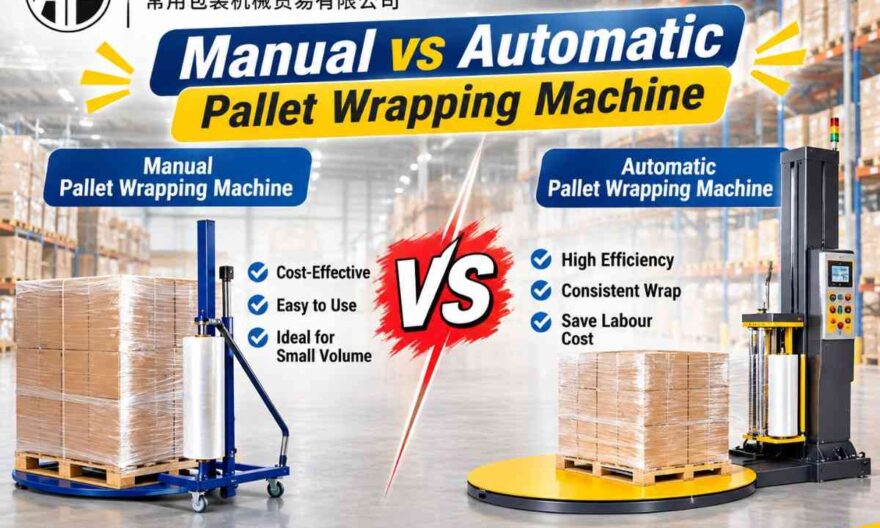
Choosing between a manual and automatic pallet wrapping machine depends on your load volume, workforce size, and budget. Manual wrappers suit low-volume operations with tight capital constraints. Semi-automatic and fully automatic stretch wrappers deliver greater consistency, reduce labour dependency, and lower per-pallet costs at higher throughputs. For most growing Malaysian SMEs, automation pays off faster than expected.
If you manage a warehouse or production floor in Malaysia, wrapping pallets might seem like a minor operational detail — until you calculate how much time, film, and labour it actually consumes. A reliable pallet wrapping machine is not just a packaging tool; it directly affects your throughput, product safety, and bottom line. The question is which type fits your operation best.
What Are the Different Types of Pallet Wrappers?
Before comparing performance, it helps to understand what you are actually choosing between. There are three main categories:
- Manual pallet wrapper: The operator walks around the pallet while holding the stretch film roll. No motor, no turntable — just labour.
- Semi automatic pallet wrapping machine: Uses a powered turntable and film carriage. The operator attaches the film, starts the cycle, and the machine does the wrapping.
- Automatic stretch wrapper: Fully integrated into a conveyor line. It wraps pallets without any manual intervention, cutting and sealing the film automatically.
Each type serves a different operational profile. The gap between them is not just about speed — it is about consistency, injury risk, and long-term cost.
Labour Requirements: Where the Real Cost Hides
Hand wrapping is physically tiring. Workers have to bend and stretch to get around each pallet multiple times, leading to fatigue and inconsistent wrap quality. In Malaysia where labor costs have been going up steadily after the minimum wage was revised to RM1,500 per month in 2023, it is a waste of resources to deploy skilled workers to manual wrapping.
A semi-automatic unit reduces active wrapping time per pallet to approximately 60-90 seconds. One operator can watch over several machines or do other tasks at the same time. A fully automatic system removes the operator from the wrapping process entirely, requiring only periodic film replenishment and maintenance oversight.
For warehouse managers running two or three shifts, the labour saving with automation compounds quickly across the week.
Wrapping Consistency: Why It Matters More Than You Think
Manual Wrapping Is Inconsistent by Nature
Human fatigue, variation in walking speed, and inconsistent film tension mean no two manually wrapped pallets are identical. This leads to load instability during transit — a leading cause of product damage claims. In industries like food manufacturing, pharmaceuticals, or electronics, inconsistent wrapping can void transit insurance or fail export compliance checks.
Automated Systems Deliver Repeatable Results
With semi-automatic and automatic machines, pre-stretch rates are consistent and usually in the range of 150% to 300%. You use a lot less film per pallet and achieve better load containment. This is not only a performance benefit, it will directly lower your monthly film consumption and cost.
Consistent wrapping also helps pallets meet shipping and stacking standards required by freight forwarders for companies shipping goods out of Port Klang or Penang Port.
Productivity Comparison: Pallets Wrapping Machine Per Hour
| Wrapping Type | Pallets Per Hour | Operator Required | Film Pre-Stretch
|
|---|---|---|---|
| Manual | 8–12 | 1 (dedicated) | None to minimal |
| Semi-Automatic | 20–30 | 1 (part-time) | Up to 200% |
| Automatic | 40–80+ | 0 (monitoring only) | Up to 300% |
For SMEs dispatching 30 to 50 pallets per day, a semi-automatic machine is typically the crossover point where automation becomes clearly cost-effective. Beyond 80 pallets per day, a fully automatic stretch wrapper is usually the right call.
Operating Costs: Total Cost of Ownership Over 3 Years
Manual wrapping appears cheap upfront — there is no machine to buy. But when you account for labour hours, film waste, product damage claims, and worker compensation risks, the cost picture shifts dramatically.
Consider a warehouse wrapping 40 pallets per day, five days a week:
- Manual: Requires 1–2 dedicated workers. Higher film usage (no pre-stretch). Higher risk of musculoskeletal injuries covered under SOCSO claims.
- Semi-automatic: Lower film consumption by 30–50% due to pre-stretch. Reduces active labour by up to 70%. Machine cost typically recovered within 12–18 months.
- Automatic: Highest upfront investment, but lowest per-pallet operating cost at scale. Best suited for manufacturers with high daily dispatch volumes.
SOCSO records in Malaysia have consistently flagged repetitive strain and manual handling injuries as a top claim category in logistics and warehousing. Automating pallet wrapping is not just a productivity decision — it is a workplace safety one.
Which Type Is Right for Your Business?
Choose a Manual Wrapper If:
- You wrap fewer than 10 pallets per day
- You have highly variable pallet sizes that resist standardised cycles
- You need a portable, low-cost interim solution
Choose a Semi-Automatic Machine If:
- You dispatch 20–80 pallets per day
- You want to reduce film waste and improve load consistency
- You are an SME looking to scale without fully automating your line
Choose an Automatic Stretch Wrapper If:
- You run a high-volume production or fulfilment operation
- Your line is conveyor-integrated and cannot afford operator bottlenecks
- You need hands-free wrapping with automatic film cut and seal
Making the Right Investment for Your Operation
For most Malaysian manufacturers and warehouse managers, the semi-automatic machine represents the best starting point — a practical balance between upfront cost, operational gain, and scalability. If your volume is growing, planning for automatic integration from the start saves costly retrofitting later.
Autopak Trading offers a range of pallet wrapper machines suited to different operational scales, from standalone semi-automatic turntable units to fully integrated automatic systems. If you are evaluating options for your facility, their team can advise on the right configuration based on your daily pallet count, load type, and floor layout. Visit Auto Pak Trading to explore the full product range.
Frequently Asked Questions
What is the difference between a semi-automatic and automatic pallet wrapping machine?
Semi-automatic machines require the operator to load the film and start each wrapping cycle, while an automatic stretch wrapper will do the entire job, including cutting and sealing the film, without operator intervention. Automation systems are better suited to high volume operations where labor efficiency and throughput are important.
How many pallets per day justify buying an automatic pallet wrapping machine?
Generally, operations that wrap more than 80 pallets per day will receive the greatest benefit from a fully automatic stretch wrapper. If you need to wrap between 20 and 80 pallets a day, a semi-automatic pallet wrapper is usually the best value for money and doesn’t involve the complexity of a full conveyor system.
Does a pallet wrapping machine reduce film usage?
Yes. Machines with pre-stretch mechanisms can cut down on film consumption by 30-50% compared to manual wrapping. Pre-stretch is a method of stretching the film before it is applied, which means that less material is used per pallet, whilst maintaining or improving the load containment strength.
Is manual pallet wrapping safe for workers in Malaysia?
Manual pallet wrapping has a risk of repetitive strain injuries and musculoskeletal disorders which are among the top categories of SOCSO claims in Malaysian warehousing. The use of semi-automatic or automatic equipment greatly reduces the physical strain and the risk of workplace injury for employees involved in pallet wrapping.
What should I look for when buying a pallet wrapping machine in Malaysia?
The key factors are your daily pallet volume, load height and weight, available floor space and whether you need conveyor integration. The film pre-stretch ratio, turntable speed and after-sales support from a local supplier are also important considerations when considering options in the Malaysian market.