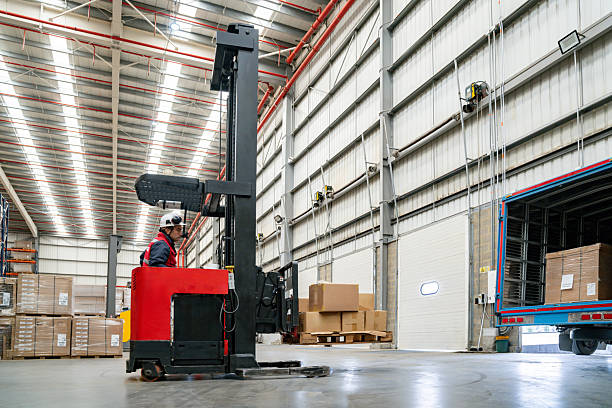
A reach truck allows warehouses to access high rack storage at heights of 12 metres or more, making it one of the most effective tools for vertical space optimisation. Unlike standard forklifts, its extending mast and compact chassis let operators work in narrow aisles and lift pallets to upper rack levels with precision — maximising every square metre of floor and ceiling space.
Why Vertical Space Is a Real Problem for Singapore Warehouses
Land is expensive in Singapore. Warehouse rental rates in established logistics hubs like Jurong, Tuas, and Penjuru remain consistently high, with industrial property among the priciest in Southeast Asia. For warehouse owners and logistics managers, expanding horizontally is rarely an option.
The practical solution is to build upward — install taller racking systems and operate equipment that can safely reach those heights. This is precisely where a reach truck delivers measurable value. It turns unused vertical metres into productive storage capacity without requiring a larger footprint.
What Makes a Reach Truck Different From Other Warehouse Equipment?
Many warehouses already use an electric pallet truck for ground-level movement. It is efficient, cost-effective, and easy to operate. But it cannot elevate loads to upper rack levels. That is where the comparison ends and the reach truck begins.
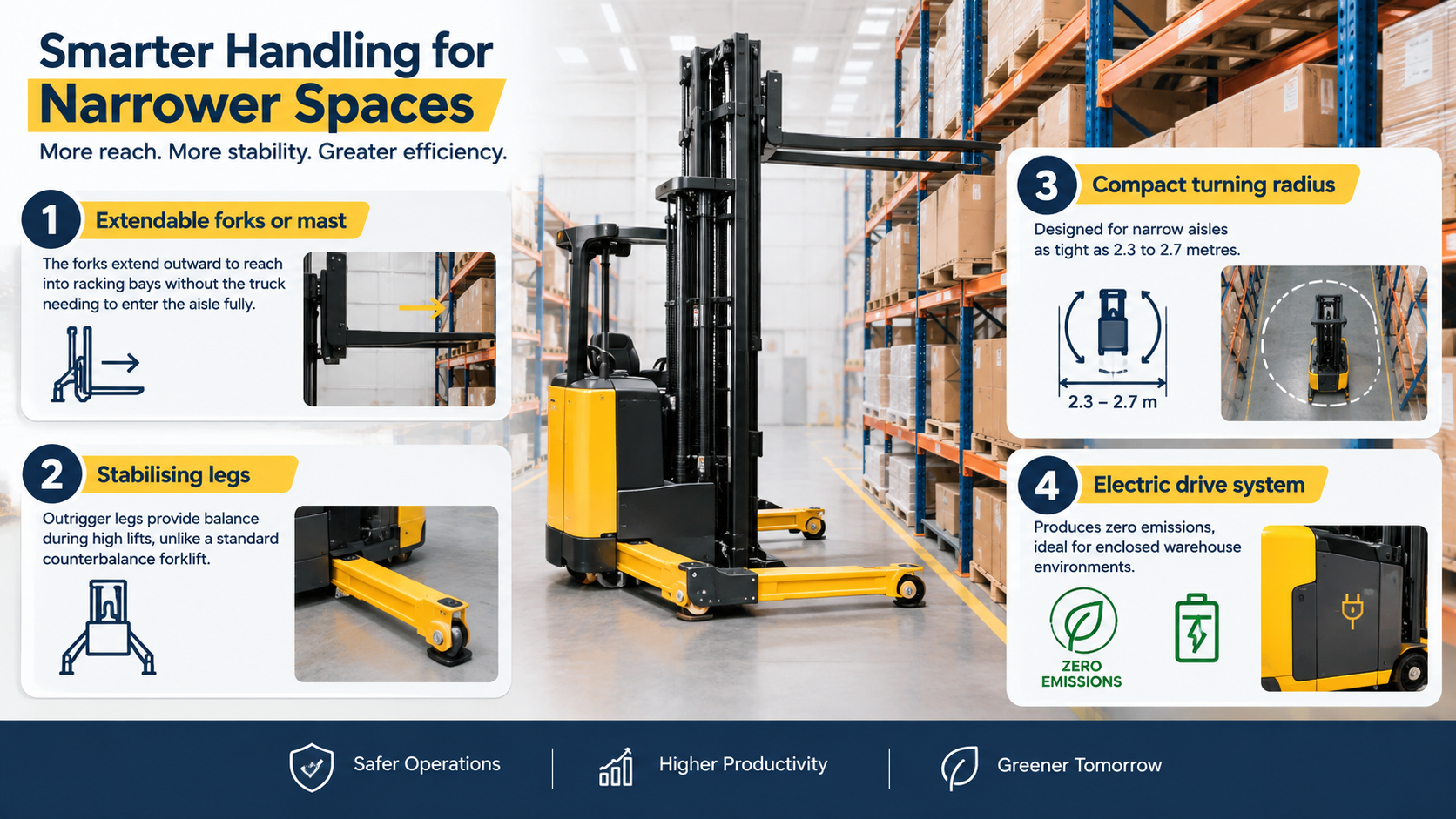
A high reach forklift is purpose-built for vertical operations. Key design features include:
- Extendable forks or mast — The forks extend outward to reach into racking bays without the truck needing to enter the aisle fully
- Stabilising legs — Outrigger legs provide balance during high lifts, unlike a standard counterbalance forklift
- Compact turning radius — Designed for narrow aisles as tight as 2.3 to 2.7 metres
- Electric drive system — Produces zero emissions, ideal for enclosed warehouse environments
This combination of precision, reach, and compact design is what makes it the right tool for high rack storage systems.
How a Reach Truck Directly Improves Warehouse Space Optimisation
1. It Lets You Add More Rack Levels
Standard counterbalance forklifts typically reach up to 6 metres. A reach truck can operate at heights between 9 and 13 metres, depending on the model. That difference alone can translate to two or three additional rack levels — effectively doubling or tripling your storage capacity within the same building envelope.
For a warehouse already paying a fixed lease, adding storage tiers without extending the building is a direct cost saving with no increase in rent.
2. It Supports Narrower Aisle Configurations
Wide aisles consume floor space that could otherwise hold racking. By switching to narrow-aisle operations enabled by a reach truck, warehouses can install additional rack runs across the same floor area. Industry guidance suggests that moving from standard aisles to narrow-aisle layouts can increase storage density by 40 to 50 percent in some configurations.
That kind of gain is significant in a Singapore context where every square metre carries a cost.
3. It Reduces Dependency on Overflow Storage
When warehouses lack vertical capacity, goods overflow into temporary storage, off-site facilities, or unplanned stacking that creates safety risks. A reach truck gives you a structured path to use your available height, reducing the need for costly overflow arrangements.
4. It Integrates With a Broader Warehouse Space Optimisation Strategy
Reach trucks do not work in isolation. They are typically part of a wider warehouse space optimisation plan that includes selective racking, very narrow aisle (VNA) systems, and warehouse management software. When properly integrated, they allow dynamic slotting — placing fast-moving SKUs at accessible lower levels and slower stock at height, all retrievable by the same machine.
Real-World Use Cases in Singapore Warehouses
Third-party logistics (3PL) providers operating in Singapore’s major logistics clusters have increasingly adopted reach trucks as their primary picking and putaway machines. Cold chain warehouses, which pay premium rates for refrigerated space, benefit particularly from vertical density — every cubic metre of cooled space saved reduces energy costs and maximises revenue-generating capacity.
E-commerce fulfilment centres, where SKU variety is high and space is tight, also depend on reach trucks to maintain organised high rack storage while keeping ground-level pick paths clear for order fulfilment teams.
Comparing Warehouse Equipment: Which Tool Does What?
| Equipment Type | Max Lift Height | Aisle Width Needed | Best Use Case
|
|---|---|---|---|
| Electric Pallet Truck | Up to 0.2 m (ground level) | Standard | Horizontal movement, loading docks |
| Counterbalance Forklift | Up to 6 m | 3.5 m+ | Open yard, loading areas |
| Reach Truck | 9 m – 13 m+ | 2.3 m – 2.7 m | High rack storage, narrow aisles |
| High Reach Forklift (VNA) | 13 m+ | 1.6 m – 1.8 m | Very narrow aisle, specialised systems |
What to Consider Before Investing in a Reach Truck
Before purchasing or leasing, warehouse managers should evaluate the following:
Getting these fundamentals right ensures the equipment delivers its full potential and meets Singapore’s workplace safety requirements.
Making the Investment Work Long-Term
A reach truck is not just a piece of equipment — it is a warehouse capacity decision. When deployed correctly, it reduces the pressure to relocate to a larger facility, defers capital expenditure on new leases, and creates a more organised, safer working environment.
For logistics managers benchmarking their operations, the calculation is straightforward: if your warehouse has unused height above four metres and you are running out of ground-level space, a reach truck is likely the highest-return equipment investment available to you right now.
ANG Equipment offers reach trucks suited to Singapore’s warehouse environments, with options across lift height, load capacity, and aisle configuration. If you are evaluating how to get more from your current facility, speaking to their team is a practical next step.
Frequently Asked Questions
What is the maximum height a reach truck can lift in a warehouse?
Most reach trucks can lift loads to heights between 9 and 13 metres, with some models exceeding that range. The exact height depends on the model, mast configuration, and load weight. Always verify the rated lift capacity at maximum height, as it typically decreases the higher the load is raised.
Is a reach truck suitable for narrow aisle warehouses in Singapore?
Yes. Reach trucks are specifically designed for narrow aisle operations, typically requiring aisle widths of 2.3 to 2.7 metres. This makes them well-suited to Singapore warehouses where floor space is limited and maximising rack density is a priority for cost-effective storage.
What is the difference between a reach truck and an electric pallet truck?
An electric pallet truck moves loads at ground level and is used mainly for horizontal transport across warehouse floors or loading docks. A reach truck is designed for vertical lifting, accessing high rack storage levels that a pallet truck cannot reach. They serve different functions and are often used together.
Do reach truck operators need a licence in Singapore?
Yes. Under Singapore’s Workplace Safety and Health Act, operators of powered industrial trucks including reach trucks must hold a valid licence issued by the Ministry of Manpower (MOM). Employers are responsible for ensuring all operators are properly trained and certified before operating the equipment.
How does a reach truck support warehouse space optimisation?
A reach truck enables warehouses to use vertical space by accessing high rack levels that other equipment cannot safely reach. Combined with narrow-aisle racking systems, it can increase storage density by 40 to 50 percent compared to standard layouts — without expanding the warehouse footprint or increasing rental costs.
Can reach trucks be used in cold storage warehouses in Singapore?
Yes. Electric reach trucks are commonly used in cold chain and refrigerated warehouse environments. Their zero-emission electric drive makes them suitable for enclosed, temperature-controlled spaces. However, batteries and components should be rated for low-temperature conditions, and regular maintenance checks are especially important in cold storage settings.