


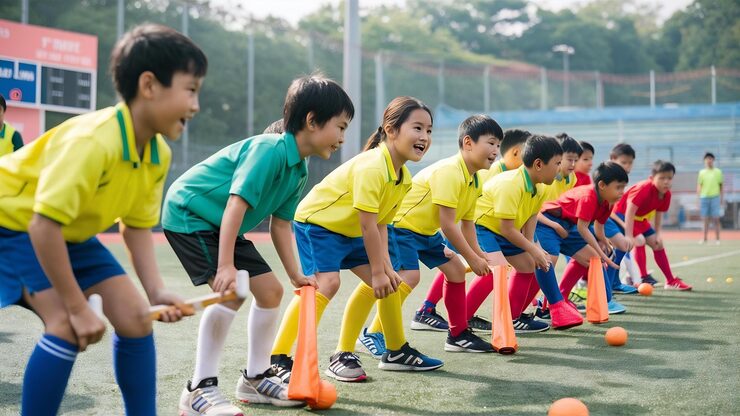
Regular participation in sports classes helps children develop communication skills, emotional resilience, and the ability to work as part of a team. When children engage in structured physical activities consistently, they practise turn-taking, learn to handle setbacks, and build self-belief through repeated achievement. These are not accidental outcomes — they are built into every session.
Why Teamwork and Confidence Matter in Early Childhood
Parents in Singapore are increasingly aware that academic performance on its own does not prepare children for life. The Ministry of Education’s Framework for 21st Century Competencies points to collaboration, communication and civic literacy as essential life skills. Sports are one of the most natural places to develop all three at the same time.
Group activities also help children learn to cope with disagreement, support their peers and articulate themselves clearly from a young age. They’re habits that are developed through repetition — and sports classes provide that kind of structured, repeated exposure.
What Sports Classes Actually Teach Beyond Physical Skills
The majority of parents enrolll their children hoping for improved fitness or coordination. What they often find is something much more valuable.
Communication Under Pressure
In team sports kids need to communicate in real time, whether that’s calling for the ball, signalling a play or just acknowledging a teammate’s effort. It is more difficult to reproduce such spontaneous communication in a classroom environment. After weeks and months of regular sessions, it becomes second nature.
Handling Wins and Losses With Maturity
It’s uncomfortable to lose a game or miss a shot in front of other people. But it is also one of the most effective ways for children to learn emotional self-regulation. The National Institute of Education (NIE) in Singapore says physical education settings provide children with unique opportunities to build resilience and emotional coping skills in ways that structured academic settings often do not.
Building Self-Confidence Through Mastery
You can’t teach confidence. You earn it.” When a child learns a new skill, whether it is passing the ball accurately, holding the right stance or completing a relay without dropping the baton, they get a real sense of achievement. That feeling gets worse over time. Every small victory adds to the growing belief that effort matters.
How Regular Attendance Deepens These Benefits
A one-off sports experience is fun. Going to a sports class once a week can change you. Consistency is extremely important at the developmental stage.
Here is what regular attendance builds over time:
-
Social bonds: Children who train together weekly develop trust and familiarity. They learn each other’s strengths, cover each other’s weaknesses, and form friendships that often extend beyond the class.
-
Accountability: Showing up, even when tired or unmotivated, teaches children that commitment matters — a lesson that transfers directly to school and family life.
-
Progress tracking: When children see their own improvement session by session, their internal motivation strengthens. They stop needing external praise to feel good about their effort.
-
Group identity: Being part of a team gives children a sense of belonging. In Singapore’s competitive education environment, that sense of belonging can be an important emotional anchor.
What to Look for in a Sports Class for Your Child
Not all programmes deliver the same developmental outcomes. When evaluating sports classes in Singapore, consider these factors:
| Factor | Why It Matters |
|---|---|
| Coach-to-child ratio | Smaller groups mean more personalised feedback and better skill development |
| Age-appropriate structure | Activities must match developmental readiness to build confidence, not frustration |
| Emphasis on participation | Programmes that celebrate effort alongside performance nurture long-term engagement |
| Qualified instructors | Trained coaches understand child psychology and create psychologically safe environments |
| Consistent weekly schedule | Regular sessions build routine and compound skill development over time |
The Role of Parents in Reinforcing What Sports Classes Build
What happens after class is just as important as what happens in class. Parents who talk over the session with their children – asking about instances of teamwork, what was difficult, or what they are proud of – reinforce the lessons learned on the pitch.
Avoid focusing exclusively on scores or performance. Instead, ask questions like:
-
“Did you help a teammate today?”
-
“What was the hardest part of today’s class?”
-
“Is there something you want to get better at?”
This kind of debrief helps children articulate their experience, which deepens the developmental impact of the class itself.
Singapore-Specific Context: Why This Matters Now
The move away from rigid streaming toward holistic development suggests a broader recognition that children need more than academic results to flourish. Sport has an important part to play in that shift.
ActiveSG under Sport Singapore continues to invest in youth sports development programs – a clear sign that physical activity and character development are being taken seriously at a national level. Parents who align their children’s activities in this direction are giving their children a real head start.
Starting Early Builds the Strongest Foundation
Children who take sports classes between the ages of four and ten are at a very impressionable age for social and emotional learning. The patterns established in those years — how to communicate, how to work together, how to pick yourself up — often stay with us well into adolescence and adulthood.
For parents in Singapore looking for a programme that takes child development seriously, Sporty Bots offers weekly sports classes designed to build exactly these qualities in a fun, age-appropriate setting. The focus is not just on physical skills — it is on growing confident, communicative children who know how to work with others.
Frequently Asked Questions
At what age should my child start sports classes in Singapore?
Structured sports activities can benefit children as young as 3 or 4. Starting early develops coordination, social confidence and communication habits. Most programs in Singapore have age-specific groups so children are never placed in environments beyond their developmental readiness.
How do sports classes help children with teamwork?
In sports classes children are put in situations where they must cooperate to be able to achieve common goals. Playing, defending and planning together teach children to listen, talk and trust others. These skills are practiced over and over every session. Teamwork builds into a real habit and not just an abstract concept.
Can sports classes improve my child’s confidence at school?
Yes. The confidence that comes from achieving something physically can carry over into academic and social settings. When a child is constantly improving in sports, they develop a belief in their ability to improve – a mindset that directly supports how they approach challenges in school.
How often should my child attend sports classes to see real benefits?
The minimum attendance recommended for meaningful development is weekly. Regular sessions help kids build on previous progress, deepen friendships with teammates and develop the consistency that makes skills – both physical and social – stick over time.