


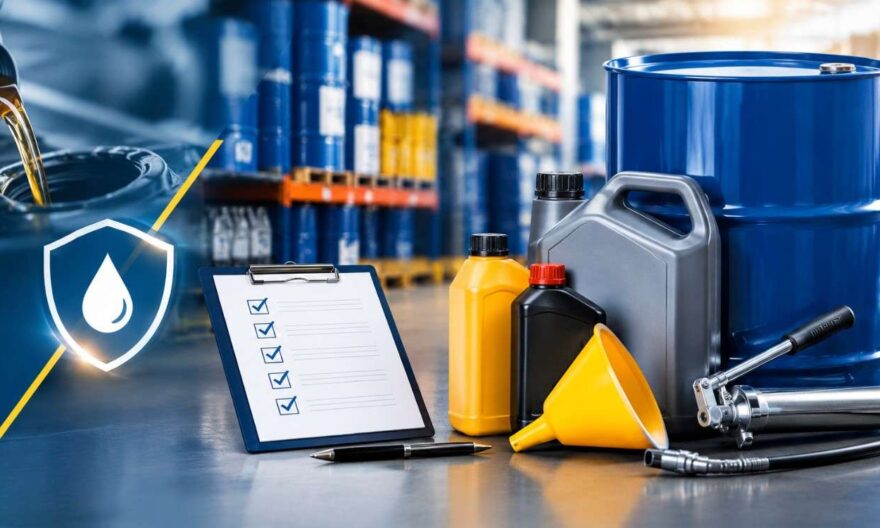
To store industrial lubricants safely, keep them in a clean, dry, temperature-controlled environment away from direct sunlight, moisture, and contaminants. Use clearly labelled containers, follow FIFO (first in, first out) rotation, and inspect stock regularly for signs of degradation. Proper storage preserves viscosity, prevents oxidation, and reduces the risk of costly product waste or equipment failure.
Poor lubricant storage is one of the most overlooked causes of equipment failure in industrial facilities. If you manage a warehouse or maintenance store, the way you handle industrial lubrication products directly affects their performance — and your bottom line. This checklist gives you a clear, actionable framework to store lubricants correctly from the moment they arrive at your facility to the point of use.
Why Proper Lubricant Storage Actually Matters
Lubricants don’t last long on the shelf. Grease and oil products can start to break down when exposed to heat, moisture and dust and even UV light. Industry guidance from the Society of Tribologists and Lubrication Engineers (STLE) states that many lubricants have a shelf life of only 12 to 24 months—and that clock begins at the time they leave the manufacturer.
Improper storage not only reduces shelf life. It promotes contamination that kills bearings, seals and gearboxes before a fault is even visible. For the facilities manager that translates into hidden costs of lubricant being scrapped and downstream equipment repair.
Industrial Lubricant Storage Checklist
1. Assign a Dedicated Storage Area
Never store lubricants alongside chemicals, cleaning agents, or solvents. Cross-contamination from vapours or accidental mixing is a real risk in shared storage rooms.
- Choose a cool, dry indoor space with controlled humidity
- Keep the area away from boilers, furnaces, or heat-generating equipment
- Ensure the floor is sealed or has drip containment trays for spill management
- Restrict access to trained personnel only
2. Control Temperature and Humidity
Temperature fluctuations are one of the leading causes of lubricant degradation. Oils exposed to repeated heating and cooling cycles can develop moisture condensation inside sealed drums — even when the lid is on.
- Maintain storage temperature between 10°C and 25°C where possible
- Avoid areas with direct sunlight or open ventilation that brings in humid air
- For greases, high temperatures can cause oil separation (bleeding), which permanently alters consistency
- Use a thermometer and hygrometer in the storage room to monitor conditions year-round
3. Store Drums Horizontally (When Appropriate)
This is a point many facilities managers get wrong. If drums are stored vertically outdoors or in areas with temperature variation, the bung area expands and contracts — pulling in air and moisture with each cycle.
- Store drums horizontally with the bungs at the 3 and 9 o’clock positions to keep them submerged in the oil
- If vertical storage is necessary, use drum covers or bung seals to prevent ingress
- Never store drums directly on bare concrete — use wooden pallets or steel racks to allow airflow and prevent floor moisture transfer
4. Label Everything Clearly and Consistently
Lubricant mix-ups are a well-documented cause of equipment failure. Using the wrong grade of oil or grease — even once — can void warranties and cause bearing damage that isn’t immediately visible.
- Label every container with product name, grade, viscosity, arrival date, and expiry date
- Colour-code dispensing equipment (funnels, pumps, grease guns) per lubricant type
- Never reuse unlabelled containers or transfer products to unbranded drums
- Keep a lubricant register that matches equipment requirements to approved products
5. Implement FIFO Stock Rotation
First In, First Out is not just a food warehouse principle — it is essential for storing industrial lubricants safely. Older stock left at the back of the shelf often expires before it’s used, resulting in write-offs and potential equipment risk if the degraded product is applied unknowingly.
- Place newer deliveries behind existing stock
- Clearly mark “use by” dates on all containers at the point of receipt
- Conduct monthly stock checks to identify and quarantine any product nearing expiry
- Work with your supplier to align order quantities with realistic consumption rates
6. Use Clean, Dedicated Dispensing Equipment
The dispensing stage is where contamination most commonly enters the lubricant. A dirty funnel, a shared grease gun, or an uncovered pump left near grinding operations can introduce particles that cause abrasive wear inside machinery.
- Use dedicated pumps, funnels, and transfer containers for each lubricant type
- Cap or cover dispensing equipment when not in use
- Clean dispensing tools before and after use — do not wipe with rags that may leave lint or grit
- Fit drum pumps with desiccant breather caps to keep moisture out during draw-down
7. Know Your Shelf Life Limits by Product Type
Not all lubricants age at the same rate. Knowing typical shelf life helps you plan stock levels and order cycles more accurately.
| Lubricant Type | Typical Shelf Life (Sealed) | Key Storage Risk
|
|---|---|---|
| Mineral oils | 3–5 years | Oxidation if exposed to air |
| Synthetic oils | 3–5 years | Additive separation in cold storage |
| Greases | 12–24 months | Oil bleed, hardening, or softening |
| Cutting fluids / coolants | 12 months | Microbial growth in diluted form |
| Biodegradable lubricants | 12–18 months | Faster degradation in warm conditions |
8. Comply with Safety and Regulatory Requirements
In India, the storage and handling of lubricants — particularly petroleum-based products — falls under the Petroleum Act, 1934, and the Petroleum Rules, 2002, which set out licensing thresholds, storage quantity limits, and facility requirements. Facilities storing lubricants above specified quantities may require a licence from the Petroleum and Explosives Safety Organisation (PESO).
- Keep Safety Data Sheets (SDS) accessible for every product stored
- Ensure fire extinguishers and spill kits are available in the storage area
- Maintain ventilation to prevent vapour build-up from volatile base oils
- Train staff on emergency spill response procedures
9. Conduct Regular Condition Checks
Visual inspections take minutes but catch issues before they become expensive. Get your team into the habit of checking stored lubricants during routine warehouse walks.
- Look for cloudy or discoloured oil — a sign of water contamination
- Check grease for oil pooling or changes in texture
- Inspect seals, bungs, and lids for damage or corrosion
- Record findings in the lubricant register and flag any suspect stock for disposal
Quick-Reference Storage Checklist Summary
- Dedicated, dry, temperature-controlled storage room assigned
- Drums stored horizontally with bungs sealed
- All containers labelled with product, grade, and expiry date
- FIFO rotation system in place and followed
- Dedicated, colour-coded dispensing equipment per lubricant type
- Shelf life limits tracked for each product category
- SDS sheets accessible and staff trained on spill response
- Monthly condition checks conducted and logged
Getting Your Storage Right Before You Order
One practical step often skipped: audit your storage setup before placing a bulk order. Facilities that invest in proper racking, breather caps, and labelling systems consistently report lower lubricant wastage and fewer unplanned equipment stoppages. The storage investment pays for itself quickly when you consider the cost of a single bearing replacement or a drum of contaminated oil written off.
If you’re reviewing your lubricant supply chain, Neotech EPL offers a range of industrial-grade chemicals and lubricants suited to demanding facility environments. Explore the full product range to match the right product to your equipment and storage capabilities.
Frequently Asked Questions
What is the ideal temperature for storing industrial lubricants?
The ideal storage temperature for most industrial lubricants is between 10°C and 25°C. Temperatures above 30°C accelerate oxidation and additive breakdown, while freezing temperatures can cause wax crystallisation in mineral oils and consistency changes in grease.
How long can you store industrial lubricants before they expire?
Mineral and synthetic oils typically last 3 to 5 years in sealed containers. Greases have a shorter shelf life of 12 to 24 months. Biodegradable lubricants and cutting fluids degrade faster and should be used within 12 to 18 months of manufacture.
Should lubricant drums be stored vertically or horizontally?
Drums are best stored horizontally with bungs positioned at 3 and 9 o’clock. This keeps the bung submerged in oil, preventing air and moisture from entering through the seal. If vertical storage is unavoidable, always fit sealed bung caps or drum covers.
How do you prevent lubricant contamination during storage?
Use dedicated, colour-coded dispensing equipment for each lubricant type. Keep containers sealed when not in use, fit drum pumps with desiccant breather caps, and store products away from dust, water, and chemical vapours. Regular visual inspections help catch contamination early.
Is there a legal requirement for storing lubricants in India?
Yes. The Petroleum Act, 1934, and Petroleum Rules, 2002, govern the storage of petroleum-based lubricants in India. Facilities storing above defined quantity thresholds may require a licence from PESO. Always keep Safety Data Sheets on-site and maintain compliant storage conditions.
What is FIFO and why does it matter for lubricant storage?
FIFO stands for First In, First Out — a stock rotation method where older inventory is used before newer stock. For lubricants, it prevents products from sitting past their shelf life and being unknowingly applied to equipment, which can cause premature wear or failure.