

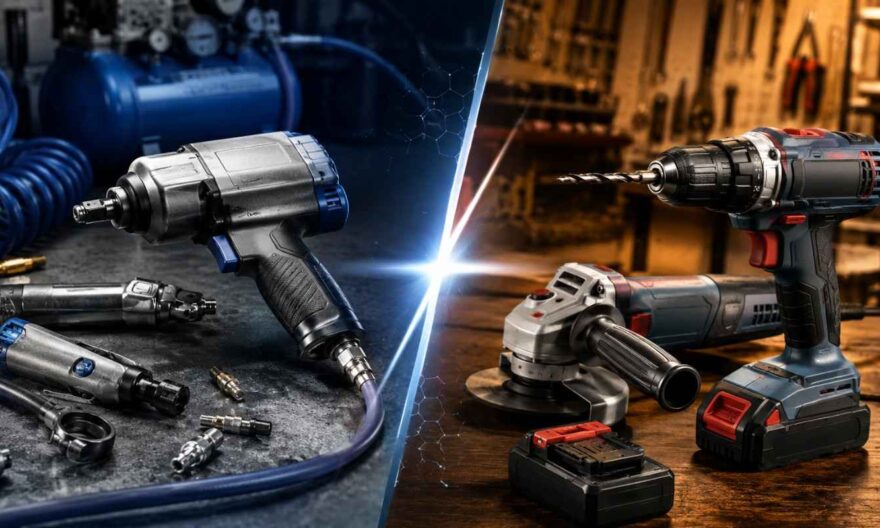
Usually pneumatic tools are more appropriate for workshops using them in continuous, high volume work where consistent power and durability are important. They run on compressed air, meaning they are lighter and more powerful for their size than most electric options. Electric tools have more portability and easier set up. The decision is based on your workflow, your space and the intensity of use of your equipment.
If you run a workshop in Singapore — whether it’s an auto repair bay, fabrication shop, or assembly line — choosing between pneumatic and electric tools is one of the most consequential buying decisions you’ll make. It affects your running costs, maintenance schedule, operator fatigue, and output quality. Pneumatic tools Singapore buyers are increasingly comparing both options before committing, and for good reason. The answer isn’t always obvious.
Let’s break it down properly.
How Each Tool Type Works
What Are Pneumatic Tools?
Pneumatic tools, also called air tools, are powered by compressed air delivered through a hose connected to an air compressor. Inside the motor is air driven, so there is no electric motor to overheat. Examples include air impact wrenches, air ratchets, air drills, spray guns and nail guns.
The tool is lightweight and compact as the power source (the compressor) is separate from the tool. That’s a significant advantage when you’re working overhead or in tight engine bays for hours on end.
What Are Electric Tools?
Electric tools can be powered from mains (cords) or by rechargeable batteries (cordless). They’re self contained, the motor is incorporated into the tool body. This makes them very portable, especially the cordless variants, but adds weight and heat build up under sustained use.
Corded Electric Tools Are Constantly Powered. The freedom of movement provided by cordless tools is offset by the fluctuating battery charge levels during periods of heavy use.
Pneumatic Tools vs Electric Tools: Head-to-Head Comparison
| Factor | Pneumatic Tools | Electric Tools
|
|---|---|---|
| Power Output | Higher torque-to-weight ratio | Moderate; varies by motor size |
| Weight | Lighter (no internal motor) | Heavier, especially cordless |
| Heat Buildup | Minimal — air cools as it expands | Higher under continuous use |
| Setup Requirement | Requires air compressor + hose | Plug-in or battery only |
| Portability | Limited by hose length | High, especially cordless |
| Maintenance | Simple — regular oiling, filter checks | Moderate — motor and battery upkeep |
| Upfront Cost | Lower per tool; compressor adds cost | Higher per tool for quality units |
| Long-Term Durability | Very high in industrial settings | Good, but batteries degrade |
| Best Environment | Fixed workshops, production floors | Field work, mobile use, home workshops |
Where Pneumatic Tools Outperform Electric
High-Torque Applications
For jobs that require raw, consistent torque—such as breaking stubborn lug nuts, driving big fasteners or running impact wrenches on heavy machinery—pneumatic tools deliver more consistent performance. An air impact wrench can deliver torque without thermal throttling, which is something electric motors are more prone to during extended use.
That is why air impact wrenches are still the norm in Singapore’s automotive workshops for tyre changes and engine work – they don’t lose momentum halfway through a job.
All-Day Use Without Overheating
In a busy shop where tools are running eight to ten hours a day, heat control becomes important. Pneumatic tools run cool . The expanding compressed air that drives the mechanism cools naturally . Electric tools , especially if used continuously , can trip thermal protection cutoffs or just wear out faster .
That is why fabrication shops, tyre workshops and assembly operations tend to standardize on air tools for their main workstations.
Lower Cost Per Tool in a Multi-Tool Setup
If your shop has multiple types of tools — wrenches, grinders, drills, spray guns — the pneumatic version of each costs a lot less than an electric model of comparable quality. Once you have a good compressor, each additional air tool is a relatively inexpensive addition.
In many cases, a mid-range air compressor that can handle six to eight tools is more economical over a three-year period than buying six to eight premium cordless tools with battery packs.
Where Electric Tools Have the Edge
Portability and On-Site Work
If you’re working outside a fixed workshop — on construction sites, in customer locations, or in areas without a compressor — electric tools are the practical choice. Cordless drills, circular saws, and angle grinders give tradespeople the freedom to work anywhere without dragging hoses or setting up compressors.
Precision Control in Finishing Work
Some electric tools, particularly variable-speed drills and sanders, offer finer speed control than pneumatic equivalents at the lower end of the RPM range. For delicate finishing work, woodworking, or applications requiring precise torque settings, a quality electric drill with an electronic clutch can outperform a basic air tool.
Simpler Setup for Occasional Use
If you only use a tool a few times a week, setting up and maintaining a compressor may not be worth the effort. A cordless drill or electric sander is ready in seconds. For hobbyists or small home workshops with light usage patterns, electric tools are often the more practical fit.
Key Considerations for Singapore Workshop Owners
Space and Ventilation
Singapore workshops — particularly in industrial estates in areas like Tuas, Jurong, or Ubi — tend to operate in enclosed spaces. Pneumatic tools don’t generate electrical sparks, which makes them safer in environments where flammable substances like oils, solvents, or paints are present. This is a meaningful safety advantage that’s often overlooked in the tool type debate.
Power Supply Reliability
Compressed air systems are not affected by power fluctuations the way electric tools can be. For workshops running sensitive equipment alongside heavy tools, separating the air tool supply from the electrical grid reduces the risk of power interference or tripped circuits.
Noise Regulations
Under Singapore’s Environmental Protection and Management Act, industrial noise levels are regulated. Both tool types generate noise, but compressor placement and tool selection both affect overall noise output. In shared industrial buildings, pneumatic tools with proper compressor isolation can sometimes be managed more predictably than high-draw electric tools.
Which Should You Choose?
There’s no universal answer, but the decision framework is straightforward:
- Choose pneumatic tools if you run a fixed workshop with daily heavy use, multiple operators, or work with automotive, fabrication, or industrial applications.
- Choose electric tools if you need portability, work across multiple sites, or have a low-volume operation where compressor setup isn’t practical.
- Consider a hybrid approach — many professional workshops use pneumatic tools as their primary workstation equipment and keep a set of cordless electric tools for mobile or supplementary tasks.
The most productive workshops don’t treat this as an either/or choice. They match the tool type to the task.
Finding the Right Pneumatic Tools in Singapore
For workshop owners ready to invest in pneumatic tools, sourcing from a reliable supplier with genuine product ranges and after-sales support matters as much as the tool itself. Chee Fatt Co. (Pte) Ltd has been supplying industrial tools and equipment in Singapore for decades, offering a curated range of pneumatic tools suited for professional workshop environments. Explore their full pneumatic range at Chee Fatt to find the right fit for your setup.
FAQ: Pneumatic Tools vs Electric Tools
Are pneumatic tools better than electric tools for workshops?
For fixed, high-volume workshops, pneumatic tools generally offer better durability, higher torque, and lower long-term costs. Electric tools are more practical for portable or occasional use. The best choice depends on your workshop’s daily workload and setup.
Do pneumatic tools require a lot of maintenance?
Pneumatic tools are relatively low-maintenance. Regular lubrication with air tool oil, moisture trap checks, and filter cleaning are the primary requirements. They have fewer moving parts than electric motors, which means less mechanical wear over time.
Are pneumatic tools safe to use indoors in Singapore?
Yes, pneumatic tools are considered safer than electric tools in environments with flammable materials since they produce no electrical sparks. Ensure proper compressor ventilation and follow standard workshop safety protocols as required under Singapore’s Workplace Safety and Health Act.
What air compressor do I need for pneumatic tools?
The compressor you need depends on the tools you plan to run simultaneously. Check each tool’s CFM (cubic feet per minute) requirement and select a compressor with at least 25–30% more CFM capacity than your total demand to ensure consistent air pressure.
Can I use pneumatic tools for automotive work in Singapore?
Absolutely. Pneumatic tools are the preferred choice in Singapore’s automotive workshops for tyre changes, engine work, and body repairs. Air impact wrenches and air ratchets are standard equipment in most professional garages due to their speed, power, and reliability.
Where can I buy pneumatic tools in Singapore?
You can purchase pneumatic tools from industrial tool suppliers in Singapore that carry professional-grade brands. Look for suppliers offering product warranties, technical support, and a broad range of air tool categories to match your specific workshop requirements.