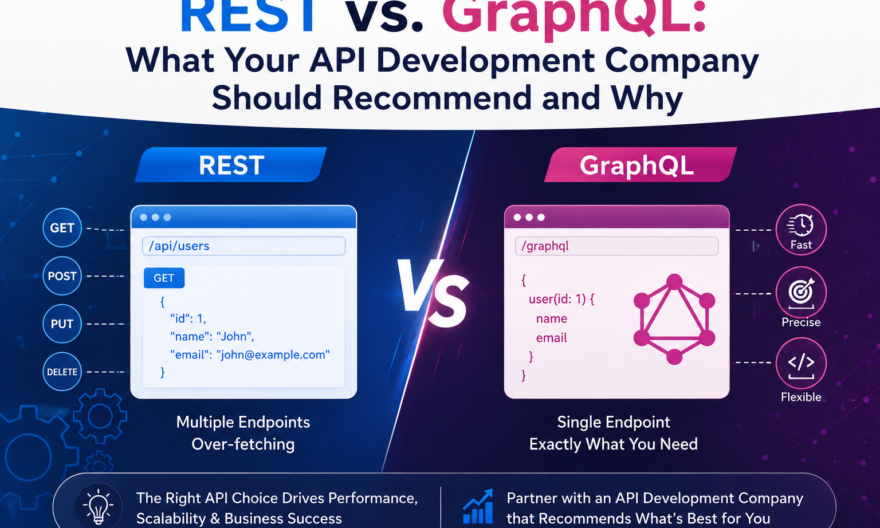
As an API development service provider, we often see businesses weighing REST against GraphQL when building a new application or modernizing an existing one.
Both can support reliable communication between applications and backend services, but they are designed around different approaches to accessing and delivering data.
Though REST and GraphQL are also not the only API approaches available today, but they remain two important options for modern web, mobile, SaaS, and enterprise applications.
So, which one should a business choose? Well,there is no universal winner here. The right approach depends on the application’s data, consumers, integrations, performance requirements, and how the API is expected to evolve.
Here is how we, at Synexc, look at the decision as an API development company.
REST and GraphQL: What’s the Difference?
REST organizes an API around resources such as customers, orders, products, or accounts. Different endpoints are used to access or modify those resources using standard HTTP methods such as GET, POST, PUT, and DELETE.
For example, a customer application might have separate endpoints for retrieving customer information, orders, and support tickets. The structure is familiar and predictable, which makes REST straightforward to build, document, test, and integrate.
GraphQL, on the other hand, takes a different approach. Instead of relying on fixed responses from different endpoints, it allows clients to request the specific data they need through a defined schema.
Consider a customer dashboard that needs customer details, recent orders, product information, and support tickets. With REST, the frontend may need to call several endpoints to assemble that information. With GraphQL, those related fields can be requested through a single query.
This can help reduce over-fetching, where an API returns more information than the client needs, and under-fetching, where the client needs additional requests to obtain related information.
The simple difference is this: REST gives clients predefined resources, while GraphQL gives clients more control over the data they receive.
When REST Makes More Sense
REST is still a strong choice when an application’s data and API requirements are relatively straightforward.
It can work particularly well for:
- Business applications with standard CRUD operations
- Public and partner-facing APIs
- Third-party integrations
- Resource-based microservices
- Applications that benefit from HTTP caching
- Systems with predictable data requirements
REST’s simplicity is often its biggest advantage. Developers and external consumers are already familiar with its conventions, which can make APIs easier to build and integrate.
It also fits naturally into the wider HTTP ecosystem. Standard HTTP methods, status codes, authentication mechanisms, caching, monitoring tools, API gateways, and security controls can all be incorporated into a REST architecture.
For businesses exposing APIs to external partners or customers, this familiarity can also make adoption easier. Developers can understand the available resources and operations without having to learn a separate query language.
Modern REST APIs can use OpenAPI to define and document endpoints, parameters, request and response structures, and authentication requirements. This provides a clear contract between the API and its consumers while retaining REST’s relatively simple operating model.
For many enterprise applications, integrations, and internal services, that simplicity is more valuable than adding additional flexibility that the application may not actually need.
When GraphQL Makes More Sense
GraphQL can be a better fit when applications deal with complex data or when different clients need different information.
For example, a business may have a web application, mobile application, and internal dashboard using the same backend. Each client may need a different combination of customer, product, order, and account information.
With a traditional REST design, this can sometimes lead to multiple endpoints or responses containing more data than a particular client needs. GraphQL allows each client to request the fields it actually needs.
GraphQL is often useful for:
- Applications with interconnected data
- Multiple clients with different requirements
- Mobile and web applications
- Applications that combine data from several services
- Products where frontend requirements change frequently
Its schema also provides a structured contract between the API and its consumers. As requirements change, teams can add fields or deprecate existing ones rather than creating a new endpoint for every variation.
However, GraphQL’s flexibility does not mean that it is automatically better or faster. Complex queries can increase the load on backend services. Production implementations therefore need to consider query depth, query cost, authorization, caching, batching, and resolver performance.
In other words, GraphQL can give clients more control, but that control needs to be managed properly on the server side.
What Should an API Development Company Consider While Recommending?
As an API Development Company, we don’t recommend REST or GraphQL simply because one is more popular. We start with the application and look at the following scenarios to determine the right API approach
-
Who will use the API?
If the API will be consumed by external developers, partners, or systems with predictable requirements, REST may provide the simplicity and compatibility they need.
If several applications require different views of the same underlying data, GraphQL may offer greater flexibility.
-
How complex is the data?
Straightforward resources such as customers, orders, products, or invoices often fit naturally into REST.
If clients frequently need related information across multiple resources or backend systems, GraphQL can provide a more flexible way to retrieve that data.
-
How important is caching?
REST works naturally with standard HTTP caching mechanisms, which can be useful when the same resources are requested repeatedly.
GraphQL can also be cached, but caching usually requires a more specific strategy because different queries can request different combinations of fields.
-
How often will requirements change?
If the API serves stable and predictable requirements, REST may be all that is needed.
If multiple clients have changing interfaces and frequently need different data, GraphQL’s client-controlled queries can be valuable.
-
What already exists?
This is an important consideration for businesses modernizing existing systems.
There is no need to replace a working REST architecture simply to introduce GraphQL. GraphQL can also work as a layer over existing services, allowing newer applications to access data through a more flexible interface while existing REST services continue operating underneath.
This can make a hybrid approach practical when different parts of an application have different requirements.
REST vs. GraphQL: Synexc’s Recommendation
There is no universal REST-versus-GraphQL winner. Our recommendation is:
- Choose REST when simplicity, predictable resources, straightforward integrations, and established HTTP capabilities are the priorities.
- Consider GraphQL when clients need flexible access to complex or interconnected data and greater control over the response is valuable.
And sometimes, both make sense. Different parts of an application can use different approaches based on what they need.
The goal is not to choose the API technology with the longest feature list. It is to choose the approach that solves the problem without adding unnecessary complexity.
At Synexc, we approach API development in the same way. We first understand the application’s requirements, its consumers, existing systems, integration needs, and future roadmap before recommending an architecture.
If you’re planning a new API or rethinking an existing one, we’d be happy to help you find the approach that fits.