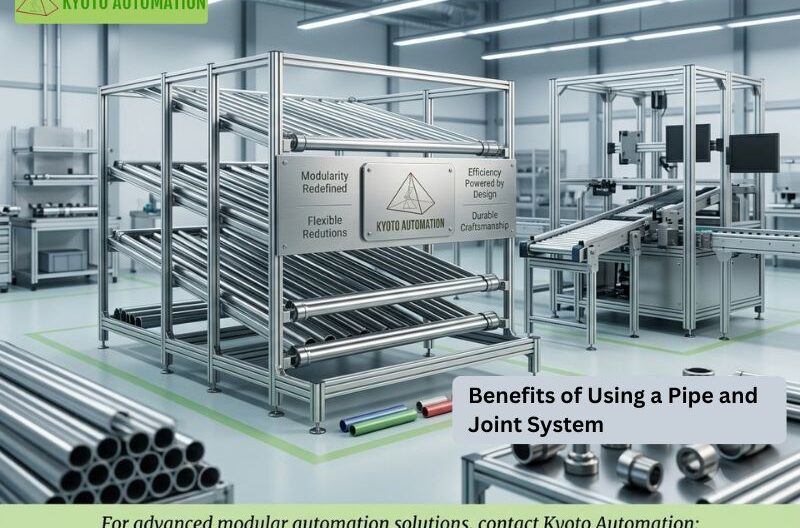
A pipe and joint system is a modular assembly system that consists of aluminium or steel pipes linked together by standardised joints. It enables manufacturers to construct, modify and enlarge workstations, racks and trolleys without the need for welding or special tools. What emerges is a flexible, cost effective infrastructure that can effortlessly be used for lean manufacturing, and adjust rapidly to evolving production requirements.
If you work in manufacturing, you already know the pressure – tighter deadlines, shifting layouts, rising material costs. The way your facility is set up either supports your team or slows it down. That is where a well-designed pipe and joint system earns its place on the floor.
Why Manufacturing Facilities Are Switching to Pipe and Joint System
Traditional welded frames and fixed workbenches made sense when production lines never changed. Today, most manufacturers deal with product changeovers, seasonal demand, and continuous improvement cycles. Rigid infrastructure simply cannot keep up. Modular pipe and joint systems fill that gap – and they do it without heavy capital investment.
Here are the ten most impactful benefits manufacturers experience when they make the switch.
1. Rapid Reconfiguration Without Downtime
Production requirements shift. A pipe and joint system lets your team disassemble and rebuild workstations in hours, not days. No welding, no fabrication lead times, no contractor fees. You simply loosen the joints, reposition the pipes, and lock everything back in place.
This is especially valuable during product launches or line balancing exercises, where layouts need to change quickly without halting output.
2. Direct Support for Lean Manufacturing Principles
Lean manufacturing is built on waste elimination — and physical clutter, inefficient layouts, and oversized workstations are all forms of waste. Pipe and joint systems are a practical tool for applying lean thinking on the factory floor.
You can build exactly what the process needs — no more, no less. Custom-sized trolleys, point-of-use racks, and ergonomic workstations all become achievable without relying on off-the-shelf furniture that rarely fits your exact workflow.
3. Lower Total Cost of Ownership
Buying standard industrial shelving or welded frames looks cheaper upfront — until you need to modify them. With a modular system, the components you buy today can be reused in a completely different configuration next year. Nothing is scrapped. Nothing is wasted.
Over a three-to-five-year lifecycle, the cost savings from reusability and in-house assembly typically outweigh the initial investment several times over.
4. Faster Setup of Modular Workstations
Building modular workstations from a pipe and joint system requires no specialised trades. Your own maintenance or engineering team can handle it with standard hand tools. Assembly instructions are straightforward, and standardised components mean fewer ordering errors.
For growing facilities or new production lines, this speed-to-setup advantage directly reduces project timelines and commissioning costs.
5. Improved Ergonomics and Worker Safety
One of the most overlooked benefits is the ability to customise height, angle, and reach zones for each workstation. With fixed furniture, workers adapt to the equipment. With a pipe and joint system, the equipment adapts to the worker.
Proper ergonomics reduces musculoskeletal strain, lowers absenteeism, and improves output quality – benefits that compound over time across a large workforce.
6. Scalable Industrial Storage Solutions
Whether you need a single parts rack or a full warehouse shelving structure, the same components scale to fit. Industrial storage solutions built with pipe and joint systems can be extended vertically or horizontally as your inventory grows – without purchasing an entirely new system.
This scalability is particularly useful for manufacturers in Malaysia who are expanding production capacity without committing to large capital expenditures on fixed storage infrastructure.
7. Enhanced Visual Management and 5S Compliance
5S methodology – Sort, Set in Order, Shine, Standardise, Sustain – is easier to implement when your physical environment is modular and organised. Pipe and joint systems support clear zoning, labelled racks, and dedicated storage locations that align directly with 5S requirements.
Visual management boards, shadow boards, and tool holders can all be integrated into the same framework, creating a cohesive and audit-ready workspace.
8. Compatibility With Automation and Digital Integration
Modern manufacturing is moving towards smart factory setups. Pipe and joint frameworks can be designed to accommodate sensor brackets, cable management channels, barcode scan points, and light curtain mounts – all built into the same modular structure.
This makes it far easier to retrofit automation into existing lines without needing to rebuild the surrounding infrastructure from scratch.
9. Durable Construction With Long Service Life
Quality pipe and joint systems use powder-coated aluminium or steel pipes paired with precision-engineered plastic or metal joints. This combination handles daily industrial use — vibration, load stress, humidity — without corroding or weakening over time.
Unlike MDF or chipboard-based furniture, the structural integrity of a well-built pipe system does not degrade with cleaning, temperature changes, or repeated reconfiguration.
10. Supports Continuous Improvement Culture
Kaizen — continuous improvement — requires a work environment that can change as ideas are tested and implemented. Rigid infrastructure is the enemy of kaizen. A pipe and joint system removes the physical barrier between an idea and its implementation.
When floor teams can physically redesign their own workspace in response to process improvements, the culture of improvement accelerates. Ideas move from whiteboard to reality without waiting weeks for fabrication approvals.
Comparing Pipe and Joint System to Traditional Alternatives
| Feature | Pipe and Joint System | Welded Steel Frame | Standard Shelving Units
|
|---|---|---|---|
| Reconfiguration Speed | Hours | Days to weeks | Limited |
| Upfront Cost | Moderate | High | Low to moderate |
| Long-Term Reusability | High | Low | Moderate |
| Ergonomic Customisation | Full | Fixed | Minimal |
| 5S and Lean Compatibility | Excellent | Poor | Moderate |
| In-House Assembly | Yes | No (requires trades) | Yes (limited) |
What to Look for When Selecting a Pipe and Joint System
Load Capacity and Pipe Diameter
Match your pipe diameter to the load requirements of each application. Light assembly lines and parts flow racks can use 28mm pipes, while heavier trolleys and storage structures may require 42mm or thicker profiles. Always verify load ratings before building.
Joint Variety and Connector Range
The richer the connector range, the more versatile your builds. Look for suppliers that offer multi-directional joints, adjustable angle connectors, and end caps — not just basic T and elbow joints. A limited joint catalogue will restrict your design options.
Supplier Support and Local Availability
For manufacturers in Malaysia, sourcing from a local supplier matters. Lead times, technical support, and the ability to visit a showroom or request samples all affect how quickly you can complete builds and resolve issues on the floor.
Kyoto offers a comprehensive range of pipe, metal joint, and accessories suited to industrial and manufacturing environments. Their product range supports facilities looking to implement lean setups, build out modular workstations, or expand industrial storage quickly and cost-effectively. Visit Kyoto to explore their full catalogue and speak with their technical team.
Frequently Asked Questions
What is a pipe and joint system used for in manufacturing?
A pipe Joint system is used to create a Modular workstation, Trolley, Racks & Storage Frames on the factory floor. It enables structure assembly and reconfiguration without welding and helps to promote lean manufacturing and continuous improvement programs while minimizing downtime.
How does a pipe and joint system support lean manufacturing?
It helps implement lean manufacturing by allowing all workstations to be customized to the right size, with the right tools, and no wasted motion, space, or materials. Since the system is a modular-type, layouts can be changed rapidly during Kaizen events or line rebalancing without the need of new equipment purchase, nor involve trades.
Are pipe and joint systems suitable for heavy-duty industrial use?
Yes. Steel pipes with reinforced metal joints can be used for large loads. Proper selection of pipe diameters and joint types will ensure structural integrity in each of the applications. Please check load ratings with your supplier prior to deployment in high stress environments.
How long does it take to build a workstation using a pipe and joint system?
Basic hand tools can usually assemble a standard single workstation in 2-4 hours. More complicated multi-level structures can require an entire day. Once an in-house team knows the parts, they are capable of carrying out most builds.
What is the difference between aluminium and steel pipe systems?
Aluminium pipes are lighter, easier to handle and corrosion resistant – perfect for food adjacent or clean environments. Steel pipes have more load capacity and rigidity for heavy load applications. The decision should be based on load requirements, environment, as well as how often the structure will be reconfigured.
Can pipe and joint systems be expanded after initial installation?
Yes. One of the key advantages of modular systems is expandability. You can add sections, increase height, or connect new modules to an existing structure using the same standardised components – without needing to replace or modify what is already built.