Concrete roofs give obvious signs of trouble before a minor leak progresses to a costly structural issue. Any water stains, surface cracks, peeling paint or moisture on interior ceilings are clues your roof is crying out for help now. By hiring the services of a trusted waterproofing contractor kuala lumpur early, you can stop water from causing damage to your building’s structure that will be irreparable.
The concrete roof in Malaysia is also subjected to a tremendous amount of stress throughout the year, due to the tropical climate especially in Klang Valley with an average annual rainfall exceeding 2,500mm. When it comes to getting water out of your ceiling, most building owners will only call for help after water has already been dripping through the ceiling. By that time the damage is so profound that a surface fix will not suffice.
These are the seven signs you should use as your warning system. Know how to identify them and they’ll be preventable before they become a full-scale renovation.
Why Concrete Roofs Are Vulnerable in Malaysia’s Climate
Concrete is a porous material. As the years go on, thermal expansion due to heat cycles, UV degradation and unrelenting monsoon rains lead the surface to micro-crack. Water enters those cracks, infiltrates the slab, and starts eating away the slab from the inside. Even if the building is well built, if it is not properly waterproofed with concrete roof, it will not last long in humid climate such as Kuala Lumpur which is around 12 years.
The problem escalates rapidly. The corrosion of the steel reinforcement bars (rebar) in concrete creates rusted, expanded rebar, a process known as concrete spalling. The resulting internal pressure further cracks the slab, continuing the failure process.
Sign 1: Water Stains or Damp Patches on Interior Ceilings
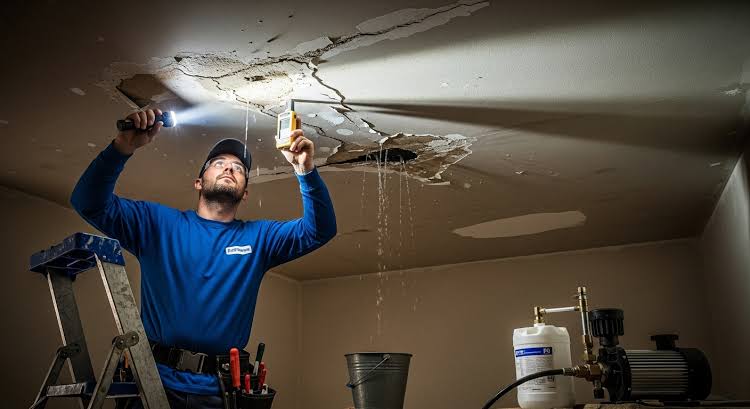
This is the first thing that they see and the longest that most people will ignore. Water has already permeated your concrete slab above if there is a yellowish-brown stain on the ceiling. It has infiltrated the building and absorbed into your walls (plaster or drywall).
Do not paint over it. That only hides the symptom. The source — a compromised waterproof membrane or cracked slab — continues to allow water ingress every time it rains. By the time you see staining, water has likely been accumulating inside the structure for weeks.
Sign 2: Visible Cracks on the Roof Surface
Not all cracks are equal, but none should be ignored on a concrete roof. Hairline cracks (under 0.3mm) may seem harmless, but in Malaysia’s wet season, they channel water directly into the slab. Wider structural cracks — especially those running across expansion joints or near the parapet wall — are red flags requiring immediate assessment.
Cracks commonly appear:
- Along the roof perimeter near drainage outlets
- Around embedded fixtures like pipes or AC condenser bases
- At the junction between the roof slab and parapet wall
- Across the flat surface in a network pattern (map cracking)
Each of these locations is a point of weakness where roof leakage repair in KL is most frequently required.
Sign 3: Efflorescence — White Powdery Deposits on Concrete
If you see white or chalky powder forming on your roof surface or on exterior walls below the roofline, that is efflorescence. It occurs when water moves through concrete, dissolves soluble salts, and deposits them on the surface as the water evaporates.
Efflorescence itself does not damage concrete, but what it signals is serious: active water movement through your slab. It confirms that moisture is consistently passing through the structure — often pointing to a failed or absent waterproof membrane beneath the surface.
Sign 4: Peeling Paint or Bubbling Waterproof Coating
A waterproof coating that bubbles, peels, or flakes is no longer doing its job. This typically happens when moisture trapped beneath the coating has nowhere to escape. The pressure builds until it lifts the membrane from the substrate.
This is a common failure mode for older acrylic or bitumen-based coatings applied without proper surface preparation. Once delaminated, these coatings create pockets where standing water accumulates — accelerating deterioration of the concrete below. Reapplying a new coat over a failing one without stripping and repairing the surface is a short-term fix that will fail again within one to two rainy seasons.
Sign 5: Rust Stains or Exposed Rebar on the Roof Surface
Brown or orange rust streaks running across your concrete roof indicate that the steel reinforcement inside has started to corrode. This is one of the most serious signs on this list. Once rebar rusts, it expands and pushes apart the surrounding concrete — a process that is irreversible without structural repair.
In Kuala Lumpur’s humid conditions, rebar corrosion can advance rapidly once water penetration reaches the steel. According to CIDB Malaysia (Construction Industry Development Board), carbonation and chloride-induced corrosion are among the leading causes of premature concrete deterioration in Malaysian buildings. If you can see rust staining or actual rebar exposure, call a waterproofing contractor immediately — structural assessment may also be needed.
Sign 6: Pooling Water After Rain
A properly designed flat concrete roof should drain completely within minutes of rainfall stopping. If water is still pooling hours later, your drainage is compromised or the roof surface has settled unevenly over time.
Standing water dramatically increases hydrostatic pressure on the slab. Even a membrane in good condition degrades faster under constant submersion. Over months and years, this accelerates micro-cracking and forces water into every available path. Check your roof after the next heavy rain. If puddles remain more than 30 minutes after rainfall ends, that is a drainage and waterproofing issue that needs professional attention.
Sign 7: Mould, Mildew, or Musty Smell Inside the Building
Mould growth on interior walls or ceilings directly below the roof is a reliable indicator of long-term moisture infiltration. In Malaysia’s warm, humid climate, mould colonies establish within 24 to 48 hours of sustained dampness — making this a fast-moving health and structural concern.
A persistent musty smell even without visible mould suggests moisture is trapped inside wall cavities or ceiling voids. This is particularly common in older shophouses and commercial buildings in Kuala Lumpur where the original waterproof roof system was never maintained or upgraded. Beyond the structural implications, prolonged mould exposure affects indoor air quality and can trigger respiratory issues for occupants.
What Happens If You Ignore These Signs?
Delaying action escalates cost significantly. A waterproofing application on an intact slab might cost a fraction of what a full structural repair involves once rebar corrosion or concrete spalling sets in. Here is a simplified comparison:
| Stage of Damage | Action Required | Relative Cost
|
|---|---|---|
| Early (surface cracks, staining) | Membrane application or coating | Low |
| Intermediate (delamination, pooling) | Surface repair + re-waterproofing | Moderate |
| Advanced (rebar corrosion, spalling) | Structural repair + full waterproofing | High |
| Severe (slab failure) | Partial or full slab replacement | Very High |
The message is straightforward: early intervention keeps both the building and the repair budget intact.
How a Professional Waterproofing Contractor Assesses Your Roof
A qualified contractor does not just apply a coating and leave. A proper assessment involves:
- Visual inspection of the entire roof surface, drainage points, and parapet walls
- Moisture meter testing to detect subsurface dampness not visible to the eye
- Core sampling on older slabs to assess depth of water penetration
- Assessment of existing coating systems to determine adhesion and condition
- Drainage evaluation to identify pooling-prone zones
The right solution depends entirely on what this assessment finds. Blanket applications without diagnosis are a common cause of repeat failures.
Choosing the Right Waterproofing System for Concrete Roofs
Not all waterproofing products perform equally on concrete roofs in tropical climates. Common systems used in Malaysia include:
- Polyurethane (PU) coatings — flexible, UV-resistant, suitable for roofs with moderate movement
- Cementitious waterproofing — rigid or semi-flexible, ideal for new construction or damp areas
- Torch-on bituminous membrane — durable for flat roofs with heavy foot traffic or planter areas
- Crystalline waterproofing — penetrates and self-seals within the concrete matrix, excellent for active water pressure situations
System selection must account for foot traffic, thermal movement, drainage design, and the current condition of the substrate. This is why professional assessment matters before any product is applied.
Real Solutions Waterproofing provides concrete roof waterproofing services across Kuala Lumpur and the Klang Valley, with solutions tailored to both residential and commercial properties. If your roof is showing any of the signs above, getting a professional inspection early is the most cost-effective decision you can make.
Frequently Asked Questions
What is the difference between waterproofing my concrete roof and patching?
If cracks are found, but moisture is not entering, then patching can be used. If, however, water stains are present, there are peeling coatings or multiple cracks, then a complete waterproofing system is required. Fixing leaky parts of the membrane is often not effective for more than one or two monsoons in Malaysia.
What is the service life of concrete roof waterproofing system in Malaysia?
Waterproofing system on a concrete roof is normally lasts from 8 to 15 years if applied professionally depending on the type of waterproofing system used, surface preparation quality and maintenance frequency in Malaysia. In regions with high rainfall, the membranes that are most likely to provide the longest service life will be polyurethane and torch-on.
Is it possible to self-apply a waterproofing to a concrete roof?
There are DIY waterproofing materials on the market, but they aren’t very successful when used on structurally problematic concrete roofs. Do-it-yourself coatings do not last long, unless adequate surface preparation, crack repair and correct application is performed. For complex systems, professional contractors will have the necessary tools and know-how to bond correctly and function over the long term.
Why do concrete roofs leak after waterproofing?
The most frequent issues are inadequate surface preparation prior to application, selection of the wrong product, inadequate pre-treatment of cracks and joints, or re-coating a failing membrane. Over time, coatings that are not designed for tropical climates can also degrade from UV degradation and thermal movement.
The average cost of roof leakage repair in KL is usually around RM 1000 for every 1 m² of the roof surface.
The cost depends on a number of factors such as roof size, damage severity and the type of waterproofing system chosen. Initial waterproofing of an undamaged slab is much cheaper than structural repairs and re-waterproofing. The most reliable method to get a good estimate of costs is to have a pro level site evaluation.
Will waterproofing a concrete roof disrupt building users?
Concrete roof waterproofing is usually done on the outside of the building and doesn’t need the building to be evacuated. Curing times will vary from system to system and are usually between 24 and 72 hours. A professional contractor will help you to determine the best time to schedule to minimise any disruption, especially for commercial properties.