

Shopping malls now compete for attention in a busy world. Bright screens help, yet flat displays often fail to stand out. Many malls struggle to create a strong visual impact that keeps visitors engaged.
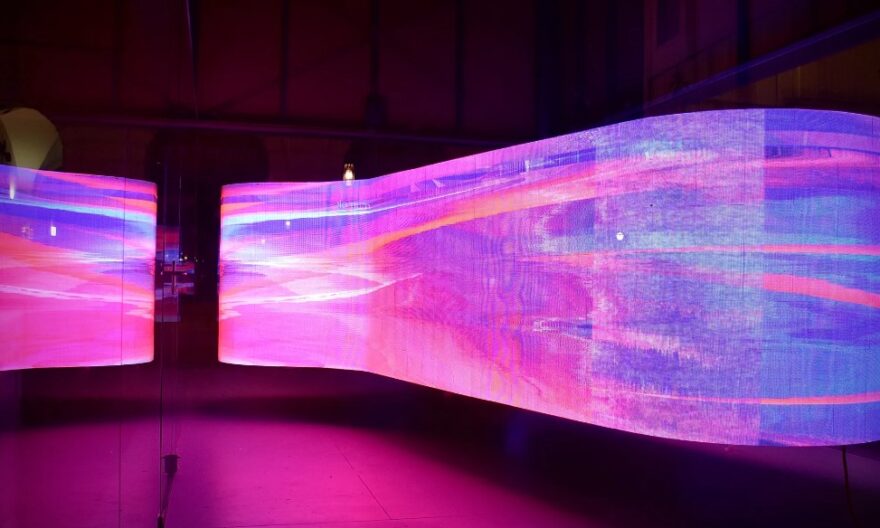
The flexible LED panel screen display system establishes new possibilities for display systems. It bends and curves to match any spatial requirement. The brand achieves exceptional visual results, which create new immersive experiences.
This guide shows you the operational functions of displays and their appropriate application areas and methods for achieving optimal performance.
What Is a Flexible LED Panel Screen Display?
The flexible LED panel screen display exists as an actual direct representation of its name. The LED screen functions as a bending display system.
The panels of these displays use soft modular components which can bend to match the shapes of columns, archways, ceilings and free-standing objects, while traditional flat LED walls use rigid display systems.
There exist two primary types of display systems.
- Soft module panels: These devices have the capability to bend, and they can adapt to handle surfaces that have non-uniform shapes.
- Arc/curved cabinet panels: Pre-set to a fixed curve angle, ideal for permanent installations.
Why Shopping Malls in Singapore Are Switching to Curved LED Screens
Shopping malls in Singapore face strong competition for attention. So, many now use the LED screen curve to stand out.
Here’s why the shift is happening:
- Visibility from multiple angles: A curved screen attracts views from all sides. Even shoppers walking past at an angle can see it clearly.
- Better use of awkward spaces: Malls have columns and curved walls. A flexible LED panel screen display fits these spaces with ease.
- Premium brand impression: Curved screens look modern and high-end. They signal strong design and investment.
Common Placements of Flexible LED Panel Screen Display for Shopping Malls
The accuracy of the location needs to match the visual quality of the display. The following locations show optimal performance for Singapore mall settings.
Entrance Atriums
The atrium is your first impression. The space uses an LED screen curve which stretches around a column and a ceiling arch to create an immediate visual centrepiece.
Escalator Facades
People spend 20–40 seconds on an escalator. The duration provides the audience with essential viewing time. A flexible panel along the escalator shaft holds their gaze with no competition.
Retail Storefront Frames
Individual tenants use curved LED panels to frame their shop entrances. The screen curve gives a modern, boutique feel that draws footfall.
Pillar Wraps
Cylindrical pillars are everywhere in malls. Flexible LED panels create dynamic advertising spaces when they cover cylindrical pillars which exist throughout malls.
Installation: What the Process Looks Like
Many mall operators assume installation is complicated. In practice, a professional team handles most of it.
- Site survey: The supplier assesses your space, measures curves, and checks power supply points
- Structure fabrication: A steel frame is built to match the display shape
- Panel mounting: Flexible modules are attached to the frame and connected
- Calibration: Colour and brightness are calibrated across the full display
- Content system setup: A content management system (CMS) is configured so you can update visuals remotely
Key Specs to Check Before You Buy
There are different types of flexible LED panel screen displays, which do not have the same performance capabilities.
Pixel Pitch
This measurement determines the visibility of images. For close-up viewing (under 3 metres), go for P2 or P2.5. For larger atrium displays, which people will see from distances of 5 metres and beyond, P4 or P6 functions effectively.
Brightness (Nits)
Mall environments have strong ambient lighting. Look for a minimum of 4,000 nits for indoor retail use. The screen becomes washed out when the brightness level falls below this threshold because of ceiling lighting.
Refresh Rate
A refresh rate of 3,840Hz or above prevents flickering on camera. This matters because shoppers film content and share it — free exposure for your mall.
Bending Radius
Each panel has a minimum bending radius. Verify that the required bending radius matches your installation surface. The installation procedure creates damage because modules will break when a panel is forced to exceed its specified bending limit.
IP Rating
For entrance areas near doors, look for at least IP54. The system protects against both dust particles and intermittent water splashes.
How to Choose the Right Supplier in Singapore
Singapore has many LED display suppliers. Yet, the real difference comes down to a few key factors.
- After-sales support: LED panels wear over time. So, check warranty terms and how fast they fix or replace faulty modules on-site.
- Local stock availability: Delays can hurt operations. Suppliers with local stock ensure quicker repairs and less downtime.
- Relevant case studies: Ask for mall projects, not offices or hotels. Retail spaces have unique needs.
- Turnkey service: The best suppliers handle design, installation, calibration, and training. This keeps the process simple.
Conclusion
The flexible LED panel screen display provides more than visual output. The display creates a new way for customers to experience the mall. The design elements of the system attract viewers while its installation enables continuous customer interaction.
The planning process needs to be executed precisely, which makes success contingent upon that requirement. The process needs to be followed exactly from design to installation because every detail needs to be handled with care.
FAQs
What exactly does a flexible LED panel screen display by means of its design?
The LED display system functions as an LED display system which includes modules that can bend to fit columns, arches and other non-standard surfaces. The screen display system needs direct wall contact because it requires a full wall length to display its content properly.
What pixel pitch is best for a shopping mall display?
The P2 to P2.5 range works effectively for users who watch displays from distances which do not exceed 3 metres. The P4 to P6 range provides users with good image quality while displaying larger screens from remote distances because it needs less money to operate per square metre.
How long does installation take in a mall environment?
The installation process for malls requires a time period which lasts between three and seven days. The installation process takes an extended time for curved displays because special steel components must be constructed using on-site resources.
Can I update content on a flexible LED screen remotely?
Yes. The majority of systems provide cloud-based content management systems, which enable users to schedule and update content from any device without needing to be present at the location.