Energy costs continue to rise, yet property owners still need reliable outdoor lighting. At the same time, many businesses, housing developments, schools, and industrial sites want to reduce their environmental impact without sacrificing safety.
That creates a difficult balance. Traditional street lighting often comes with high electricity bills, expensive trenching work, and ongoing maintenance costs. As a result, many property managers are searching for a smarter solution.
This is where solar-powered street lights stand out. They offer dependable lighting, lower running costs, and greater energy independence.
Whether you manage a commercial property, residential development, industrial facility, or public space, understanding how solar lighting works can help you make a more informed investment decision.
What Are Solar-Powered Street Lights?
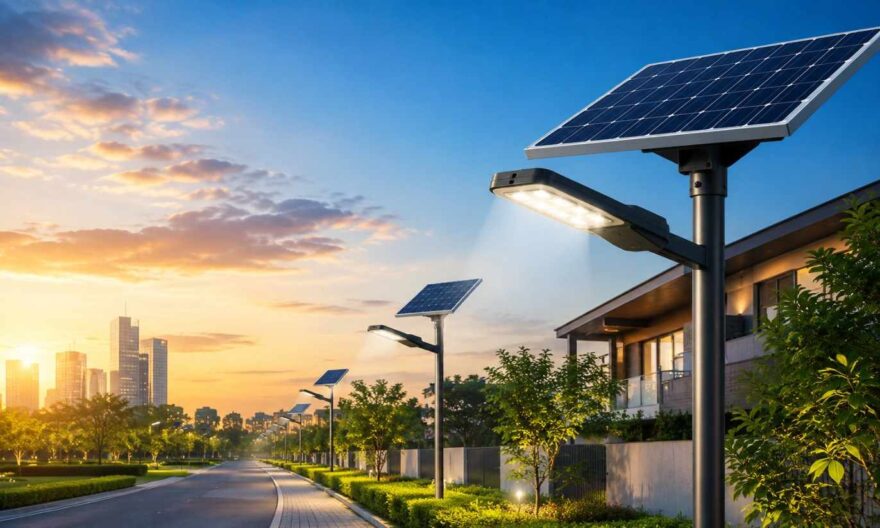
These lights are referred to as solar street lights because the electricity used by these street lights is produced using the sunlight rather than the power supplied through the electrical network.
The components that comprise such a street light include:
- Solar cells
- LED light units
- Batteries
- Charge controllers
- Lighting poles
Solar cells collect energy during the day while the batteries store the collected energy to be used when night comes.
Why Solar-Powered Street Lights Are Becoming More Popular
Increasing numbers of property owners seek lighting solutions that will help them save money and pursue sustainable objectives. In response to this demand, solar street lights have started becoming popular for both private and commercial applications.
Growing Electricity Prices
Prices of electricity have been increasing in several areas around the globe. As a result, solar lighting systems are becoming increasingly popular because of their ability to reduce energy costs.
Aiming at Lower Carbon Footprints
Businesses and organisations are trying to minimise carbon footprints. Solar lighting can help them achieve their goals since it reduces energy usage and leads to a greener environment.
Higher Efficiency Levels
Today, most solar lighting systems are much more efficient than previous models. This improvement comes from advancements in solar panels, batteries, and smart controls.
Easier Installation
Solar street lights need much fewer cables when installed than regular lights, which means that installation has become quicker and easier.
Guaranteed Lighting
High-quality batteries ensure the efficiency of energy storage, and therefore, solar lighting systems can function even when there is no power supply.
Reduced Maintenance Requirements
LEDs are known to be long-lasting. For this reason, solar lighting systems need significantly fewer maintenance services than other solutions.
Why Solar Installation in Singapore Is Driving Outdoor Lighting Growth
Singapore is continuously working hard on ensuring sustainable and renewable sources of energy.
As such, an increasing number of organisations and owners of buildings are beginning to adopt solar installation in Singapore that increases their energy efficiency and ultimately minimises operational expenses.
- Solar power technologies include rooftop solar installations that enable buildings to produce clean energy.
- Solar car parks are not only energy-efficient but also allow organisations to maximise available space.
- Solar lighting is another form of energy-efficient solar technology that allows for improved illumination and safety around streets.
Through these technologies, solar energy has become increasingly practical in modern construction.
Where Solar Street Lights Work Well in Singapore
A solar street light system may be installed on various types of property in Singapore due to its adaptability and easy installation. It is particularly useful in places that need proper outdoor lighting.
Private Estates and Condominiums
Perimeter roads, car park areas for visitors, and garden walkways are typical places for installing solar lighting because they will allow savings on shared electrical expenses and improve vision at the same time.
Industrial and Logistics Property
In industrial estates, lighting installations usually stretch along the entire perimeter road. In this case, the absence of wiring facilitates the work considerably.
Landed Housing
Such properties as driveways, entrance zones, and gates can also profit from solar lighting because the system provides reliable lighting without additional electrical connections.
Temporary Sites
Sites like construction camps and event venues may need adaptable lighting installations, which can be relocated later when the need arises.
How Solar Street Lights Compare to Traditional Ones
| Features | Solar Street Light | Grid-Connected Light |
| Energy cost | Zero after installation | Ongoing monthly cost |
| Installation | Simple, no trenching | Requires cabling and permits |
| Grid dependency | None | Full |
| Maintenance | Minimal | More complex |
| Upfront cost | Higher | Lower |
| Autonomy | 3–5 days battery backup | None |
What to Look for When Choosing a System
Not all solar street lights provide equal quality results. Proper choices in system components may increase its efficiency, reliability, and lifespan.
Panel & Battery Quality
Better quality panels produce more electricity and make a difference for small installation sites. LiFePO4 batteries have become widely popular due to their improved safety and efficiency as well as their increased life expectancy.
IP Rating
Singapore’s weather conditions are characterised by precipitation and high humidity levels throughout the year. An IP65 rating or higher will protect the inside of the installation from exposure to moisture and other negative impacts.
Light Output
The level of light performance is calculated in lumens instead of watts. The proper amount of lumens will ensure sufficient lighting of roads, walkways, parking lots, etc.
Smart Control Features
Current systems have motion detectors and other smart features that allow controlling light intensity and usage periods.
The Role of a Qualified Solar Installer in Singapore
Design is crucial for solar power systems – one wrong move means that the system will not survive through the whole night in rainy days because it will be too small.
The professional solar panel installation service provider will perform all necessary surveys, identify shadowing issues, if any, estimate the energy demand, and install a properly sized system.
Additionally, if needed, the professional company will take care of the structure and installation according to BCA and other relevant standards. A guarantee for the system performance should be required, not only the warranty for the products. These are different concepts.
The Future of Solar Street Lighting
Solar lighting technology continues to develop.
Some of these developments include:
- Motion sensing
- Remote monitoring
- Smart brightness adjustment
- Smart city compatibility
- Energy management through artificial intelligence
All these technologies will ensure that solar-powered street lights will become even more efficient and effective. As the concept of sustainability gains more importance, its use will increase.
Conclusion
The shift towards the use of solar-powered street lights is not only driven by environmental sustainability but also by cost-effectiveness, efficiency, safety, and dependability as well. In addition, the evolution in technology is helping increase the efficiency of such lighting solutions, making them more cost-effective and durable than before.
Solar lighting systems are the need of the hour for today’s property owners, be it homeowners or businesses, who can benefit immensely from them in terms of cost savings and dependability.
FAQs
How long does installation take?
For a usual residential property which requires 20-30 lights, the installation process takes about 1-2 days. There will be no delay due to cable installations.
Do the lights still operate on cloudy days?
Yes. The batteries in today’s solar-powered lighting system will have sufficient power storage capabilities that can last throughout several overcast days, given the regularity of Singapore’s weather.
When should a new battery be replaced?
Quality solar-powered lights using lithium batteries typically last up to 8-12 years. However, once it does require a new battery, the process is just a simple replacement at the unit, requiring no electrical contractor or electricity permit.
Are the lights sufficiently bright?
Yes. The current generation of LED solar-powered street lights is able to provide adequate lumens, even better than the sodium and metal halides.