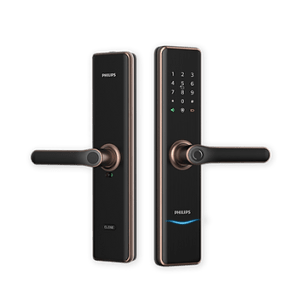
A fingerprint door handle collects biometric data – your unique fingerprint – and uses it as a method of granting or denying access. Biometric locks don’t have the same vulnerabilities as traditional locks that use physical keys – there’s no lock picking, no keys to be duplicated and no lockouts. Fingerprint locks offer better long-term value, faster entry, and stronger access control than traditional key-based systems when the homeowner considers security and convenience.
Choosing the right lock for your home is not just about keeping intruders out. It’s about daily convenience, long-term cost, and peace of mind. If you’ve been weighing a fingerprint door handle against a traditional lock, this comparison breaks down what actually matters — security strength, real-world usability, and whether the investment is worth it.
How Traditional Door Locks Work
Traditional locks — deadbolts, knob locks, and padlocks — use a mechanical pin tumbler system. You insert a key, the pins align, and the lock turns. Simple, proven, and widely understood.
But that simplicity is also their weakness. Keys get copied. Locks get picked. And if you lose your key, you’re either locked out or forced to replace the entire cylinder.
Common vulnerabilities include:
- Lock bumping — a technique where a specially cut key is tapped to manipulate the pins
- Key duplication — easily done at any hardware shop without proof of ownership
- Forced entry — most standard pin tumbler locks offer limited resistance to brute force
- Wear and tear — mechanical parts degrade over time, leading to stiff or failing locks
How a Fingerprint Door Handle Works
A fingerprint door handle reads the unique ridge patterns of your fingerprint using either optical or capacitive sensor technology. The scan is converted into an encrypted digital template and compared against stored data in milliseconds. No match, no entry.
Modern biometric locks can store between 50 to 200 fingerprints, meaning you can give family members, domestic helpers, or trusted guests their own access — without cutting a single key.
Most models also support multiple access methods:
- Fingerprint scan
- PIN code
- RFID card or key fob
- Mobile app or Bluetooth
- Physical override key (for emergencies)
This layered approach to entry is something traditional locks simply cannot offer.
Security Comparison: Fingerprint Lock vs Traditional Lock
| Feature | Fingerprint Door Handle | Traditional Lock
|
| Pick-resistant | Yes — no keyhole to exploit | No — vulnerable to bumping and picking |
| Key duplication risk | None | High |
| Access control | Individual user profiles | Anyone with a key |
| Audit trail | Yes — logs entry time and user | No |
| Lockout risk | Low — multiple access methods | High — lost key = locked out |
| Forced entry resistance | High — reinforced housing common | Variable — depends on grade |
Convenience: Where the Gap Becomes Obvious
Security aside, daily usability is where fingerprint locks genuinely outshine traditional ones. Think about how many times you’ve fumbled for your keys while carrying groceries, or had to hide a spare key under a mat — which, frankly, is not hiding anything from anyone.
With a smart door lock or biometric handle, you approach, press your finger, and you’re in. That’s it. No bag-digging, no key juggling.
Managing Access for Families and Helpers
One of the most practical advantages for homeowners in Singapore is managing multiple users. You can register a domestic helper’s fingerprint and delete it the moment they leave — no lock replacement needed. Traditional locks require you to collect keys, re-key the lock, or simply hope the key isn’t copied.
With keyless entry, you stay in control of who enters your home and when, without any physical handover.
Long-Term Value: Is a Fingerprint Lock Worth the Cost?
Upfront, a quality fingerprint door handle costs more than a traditional deadbolt. But the comparison doesn’t end at the shelf price.
Consider the hidden costs of traditional locks:
- Locksmith fees for lockouts — in Singapore, emergency locksmith services can cost between S$80 to S$300 depending on timing
- Re-keying costs when keys are lost or a helper’s contract ends
- Replacement locks when mechanisms wear out
- No audit trail — you can never verify who came and went
A digital door lock, by contrast, eliminates most of these recurring costs. The initial investment typically pays for itself within two to three years for an average household.
Are There Any Drawbacks to Fingerprint Locks?
You could say that there are limitations, of course. Biometric locks need electricity to work — most are powered by AA batteries, which usually last anywhere from 6 to 12 months. Most models have a low battery warning as standard and all reputable locks come with a physical key override in case of emergencies.
Wet or injured fingers can sometimes cause read errors. But multi-mode access (PIN, card, app) means you never get locked out with a single point of failure.
What About Hacking or Spoofing?
High-quality biometric locks use liveness detection and encrypted templates, making fingerprint spoofing extremely difficult. Cheap, uncertified models carry higher risk — which is why choosing a lock from a reputable brand with verified security certifications matters significantly.
Which Should You Choose?
For most homeowners, the choice comes down to this: if security, access control, and long-term convenience matter to you, a fingerprint door handle is the stronger option. Traditional locks remain functional for low-risk environments, but they offer no audit trail, no user management, and no real defense against determined bypassing techniques.
If you’re upgrading a main entrance, a bedroom door, or a unit in a condominium or HDB flat in Singapore, the case for going biometric is strong. The technology has matured significantly, prices have come down, and installation is simpler than most homeowners expect.
For homeowners ready to make the switch, Smart Digital Lock Reddot offers a curated range of fingerprint and digital door locks suited to Singapore homes — with professional installation and after-sales support to match.
Frequently Asked Questions
Q: Can a fingerprint door handle be hacked or fooled with a fake fingerprint?
A: Quality biometric locks use encrypted templates and liveness detection, making spoofing extremely difficult. Cheap, uncertified models carry more risk — always choose locks with verified security certifications for reliable protection.
Q: What happens if the battery dies on a fingerprint door handle?
A: Most fingerprint locks give low-battery warnings well in advance. They also include a physical key override slot, so you’re never completely locked out even if the battery runs flat.
Q: Is a fingerprint door handle suitable for HDB flats in Singapore?
A: Yes. Most fingerprint and digital door locks are designed to fit standard HDB door frames and gate configurations. Many models in Singapore are specifically built for local residential requirements and installation standards.
Q: How many fingerprints can a biometric lock store?
A: Most mid-range fingerprint door handles store between 50 to 200 fingerprints. This is more than enough for a household, including family members, domestic helpers, and occasional trusted guests with temporary access.
Q: Are fingerprint door locks more expensive than traditional locks in Singapore?
A: The upfront cost is higher, but when you factor in locksmith fees, re-keying costs, and replacement expenses over time, biometric locks often deliver better long-term value for Singapore homeowners within two to three years.
Q: Can I still use a key with a fingerprint door handle?
A: Yes. Most fingerprint door handles include a physical key override for emergency use. They also support multiple access methods — PIN code, RFID card, and mobile app — so you always have a backup option available.