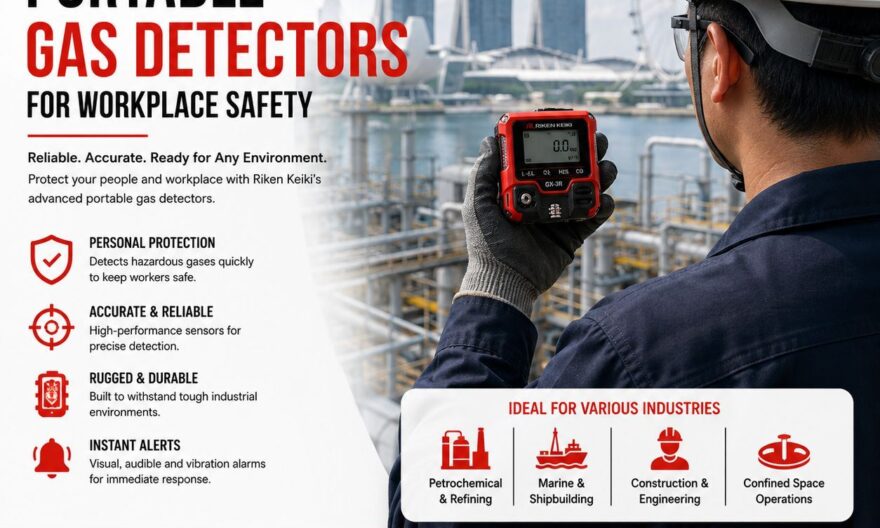
Businesses in Singapore rely on portable gas detector because they offer real-time hazard detection, mobility across job sites, and measurable compliance support under MOM workplace safety regulations. These devices protect workers from toxic and combustible gas exposure in industries ranging from oil and gas to construction. Fast response times and compact designs make them practical for high-risk, dynamic work environments.
Workplace safety in Singapore is not optional it is a legal and operational priority. For facility managers and safety officers overseeing high-risk environments, a portable gas detector Singapore professionals depend on must deliver more than basic readings. It needs to be reliable under pressure, easy to deploy, and built to meet the demands of real industrial conditions.
This guide breaks down exactly why these instruments have become standard equipment across Singaporean industries, what to look for, and how they fit into a broader workplace safety framework.
What Is a Portable Gas Detector and How Does It Work?
A portable gas detector is a handheld or body-worn instrument designed to sense the presence of hazardous gases in the surrounding atmosphere. It continuously samples ambient air and triggers visual, audible, or vibration alarms when gas concentrations exceed pre-set threshold levels.
Most modern units monitor multiple gases simultaneously including oxygen (O₂), carbon monoxide (CO), hydrogen sulphide (H₂S), and combustible gases. Sensor technologies vary by application, with electrochemical, catalytic bead, photoionisation (PID), and infrared sensors each suited to different gas types and environments.
Why Singapore’s Industrial Sectors Depend on Portable Gas Detection Solutions
Singapore’s industrial landscape is dense and diverse. The Jurong Island petrochemical cluster alone houses over 100 companies, and confined space work is common across utilities, construction, and marine industries. In these environments, invisible gas hazards can escalate from undetected to fatal in minutes.
The Ministry of Manpower (MOM) requires employers to conduct risk assessments and implement appropriate gas monitoring measures, particularly for confined space entry under the Workplace Safety and Health (Confined Spaces) Regulations. Non-compliance carries penalties and, more critically, puts lives at risk.
Portable gas detection solutions give teams the flexibility to conduct pre-entry checks, continuous monitoring during work, and rapid evacuation response all without fixed infrastructure.
Key Industries Using Portable Gas Detectors in Singapore
- Oil, Gas, and Petrochemicals: Jurong Island facilities routinely use multi-gas detectors for confined space entry, tank inspection, and shutdown maintenance.
- Construction and Civil Engineering: Underground works, tunnels, and excavations carry methane and CO risks that portable units address directly on-site.
- Marine and Shipbuilding: Singapore’s shipyards require gas clearance before welding and hot work in enclosed vessel spaces.
- Facilities Management: Building engineers managing boiler rooms, car parks, and mechanical shafts use portable detectors for routine safety checks.
- Wastewater and Utilities: Sewer maintenance teams rely on H₂S monitoring given the gas’s acute toxicity even at low concentrations.
4 Core Advantages That Make Portable Detectors the Preferred Choice
1. Mobility Without Compromise
Fixed gas detection systems protect a specific zone. Portable units protect the worker. This distinction matters enormously in dynamic job sites where hazards move as operations shift. A worker entering a new confined space, climbing into a tank, or responding to a spill can carry their detector with them providing continuous, location-specific protection.
2. Fast Response for Critical Decisions
Modern portable gas monitors respond in seconds. Alarm thresholds are typically calibrated to IDLH (Immediately Dangerous to Life and Health) levels or TWA/STEL values as defined by occupational health guidelines. When alarms trigger, workers have the data they need to evacuate immediately rather than guess.
3. Regulatory Compliance Support
Under Singapore’s WSH framework, employers must demonstrate active hazard monitoring. Portable gas detectors provide documented, real-time evidence of compliance. Many modern units log readings with timestamps, supporting audit trails and incident reporting requirements under MOM guidelines.
4. Worker Confidence and Cultural Safety Buy-In
Equipment that workers can see, hold, and understand reinforces a safety-first culture. When teams are equipped with reliable gas monitoring equipment, they are more likely to follow safety protocols consistently. This behavioural dimension of safety is often undervalued but critical to reducing incident rates.
What to Look for in Industrial Gas Safety Equipment in Singapore
Not all portable detectors are equal. Decision-makers should evaluate units against these criteria:
| Feature | Why It Matters
|
|---|---|
| Multi-gas detection capability | Covers complex environments with overlapping hazards |
| Intrinsically safe certification (ATEX/IECEx) | Required for use in explosive atmospheres |
| IP rating for dust and water resistance | Ensures durability in humid Singapore conditions |
| Long battery life (10+ hours) | Supports full-shift operations without interruption |
| Data logging and connectivity | Supports compliance documentation and fleet management |
| Alarm types (audible, visual, vibration) | Ensures detection in noisy or low-visibility environments |
Intrinsic safety certification is non-negotiable for petrochemical and marine applications. Singapore-based procurement teams should also verify that sensors are factory-calibrated and that local calibration support is available to maintain accuracy over time.
Confined Space Entry: A High-Stakes Use Case
Confined space accidents remain among the most preventable yet fatal incidents in Singapore’s industrial sector. The WSH (Confined Spaces) Regulations mandate that no worker enters a confined space without a valid gas test conducted by a competent person immediately before entry.
Portable multi-gas detectors fulfil this requirement directly. A pre-entry test takes under two minutes and provides a documented gas reading covering oxygen levels, combustibility, and toxic concentrations. This single use case alone justifies their adoption across construction, utilities, and marine sectors.
Maintenance and Calibration: Keeping Gas Monitors Accurate
A gas detector is only as reliable as its last calibration. Sensors drift over time, particularly in high-humidity environments like Singapore’s. Bump testing exposing the sensor to a known gas concentration to verify alarm function should be performed daily before use.
Full calibration with certified gas mixtures should follow the manufacturer’s schedule, typically every three to six months. Facilities managing large detector fleets benefit from docking station systems that automate bump testing, calibration, and data logging across multiple units simultaneously.
Building a Smarter Safety Programme Around Portable Detection
Portable detectors are most effective when integrated into a structured safety program rather than used ad hoc. This means pairing them with written confined space procedures, worker training on alarm response, and regular equipment audits.
For facility managers overseeing multiple sites or large workforces, detector fleet management software provides centralised visibility into instrument status, calibration due dates, and historical exposure data turning individual devices into an organisational safety asset.
Riken Keiki, with its established presence in the Asia-Pacific region, offers portable gas detection instruments built to meet the rigorous demands of Singapore’s industrial environments. Their product range supports multi-gas detection, intrinsic safety standards, and the kind of long-term reliability that safety-critical operations require. For teams building or upgrading their gas safety programme, exploring their portable detection range is a practical starting point.
Frequently Asked Questions
Q1: Are portable gas detectors mandatory in Singapore workplaces?
Under Singapore’s WSH (Confined Spaces) Regulations, gas testing is legally required before confined space entry. Portable gas detectors are the standard tool used to meet this requirement. Employers who fail to conduct pre-entry gas tests risk MOM enforcement action and significant liability in the event of an incident.
Q2: How often should portable gas detectors be calibrated in Singapore?
Most manufacturers recommend full calibration every three to six months, with daily bump testing before each use. Singapore’s humid climate can accelerate sensor drift, making regular calibration especially important. Always follow the specific calibration schedule outlined in your instrument’s technical manual and maintain records for compliance purposes.
Q3: What gases should a portable detector monitor in Singapore’s petrochemical sector?
At minimum, detectors used in petrochemical environments should monitor oxygen (O₂), combustible gases (LEL), carbon monoxide (CO), and hydrogen sulphide (H₂S). Depending on the specific process or confined space, additional sensors for volatile organic compounds (VOCs) or other site-specific gases may also be required by the facility’s risk assessment.
Q4: What is the difference between a portable and fixed gas detection system?
Fixed systems monitor a specific location continuously and are suited to permanent hazard zones like pump rooms or gas cabinets. Portable detectors travel with the worker, providing personal protection in dynamic or temporary work areas. Many industrial safety programmes in Singapore use both in combination for comprehensive coverage.
Q5: What certifications should I look for when purchasing a portable gas detector in Singapore?
Look for ATEX or IECEx intrinsic safety certification for use in explosive atmospheres, along with relevant calibration certifications. An IP65 or higher rating ensures resistance to humidity and dust. Confirm that the supplier offers local calibration and technical support in Singapore to maintain instrument accuracy throughout its service life.
Q6: Can one portable gas detector cover all industrial applications in Singapore?
A quality multi-gas detector covers most common scenarios, but specific applications may require specialised sensors. Confined space work typically needs a four-gas unit (O₂, LEL, CO, H₂S), while chemical processing may require PID sensors for VOC detection. Always base detector selection on a site-specific risk assessment rather than a one-size-fits-all approach.