Choosing the right company for renovation and interior design comes down to verifying credentials, reviewing past work, understanding contract terms, and ensuring the firm communicates clearly. Look for registered firms with a proven portfolio, transparent pricing, and experience matching your property type — whether a HDB flat, landed home, or condominium.
Renovating your home is one of the most significant investments you will make. In Singapore, renovation costs for a typical resale flat can range from S$30,000 to over S$80,000 depending on scope and finishes. Getting the company selection right from the start saves you from costly disputes, project delays, and disappointing results. Here is how to make that decision with confidence.
Why Choosing the Right Renovation Company Matters More Than You Think
Singapore’s renovation industry is competitive and largely unregulated at entry level. Anyone can register a business and offer design services. That makes due diligence non-negotiable. According to the Consumers Association of Singapore (CASE), renovation-related complaints consistently rank among the top categories received annually — covering issues like contractors abandoning projects midway, poor workmanship, and disputes over payment terms.
The right firm does not just deliver beautiful spaces. It manages your timeline, coordinates subcontractors, handles permits with the relevant authorities, and keeps you informed at every stage.
Key Criteria for Selecting a Renovation and Interior Design Firm
1. Check Registration and Licensing
Begin with the basics. In Singapore, all legitimate renovation contractors are registered with the Building and Construction Authority (BCA). Interior design firms can also be members of the Interior Design Federation Singapore (IDFS) or the Singapore Institute of Interior Designers (SIID) – respected industry bodies that hold members to professional and ethical standards.
Always check the firm’s business registration via the Accounting and Corporate Regulatory Authority (ACRA) portal. If a company can’t be transparent about this, that’s a red flag.
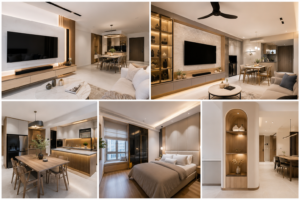
2. Review Their Portfolio Critically
A portfolio tells you far more than any sales pitch. When reviewing a firm’s past work, ask yourself:
- Does their aesthetic match your vision, or are they rigidly locked into one style?
- Have they completed projects similar in scale and property type to yours?
- Are the after-photos showing real craftsmanship, or heavily reliant on styling and photography angles?
Request to visit a completed or active project site if possible. Seeing actual workmanship in person reveals far more than polished Instagram images.
3. Understand How They Handle Condo Renovation in Singapore
For owners of a condominium unit, the renovation process is an added layer of compliance. Every Management Corporation Strata Title (MCST) – the management body of your condo – has its own set of renovation rules, including approved working hours, permitted materials, and hacking restrictions.
For condo renovation in Singapore, homeowners should look for companies that know the MCST submission processes and have a track record of getting approvals smoothly. New firms often cause delays because they submit incomplete documentation or don’t include certain building requirements.
4. Assess Transparency in Quotations
A detailed, itemised quotation is a hallmark of a trustworthy firm. Be cautious of vague lump-sum quotes that bundle everything together without breakdowns. A professional quotation should clearly state:
- Materials specified by brand, grade, and quantity
- Labour costs separated from material costs
- Payment milestones tied to project stages
- Scope inclusions and exclusions explicitly stated
Get at least three quotes before committing. This is not just about price comparison — it helps you understand market rates and identify firms that may be cutting corners on materials to win on cost alone.
5. Evaluate Communication Style Early
How a firm communicates during the sales process tells you exactly how they will communicate once your project starts. Are they responsive? Do they listen before pitching ideas? Do they ask detailed questions about your lifestyle, storage needs, and long-term plans for the space?
Slow replies, vague answers, or high-pressure tactics during consultation are warning signs. Renovation projects typically last eight to sixteen weeks — that is a long working relationship. Choose a team you can communicate with honestly.
6. Read Contracts Before Signing
A solid renovation contract should include the start and end dates of the project, payment schedule, warranty on workmanship, a list of materials and suppliers, and a dispute resolution clause. CASE has a CaseTrust accreditation scheme for renovation companies – companies with this seal of approval have committed to ethical business practices and fair contract terms.
Never pay the entire project cost in advance. Industry practice in Singapore is to make progress payments – usually 20-30% in advance and then payments linked to project milestones.
Comparison Table: What to Look for Across Firm Types
| Criteria | Interior Design Firm | General Renovation Contractor
|
| Design Conceptualisation | Yes — full design service | Limited or none |
| Project Management | Usually included | Varies by firm |
| MCST / HDB Compliance | Experienced firms handle this | Depends on experience |
| Ideal For | Full-home redesign, new homes | Specific works, tight budgets |
| Cost Range | Generally higher | Generally lower |
Questions to Ask During the First Consultation
Before you commit, use the consultation to dig deeper. Here are direct questions worth asking:
- How many projects are currently running in parallel, and who will be my dedicated point of contact?
- What is your process if materials are delayed or out of stock?
- Do you have in-house carpentry, or is it outsourced? If outsourced, how do you manage quality?
- What warranty do you provide on workmanship, and what does it cover?
- Can you share references from clients with similar property types?
The answers — and the confidence with which they are delivered — will tell you a great deal about how the firm operates under pressure.
Making the Final Decision
No single factor should drive your decision. Weight the combination of credentials, portfolio quality, communication responsiveness, contract clarity, and client reviews together. Check Google Reviews and HardwareZone forums, where Singapore homeowners openly share renovation experiences — positive and negative.
Trust your instincts too. If a firm makes you feel rushed, dismissed, or confused during the sales process, that dynamic rarely improves once works begin.
For homeowners looking for a firm that balances thoughtful design with practical execution, Urban Home Design brings together experienced designers who understand the nuances of local property types and regulatory requirements — helping you move from brief to beautiful home without the usual stress.
Frequently Asked Questions
Q1: How do I verify if a renovation company in Singapore is legitimate?
Confirm the company’s registration with ACRA business registry and that they are BCA licensed. Pursue CaseTrust accreditation as a sign of your commitment to ethical practices. Membership in institutions like SIID or IDFS adds credibility and indicates that the firm follows professional standards.
Q2: What’s the average renovation cost in Singapore?
The cost to renovate a home in Singapore can typically range from S$30,000 to S$80,000 or more, depending on the size of the flat, type of property and scope of work. Renovations are usually cheaper for new BTO flats than resale flats, which may require more hacking and replacement of existing fittings.
Q3: Will interior design companies help me get approval for my condo/HDB renovation?
Yes, good interior design firms would be the one to submit renovation permits to HDB or relevant MCST body on your behalf. – compliance with approved materials, noise restrictions and structural requirements, minimising the possibility of rejected applications or violations on site during the renovation process.
Q4: What is the typical duration for home renovation in Singapore?
Depending on the scope of work, most home renovation projects in Singapore take from eight to sixteen weeks from start to finish. Full home renovations take longer due to extensive carpentry and hacking. Allow for some buffer time in your planning. Delays are often encountered when material lead times are lengthy or permit approvals are slow.
Q5: What should a renovation contract in Singapore contain?
A good renovation contract will include a project schedule, a payment schedule, a list of materials and specifications, a warranty on workmanship and a dispute resolution clause. Don’t ever sign a contract that is vague or incomplete. Standard contracts used by CaseTrust-accredited firms provide better consumer protection than informal agreements.
Q6: Must I engage an interior designer and renovation contractor separately?
Having a company that handles both interior design and renovation under one roof makes for simpler communication and accountability. Different engagements can create gaps in the coordination of the designer’s vision and the contractor’s execution. Most homeowners find that working with an integrated firm lessens risk and provides a more cohesive result across the entire project.