

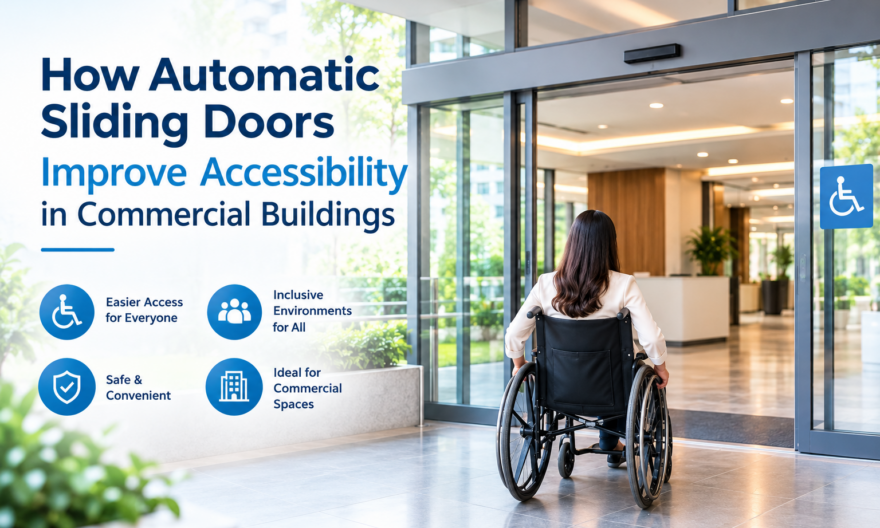
Automatic sliding doors enhance accessibility in business buildings allowing hands-free entry for all users including the elderly, wheelchair users and persons with mobility limitations. They remove physical obstacles like push/pull handles, alleviate crowding at entrances, and meet barrier-free design criteria. Their motion-sensing technology provides smooth, easy access with no physical effort on the part of the user.
Automatic sliding doors in Singapore are no longer just a convenience feature — they are a core part of inclusive building design. As commercial spaces increasingly prioritise universal accessibility, the entrance becomes the first test of whether a building truly welcomes everyone. For property owners, architects, and facility managers, choosing the right door system is both a design decision and a responsibility.
Why Accessibility Starts at the Entrance
The entryway of a building is the first impression for each visitor. A manual door can be an instant barrier for a person in a wheelchair, a parent wheeling a pram or an elderly visitor with low gripping power. That thing where you have to push or pull on a heavy door, or even reach for a handle, produces friction. A good commercial space won’t have that.
Barrier-free doors do away with this friction altogether. A door that opens automatically as you approach tells you something crucial about the space: it was built for you. That signal is important, both for user satisfaction and the building’s compliance with accessibility regulations.
How Automatic Sliding Doors Support Mobility-Impaired Users
The functional benefits for mobility-impaired users are straightforward but significant. Here is how automatic entrance doors make a real difference:
- No physical contact required: Motion sensors or presence detectors trigger the door to open before the user reaches it. There is nothing to push, pull, or hold.
- Wide clear opening: Sliding door systems can be configured to provide a wide passage width, comfortably accommodating standard and wide-frame wheelchairs.
- Smooth, controlled movement: The door opens and closes at a regulated speed, giving users adequate time to pass through without rushing.
- No threshold obstruction: Most automatic sliding door systems are installed flush with the floor, removing the raised threshold that can catch wheelchair wheels or walking aids.
- Bi-directional operation: Sensors on both sides of the door ensure equal access for users entering and exiting.
What Singapore’s Accessibility Standards Require
In Singapore, the Building and Construction Authority (BCA) has released the Code on Accessibility in the Built Environment which has detailed regulations on accessible entrances for commercial buildings. Key provisions relevant to automatic door systems include:
- A minimum clear opening width of 850mm for accessible entrances
- Level or flush thresholds at accessible entrances (maximum 10mm)
- Entrances that are operable without tight grasping, pinching, or twisting of the wrist
Automatic sliding doors inherently satisfy most of these requirements. For architects and facility managers working on new developments or retrofits, specifying an automatic sliding door system is one of the most reliable ways to align with BCA accessibility guidelines from the outset.
Beyond Compliance: The Broader Case for Accessible Entrances
Ageing Population and Long-Term Building Value
The resident population of Singapore aged 65 and beyond has exceeded 18% in 2023, reported the Department of Statistics Singapore. The number is expected to climb dramatically in the next decade. For owners of commercial property this demographic transition has direct implications for building design and retrofitting.
It’s easier for an 80-year-old visitor to get through an entry, easier for a delivery worker with boxes, a staff member with a temporary injury or a guest with a young child. Accessible design is for a lot more people than it usually gets credit for – this is the idea of universal design, and automated sliding doors are one of the most obvious examples of it.
Operational Benefits for Facility Managers
Beyond accessibility, automatic sliding doors offer practical operational advantages that facility managers will recognise:
- Reduced wear on door hardware: No handles, hinges, or push plates means less maintenance over time.
- Energy efficiency: Modern systems are designed to minimise open dwell time, reducing air-conditioning loss — a meaningful consideration in Singapore’s climate.
- Traffic flow management: In high-footfall commercial environments such as retail malls, clinics, or office lobbies, automatic doors reduce bottlenecks and improve throughput.
- Integration with access control: Many systems can be connected to security or access control infrastructure, allowing selective entry based on credentials while maintaining accessibility for general visitors.
Choosing the Right Automatic Sliding Door System
Not all automatic sliding door systems perform equally. When specifying or procuring a system for a commercial building, consider these factors:
| Factor | What to Look For |
|---|---|
| Sensor type | Microwave or infrared presence detection for reliable activation |
| Opening width | Configurable to meet BCA minimum clear width requirements |
| Opening and closing speed | Adjustable to suit user traffic profile and safety requirements |
| Safety features | Anti-pinch sensors, obstacle detection, and manual override |
| Drive system reliability | Low-noise, low-maintenance drives suitable for high-cycle commercial use |
| Certification | Systems tested to international standards such as EN 16005 |
Here the quality matters. A sliding door that is slow to respond, stops mid-cycle or is noisy in operation defeats the very accessibility and experience it is designed to give. The practical protection against these problems is to select a system from a vendor with a good track record of commercial applications.
Where Automatic Sliding Doors Are Most Impactful
Certain commercial settings see the greatest benefit from automatic sliding door installations:
- Healthcare facilities: Clinics, hospitals, and medical centres serve a high proportion of elderly and mobility-impaired users. Hands-free access is not optional here — it is essential.
- Retail and F&B spaces: High foot traffic combined with customers carrying bags or trolleys makes automatic entry a practical and accessible choice.
- Office buildings: Main lobby entrances benefit significantly, particularly in buildings that receive external visitors or clients.
- Government and civic buildings: Public-facing facilities are held to a high standard of accessibility and often subject to BCA compliance audits.
- Hotels and hospitality: Guest experience begins at the entrance. Automatic doors set a tone of ease and welcome from the first moment.
If you are specifying or upgrading entrance systems for any of these environments, Multiwall Engineering offers GEZE automatic sliding door solutions engineered for commercial performance and accessibility compliance in Singapore. Their systems combine precision drive technology with adjustable safety features, making them a reliable choice for architects and facility managers who need both design quality and long-term dependability.
Frequently Asked Questions
Do automatic sliding doors meet Singapore’s BCA accessibility requirements?
Yes. Automatic sliding doors usually comply with BCA Code on Accessibility criteria for commercial entrances, including minimum clear opening widths and hands-free operation. However, the installation should be checked against the unique project requirements and the BCA criteria that apply to ensure that it fully complies.
What is the minimum door width required for wheelchair accessibility in Singapore?
The BCA Code on Accessibility in the Built Environment requires a minimum clear opening width of 850mm for accessible entrances. This requirement may be designed into most commercial automatic sliding door systems.
Are automatic sliding doors suitable for high-traffic commercial buildings?
Yes. Automatic sliding doors are well-suited to high-footfall environments such as retail malls, office lobbies, and healthcare facilities. They are designed for high-cycle operation, reduce congestion at entrances, and require less maintenance than traditional hinged door systems.
How do automatic sliding doors help elderly users?
Automatic sliding doors do not require pushing, pulling or gripping of a door handle – all of which might be difficult for older users with limited strength or dexterity. The door opens automatically without any physical effort thanks to motion sensors which activate the door for safe and independent entry.
Can automatic sliding doors be integrated with building security systems?
Yes. Many automatic sliding door systems support integration with access control infrastructure, including card readers, intercoms, and security management platforms. This allows buildings to maintain controlled entry for restricted zones while preserving open, accessible entry for general visitor areas.
What maintenance is required for automatic sliding doors in commercial buildings?
Typical routine maintenance involves inspecting the drive mechanism, calibrating the sensors, cleaning the track, and verifying the safety features. Good commercial systems are built for long durations between maintenance and most manufacturers propose planned servicing yearly or by usage.