

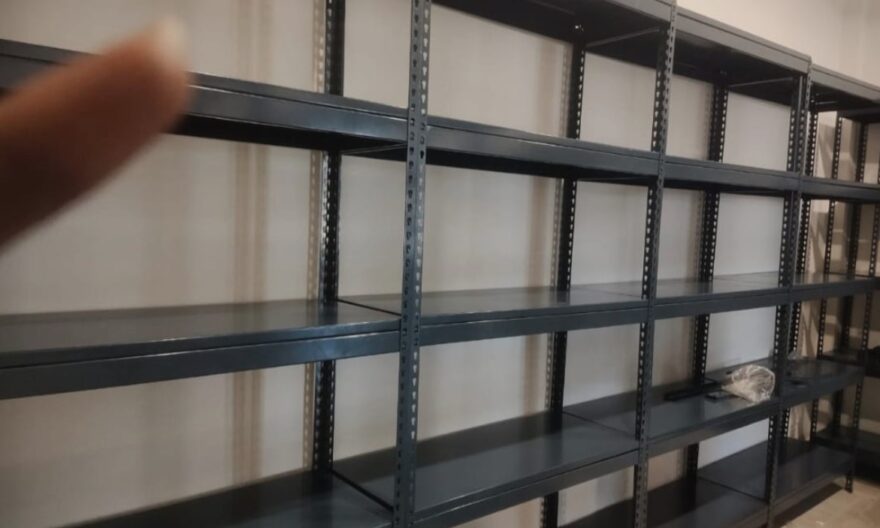
Boltless shelving maximises warehouse storage space by using a modular, tool-free design that allows shelves to be adjusted at any height increment. This flexibility enables warehouses to stack inventory vertically, customise bay widths, and reconfigure layouts without downtime. The result is more usable floor-to-ceiling storage with less wasted vertical or horizontal space.
If your warehouse aisles feel cramped or your shelves are half-empty while floor space is overflowing, the problem is usually layout — not square footage. Boltless shelving offers a practical, scalable fix that works whether you’re running a compact stockroom or a large distribution facility. Here’s how to make it work for you.
What Is Boltless Shelving and Why Does It Matter for Warehouses?
Boltless shelving — also called rivet shelving or clip shelving — is a freestanding storage system where shelves slot into upright frames using metal clips or rivets. No bolts, no tools, no specialist labour. Each unit can be assembled in minutes and reconfigured just as fast.
For warehouse owners and logistics companies, that flexibility has a direct impact on storage efficiency. Traditional fixed shelving locks you into one configuration. Boltless systems let you adapt as your inventory changes — adding levels, widening bays, or connecting units side-by-side to create a continuous store rack run along an entire wall.
How Boltless Shelving Maximises Vertical Space
Most warehouses underutilise the space above 1.8 metres. It’s one of the most common — and costly — storage mistakes. Boltless shelving addresses this directly.
Adjustable Shelf Heights Let You Eliminate Dead Space
Because each shelf level is independently adjustable, you can match shelf spacing exactly to your SKU heights. Storing items that are 30 cm tall? Set the gap to 35 cm and add an extra shelf level where a fixed system would waste 20 cm of dead air above every item.
Across a 10-bay shelving run, that saved space can translate to one or two additional shelf levels — effectively increasing capacity by 15–25% without adding a single square metre of floor space.
Multi-Tier Configurations for High-Bay Warehouses
For warehouses with ceiling heights of 4 metres or more, boltless shelving can be extended vertically with add-on frames. Some systems support stacking up to 5–6 levels high when paired with a mezzanine platform or step ladder access. This is particularly relevant for warehouses in Singapore, where industrial floor space is at a premium and maximising every cubic metre is a business necessity.
Smarter Shelving Layouts That Improve Flow and Density
It’s not just about going higher. How you arrange your shelving units determines how much of your floor plan is actually productive.
Double-Deep and Back-to-Back Arrangements
Boltless units can be positioned back-to-back, creating double-sided access rows. This reduces the number of aisles needed and increases storage density. A standard aisle-per-row layout typically uses 40–50% of floor space just for movement. Back-to-back shelving can bring that figure down significantly, freeing up room for more storage runs.
Modular Expansion Without Disruption
Because boltless systems are modular, you can expand an existing row by adding bay extensions — called add-on units — that share an upright frame with the previous bay. This is more cost-efficient than buying standalone units and keeps your shelving layout tight and continuous, which supports better warehouse organization and picking efficiency.
Matching Shelving Specifications to Your Inventory
Not all shelves are equal. Choosing the wrong load capacity or shelf material leads to either structural risk or unnecessary cost. Boltless shelving systems typically come in light-duty, medium-duty, and heavy-duty variants, each rated for specific load-per-shelf values.
| Shelf Type | Load per Shelf | Best For
|
|---|---|---|
| Light-duty | Up to 100 kg | Small parts, files, retail stock |
| Medium-duty | 100–300 kg | Boxed goods, tools, spare parts |
| Heavy-duty | 300–600 kg+ | Industrial components, bulk inventory |
Selecting the correct duty rating means you can safely maximise how much you store per shelf without under-specifying and creating a safety risk — or over-specifying and paying more than necessary.
Storage Optimization Strategies Using Boltless Shelving
Boltless shelving is a tool. How you use it determines the outcome. These strategies consistently deliver measurable storage gains.
- Zone by frequency: Place fast-moving SKUs at mid-height on shelves closest to dispatch. Use upper and lower levels for slower stock. This reduces travel time and improves pick rates.
- Label and categorise every bay: Clear bay labelling supports storage optimization by reducing search time and preventing items from being stored in inefficient locations.
- Use shelf dividers and bins: Small items stored loose waste shelf depth. Dividers and bins keep items upright, visible, and fully utilising the available shelf area.
- Review layout quarterly: Inventory profiles change. A quarterly review of your shelving layout ensures your configuration still matches your current stock mix and volume.
- Combine with pallet racking: Use boltless shelving for carton-level picking and pallet racking for bulk reserve stock. This two-tier approach is one of the most effective ways to handle mixed inventory types.
Why Boltless Shelving Works Particularly Well in Singapore Warehouses
Industrial space in Singapore is among the most expensive in the region. According to JTC Corporation, industrial property rental rates have remained under consistent upward pressure, making efficient space use a direct cost-saving lever for logistics operators and warehouse owners.
In this context, a shelving layout that yields even 20% more usable storage — without requiring a larger tenancy — has a real and measurable return. Boltless shelving delivers that without major capital outlay, long lead times, or complex installation.
The systems are also well-suited to Singapore’s humidity and temperature conditions when specified in powder-coated steel, which resists corrosion and maintains structural integrity over time.
Common Mistakes That Reduce Shelving Efficiency
Even the best shelving system underperforms if deployed poorly. Watch out for these frequent errors:
- Ignoring ceiling height: Many warehouses set shelf heights by habit rather than by the actual ceiling clearance available. Always calculate maximum vertical reach before specifying shelf units.
- Fixed aisle widths: Aisle widths should match your equipment — whether that’s a hand trolley or a powered picker. Narrow aisles with hand trolleys can safely recover floor space that wide aisles waste.
- Under-loading shelves: If shelves are half-empty, either consolidate bays or reduce shelf levels and replace with additional units elsewhere. Under-loaded shelves are expensive floor space.
- No growth buffer: Leave 10–15% of capacity unallocated. Fully packed warehouses have no flexibility for incoming stock surges and typically result in floor-level storage, which negates shelving efficiency entirely.
Choosing the Right Boltless Shelving System
When evaluating systems, look at these four factors before purchasing:
- Upright frame height and bay width options — Ensure the supplier offers sizes that match your ceiling height and inventory dimensions.
- Shelf increment spacing — The smaller the adjustment increment, the more precisely you can eliminate dead space. 25 mm increments are standard; 50 mm is less flexible.
- Load ratings and certifications — Confirm that load ratings are tested and certified, not estimated. This matters for both safety compliance and insurance purposes.
- Add-on bay compatibility — Make sure future expansion uses the same upright frames to avoid wasted investment when you scale.
For warehouse owners and logistics operators looking for a reliable and well-specified range of boltless shelving solutions, Hubs offers a comprehensive product selection designed to support practical, scalable warehouse storage — from light-duty stockroom shelving to heavy-duty industrial configurations built for demanding environments.
Frequently Asked Questions
What is the weight capacity of boltless shelving?
Boltless shelving is available in light-duty (up to 100 kg per shelf), medium-duty (100–300 kg), and heavy-duty (300–600 kg+) variants. Always verify the rated load per shelf — not just per unit — and match the specification to your heaviest stored item to ensure safe, compliant use.
Can boltless shelving be extended or reconfigured after installation?
Yes. Boltless shelving is designed for easy reconfiguration without tools. You can add shelf levels, extend bays with add-on units, or adjust shelf heights in minutes. This makes it one of the most flexible storage solutions for warehouses where inventory types or volumes change regularly.
How does boltless shelving improve warehouse organization?
Adjustable shelf heights let you zone inventory by type, size, and pick frequency, reducing wasted space and improving picker movement. Combined with labelling and bin systems, boltless shelving creates a structured, easy-to-navigate storage environment that directly supports faster fulfilment and fewer picking errors.
Is boltless shelving suitable for heavy industrial use in Singapore warehouses?
Heavy-duty boltless shelving in powder-coated steel is well-suited to Singapore’s humid industrial environment. It resists corrosion and maintains load integrity over time. For very heavy or palletised loads, it is best used alongside pallet racking rather than as a standalone solution for bulk storage.
What is the difference between boltless shelving and pallet racking?
Boltless shelving is designed for carton, bin, and loose-item storage with manual access at each shelf level. Pallet racking is engineered for full pallet loads using forklifts. Many warehouses use both — boltless shelving for active picking areas and pallet racking for bulk reserve stock — to maximise overall storage efficiency.
How much space can boltless shelving save compared to fixed shelving?
By eliminating fixed shelf gaps and allowing precise height adjustment, boltless shelving can recover 15–25% more usable vertical storage compared to fixed-height systems. In warehouses where floor space is expensive, this translates directly into higher storage capacity without needing a larger facility footprint.