


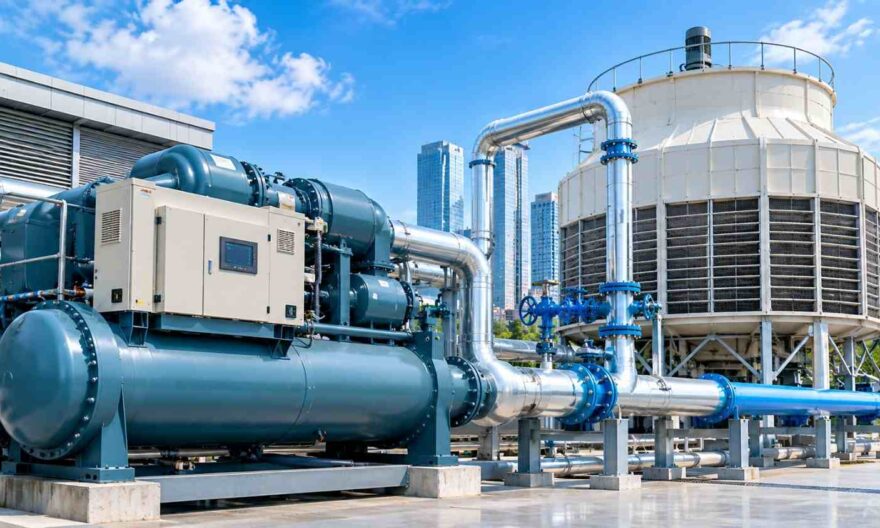
Industrial chillers and cooling towers work together as the backbone of large-scale HVAC systems. The chiller removes heat from process water or air, while the cooling tower dissipates that heat to the atmosphere. Together, they form a closed-loop thermodynamic cycle that keeps facilities operating within safe temperature ranges — efficiently and continuously.
If you are an engineer planning a complete facility cooling system, understanding how these two components interact is not optional — it is foundational. An industrial chiller does not operate in isolation. Its performance is directly tied to the cooling tower connected to it, the pipework linking them, and how well the entire system is designed and maintained.
How the Chiller-Tower System Works Together
At its core, a water-cooled industrial chiller uses condenser water to reject heat. Here is how the cycle flows:
- The chiller absorbs heat from the facility’s process or air-conditioning load via the evaporator.
- That heat is transferred to condenser water, which exits the chiller at a higher temperature.
- The warm condenser water travels to the cooling tower, where it is cooled through evaporation.
- The cooled water returns to the chiller’s condenser, ready to absorb heat again.
This loop runs continuously. If either component underperforms, the entire system suffers. A cooling tower operating with fouled fill media or poor water treatment will raise condenser water temperature — forcing the chiller to work harder, consuming more energy, and shortening its operational life.
Key Integration Points Engineers Must Get Right
Condenser Water Temperature and Flow Rate
The design entering condenser water temperature (ECWT) is typically set at 29°C in Malaysian and Southeast Asian climates. Sizing the cooling tower to consistently deliver water at or below this temperature is critical. Exceeding it even by a few degrees can reduce chiller efficiency by 2–3% per degree Celsius — a significant operational cost over time.
Flow rate must also be matched precisely. Under-pumping starves the condenser; over-pumping wastes energy and can cause erosion in the condenser tubes.
Pipework and System Hydraulics
The piping between the chiller plant and the cooling tower is a critical integration layer that engineers often underestimate. Poorly routed or undersized pipework creates pressure drops that force pumps to overwork. Proper pipe sizing, correct valve placement, and air elimination all affect how smoothly the condenser water loop performs.
When chillers, cooling towers, and pipework are commissioned together by a single specialist, alignment between these components is far more precise than when they are sourced and installed separately.
Controls and Building Management System (BMS) Integration
Modern chiller-tower systems are managed through integrated controls. Variable speed drives (VSDs) on cooling tower fans and condenser water pumps allow the system to respond dynamically to load changes. When properly integrated into a BMS, the system can optimise energy use around the clock — particularly important in Malaysia, where cooling loads remain high year-round.
Industrial Chiller Warning Signs You Should Never Ignore
An integrated system means that a problem in one component quickly surfaces as a symptom in another. Recognising industrial chiller warning signs early can prevent cascading failures across the entire cooling loop.
- Rising condenser pressure: Often caused by a fouled cooling tower or poor water treatment — not a chiller fault.
- Increased energy consumption: A chiller drawing more power than its design point may be fighting elevated condenser water temperatures.
- Frequent high-pressure trips: Usually traced back to insufficient cooling tower capacity or restricted condenser water flow.
- Refrigerant leaks: Increased mechanical stress from thermal inefficiency accelerates wear on seals and components.
- Unusual vibration or noise: Can signal pump cavitation within the condenser water circuit.
Diagnosing these symptoms requires a system-level view — not just isolating the chiller. Engineers who treat the chiller and cooling tower as separate assets often misdiagnose faults and apply costly fixes to the wrong equipment.
Comparing Water-Cooled vs. Air-Cooled Chiller Integration
| Factor | Water-Cooled Chiller + Cooling Tower | Air-Cooled Chiller (Standalone)
|
|---|---|---|
| Energy Efficiency | Higher — typically 15–20% more efficient | Lower — relies on ambient air temperature |
| Installation Complexity | Higher — requires tower, pipework, pumps | Lower — fewer components |
| Best For | Large industrial or commercial facilities | Smaller facilities or remote locations |
| Maintenance Scope | Broader — covers tower, water treatment, pipework | Narrower — primarily the chiller unit |
| Long-Term Operating Cost | Lower at scale | Higher at scale |
Planning a Complete Facility Cooling System: What to Address Upfront
When designing an integrated chiller-tower system, engineers should work through the following before specifying equipment:
- Define the total cooling load — Account for process heat, occupancy, lighting, and envelope gains. Oversizing leads to short-cycling; undersizing causes thermal failures.
- Select compatible equipment — The chiller’s condenser water design parameters must match what the cooling tower can reliably deliver in local climatic conditions.
- Design the condenser water circuit — Pipe sizing, pump head calculations, and expansion provisions must be completed as a unified design, not as afterthoughts.
- Plan for water treatment — Cooling towers are open systems exposed to atmospheric contamination. A water treatment programme is not optional — it protects both the tower fill and the chiller’s condenser tubes.
- Commission as a system — Witness testing of the chiller in isolation tells you little. Commission the full loop under realistic load conditions.
Why Single-Source Expertise Matters for Integration
Facilities that source chillers, cooling towers, and pipework from different contractors often encounter integration gaps — mismatched flow rates, incompatible control protocols, or warranty disputes when faults occur at the interface between systems.
Working with a provider who covers all three disciplines eliminates these gaps. It also simplifies ongoing maintenance, because a single team understands the full system design intent, not just one component in isolation.
Leak Eong has been providing industrial cooling solutions across Malaysia for decades, offering expertise across chillers, cooling towers, and pipework. If you are planning a complete facility cooling system and want components that are specified, installed, and maintained as an integrated whole, their team is well-positioned to support you from design through commissioning.
Frequently Asked Questions
What is the role of a cooling tower in a chiller system?
A cooling tower dissipates the heat rejected by the chiller’s condenser into the atmosphere through evaporative cooling. It returns cooled condenser water back to the chiller, completing the heat rejection loop. Without a properly sized and maintained cooling tower, chiller efficiency drops significantly and equipment lifespan is shortened.
How do I know if my industrial chiller is underperforming?
Key indicators include rising energy consumption, frequent high-pressure trips, elevated condenser water temperatures, and unusual vibration or noise. These symptoms often point to system-level issues — such as a fouled cooling tower or restricted water flow — rather than a fault isolated to the chiller itself.
What condenser water temperature should a cooling tower deliver in Malaysia?
In Malaysian climatic conditions, cooling towers are typically designed to deliver condenser water at or below 29°C. Consistently exceeding this design temperature forces the chiller to operate at reduced efficiency and can increase energy consumption by 2–3% for every additional degree Celsius above the design point.
Can an industrial chiller operate without a cooling tower?
Water-cooled industrial chillers require a cooling tower or alternative heat rejection method to function. Air-cooled chillers do not need a cooling tower but are generally less efficient at scale. For large industrial and commercial facilities in Malaysia, water-cooled systems with cooling towers offer better long-term energy and cost performance.
Why is pipework design important in a chiller-tower system?
Pipework carries condenser water between the chiller and cooling tower, so undersized or poorly routed pipes create pressure drops that reduce flow and force pumps to overwork. Correct pipe sizing, valve placement, and air elimination are essential to maintaining the design flow rate and ensuring the chiller operates within its specified parameters.
How often should an integrated chiller and cooling tower system be serviced?
Full system inspections are recommended at least twice per year, with water treatment monitoring conducted monthly. Cooling tower fill, drift eliminators, and basin should be inspected quarterly. Chiller refrigerant levels, condenser tube cleanliness, and electrical components should be checked as part of an annual planned maintenance programme.
