


Dubai has built a strong digital ecosystem around connected services, digital payments, data, cybersecurity, and digital infrastructure.
Digital Dubai’s strategy specifically focuses on creating seamless and interconnected digital experiences, while its digital economy initiatives include strategic-sector digitalisation and digital payments.
For businesses in Dubai, an app may need to work with existing business systems, handle customer data securely, support different user needs, and fit into an increasingly connected digital ecosystem..
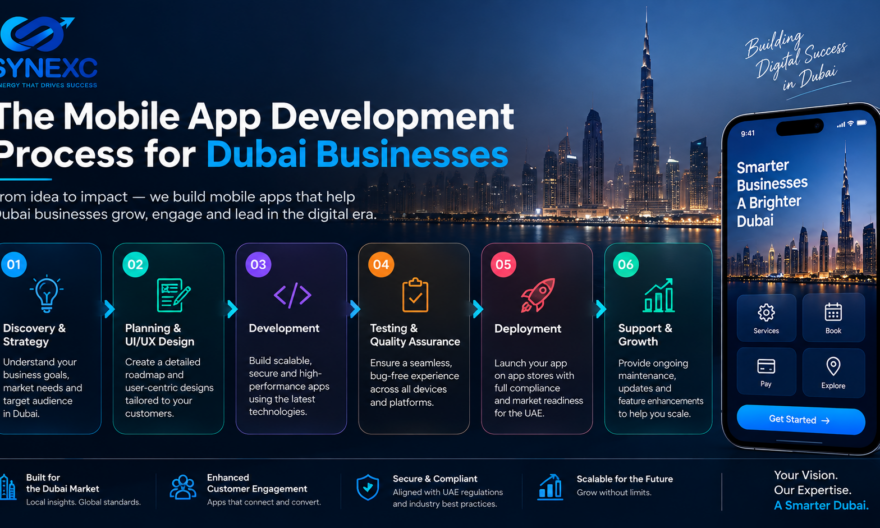
So, what does the mobile app development process in Dubai actually look like?
Let’s walk through it.
1. Start With the Business Objective
Before choosing a technology stack or discussing design, start with a simple question: What problem is the app supposed to solve?
A retail business might want to make shopping easier, whereas a real estate company may want to simplify property searches. A logistics company, on the other hand, could need real-time delivery tracking, while a service business might want customers to book appointments without calling.
The objective gives the project direction.
It also prevents a common problem: building an app packed with features that don’t really help the business or its customers.
2. Understand Your Target Users
Once the business goal is clear, the next step is understanding who will actually use the app.
Dubai has a diverse customer base, so assumptions can easily lead you in the wrong direction. Research should look at
- customer behaviour
- existing pain points
- competitors
- preferred ways of interacting with the business, and
- the services users actually need.
Language can also matter.
If an app is intended for both Arabic- and English-speaking users, that should be considered during UX planning.
The more clearly you understand the user, the easier it becomes to decide what the app should and shouldn’t do.
3. Plan the Features and Technology
Now comes the practical part: deciding what goes into the app.
Depending on the business, features might include:
- User registration and login
- Customer profiles
- Search and filtering
- Product or service catalogs
- Booking and appointment management
- Push notifications
- GPS and location services
- Online payments
- Customer support
- CRM or ERP integration
- Analytics and reporting
Not every feature needs to make it into version one.
A focused MVP can often be a better starting point. It lets the business launch the core experience, learn from real users, and then decide where further investment makes sense.
At this stage, the mobile app developer in Dubai also decides on the architecture, APIs, database, backend, mobile technology, and third-party services.
4. Plan Data, Privacy and Security Early
This is one part of development where leaving things until the end can create real problems.
The UAE’s Personal Data Protection Law provides a framework for protecting personal data and establishes obligations around its processing, security, confidentiality, and privacy.
So, before development begins, businesses should understand:
- What data the app will collect
- Why that data is needed
- Where it will be stored
- Who can access it
- How it will be transferred
- How long it will be retained
- How users can manage their information
Security should be considered alongside these questions.
OWASP’s Mobile Application Security Verification Standard (MASVS), for example, covers areas such as authentication, secure storage, privacy, network communication, and secure handling of application components.
5. Design the User Experience
Once the requirements are clear, it’s time to figure out how the app will actually feel to use.
This normally starts with wireframes and user flows, followed by prototypes and the final UI design.
The goal isn’t to make important actions easy.
Take a booking app. A customer shouldn’t have to hunt through multiple menus just to find an available appointment. The journey from selecting a service to confirming the booking should feel natural.
For businesses working with an experienced mobile app developer in Dubai, this is also a good stage to test the proposed experience before significant development work begins.
6. Develop the App and Connect It to Your Business
Once the design is approved, development begins.
That can include the
- mobile frontend, backend, APIs, databases, authentication, payment systems, third-party services, and administrative tools.
For many businesses, there’s another important piece, which is integration.
The mobile app may need to communicate with an existing CRM, ERP, inventory system, payment gateway, or other business platform. Getting that connection right can be just as important as building the app itself.
Dubai’s own digital transformation efforts increasingly focus on integrated systems and unified data. In April 2026, Digital Dubai announced a direction to integrate individual and business services into a unified digital platform.
For a private business, that doesn’t mean government integration is required. It does highlight the broader direction toward connected digital services and why integration should become inherent in the mobile app development process in Dubai.
7. Test Before You Launch
An app that works perfectly on one device isn’t necessarily ready for thousands of users.
- Testing should cover functionality, performance, APIs, security, authentication, payments, device compatibility, and the overall user experience.
- It should also consider different network conditions and operating-system versions.
- Security testing deserves particular attention. OWASP recommends controls covering secure authentication, protection of sensitive data, and the use of components without known vulnerabilities.
User acceptance testing is equally useful because it answers if the app actually work the way customers and employees expect it to.
8. Prepare for the App Store
After your mobile app development process is finished, comes the launch process .
Applications need to meet the requirements of the relevant app stores, including
- requirements around privacy,
- metadata,
- permissions,
- functionality, and
- Legal compliance.
Apple, for example, reviews apps for privacy, security, safety, and reliability, and requires developers to provide information about their data practices.
It’s worth planning for these requirements early. Discovering a store-review issue at the very end can delay an otherwise ready launch.
9. Launch, Monitor and Improve
Here’s something businesses sometimes overlook: launching the app is not the end of development.
Once real users start using it, you’ll have information that simply wasn’t available during planning.
You might discover that one feature is extremely popular, another is barely used, or users are dropping off at a particular step.
Analytics, customer feedback, crash reports, and performance data can help turn those observations into useful improvements.
Regular updates also help keep the app compatible with newer operating systems, secure, and aligned with changing customer expectations.
Choosing the Right Mobile App Development Partner
If you’re searching for a Mobile app development company UAE businesses can rely on, don’t look only at portfolios and screenshots.
Ask how the team approaches architecture, integrations, security, testing, scalability, and post-launch support.
A good mobile app development partner like Synexc should be comfortable discussing the business problem as well as the technology needed to solve it.
So, Planning a Mobile App for Your Dubai Business?
From app strategy and development to integrations, testing, and ongoing support,Synexc works around your business requirements to help you turn the concept into a practical, scalable mobile solution
Let’s talk about your app idea and see where it can take your business!