

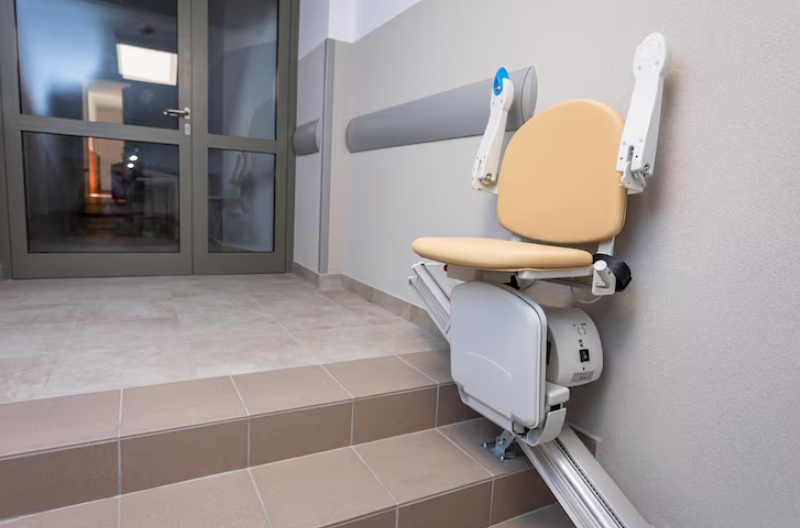
A wheelchair platform lift is a motorized vertical or inclined lift system that is intended to safely transport a wheelchair user between floors or up and down a staircase while they are seated in their chair. The user does not have to get out of their wheelchair, in contrast to a typical stairlift. Because of this, it is the recommended accessibility option for people who are wheelchair dependent or have restricted movement.
For wheelchair users, caregivers, and homeowners in Singapore, a wheelchair platform lift can transform a home or commercial space into a genuinely accessible environment — without the cost or structural disruption of a full elevator installation.
What Is a Wheelchair Platform Lift and How Does It Work?
A wheelchair platform lift operates using a motor-driven rail system mounted along a staircase. A flat, open platform — large enough to accommodate a standard or powered wheelchair — travels along the rail. The user simply wheels onto the platform, engages the safety barriers, and activates the lift using a simple control panel or remote.
Most systems are designed for both straight and curved staircases, though curved installations require custom-built rail configurations. The lift moves at a controlled, low speed, typically between 0.1 and 0.15 metres per second, prioritising safety over speed.
Key Components of a Platform Stairlift
- Motorised rail system — fixed to the staircase structure, not the wall
- Flat or folding platform — accommodates wheelchairs of standard and larger dimensions
- Safety barriers or ramps — prevent the wheelchair from rolling off during travel
- Controls — available on the platform itself and via remote handsets at each landing
- Safety sensors — detect obstructions and stop the lift automatically
Wheelchair Platform Lift vs. Standard Stairlift: What Is the Difference?
This is one of the most common questions caregivers and homeowners ask. The key distinction lies in whether the user transfers out of their wheelchair or remains seated in it.
| Feature | Wheelchair Platform Lift | Standard Stairlift (Chair) |
|---|---|---|
| User remains in wheelchair | Yes | No |
| Transfer required | No | Yes |
| Suitable for full-time wheelchair users | Yes | No |
| Platform size | Large (fits standard wheelchair) | Compact seat only |
| Staircase width required | Wider (typically 900mm+) | Narrower |
| Typical installation complexity | Moderate to high | Low to moderate |
For someone who can walk short distances and only needs support on stairs, a standard chair stairlift may be sufficient. But for those who rely on a wheelchair full-time, a platform stairlift is not just more convenient — it is often the only practical option.
When Is a Wheelchair Lift in Singapore the Right Choice?
Not every home requires a platform lift, but certain situations make it the clear recommendation. Consider a wheelchair stairlift if:
- The user cannot safely transfer between a wheelchair and a seated stairlift
- The user operates a powered wheelchair that is too heavy or bulky for manual transfer
- The caregiver is elderly or physically unable to assist with transfers
- The property has two or more storeys with no lift access
- The staircase connects living spaces used daily, such as bedroom to bathroom or ground floor to bedroom
In Singapore’s residential landscape — particularly in older HDB maisonettes, landed properties, and private terrace houses — internal staircases are common. With Singapore’s ageing population (by 2030, one in four residents will be aged 65 and above, according to the Ministry of Health), the demand for home accessibility solutions is growing steadily.
Staircase Requirements and Installation Considerations
Straight vs. Curved Staircases
Straight staircases are the most straightforward to fit with an accessibility lift. The rail system is manufactured to a fixed length and installed in a single session. Curved staircases — those with a landing, turn, or spiral configuration — require custom-designed rails, which increases both lead time and cost.
Minimum Staircase Width
A platform stairlift requires a usable staircase width of at least 800–900mm to allow safe passage of the platform while leaving clearance for the rail. A site survey carried out by a certified technician will confirm whether your staircase qualifies.
Power Requirements
Most residential platform lifts operate on a standard 13A power socket. They draw power continuously when charging and use minimal energy during individual trips — making them cost-efficient for daily use.
Safety Standards and Regulatory Context in Singapore
In Singapore, the installation of home lifts and stairlifts is guided by the Building and Construction Authority (BCA) accessibility guidelines. While private residential installations may not fall under mandatory BCA compliance, commercial premises and public buildings are required to meet the BCA’s Code on Accessibility. Choosing a supplier who operates in compliance with these standards ensures your installation is safe, insurable, and future-proof.
Additionally, the BCA’s Enable Fund and other government-linked schemes such as the Eldershield Supplement and MediSave-linked programmes have historically supported home modification for elderly and disabled residents. It is worth checking current eligibility with the relevant agencies at the time of enquiry.
What to Look for in a Wheelchair Platform Lift Supplier
Choosing the right supplier matters as much as choosing the right product. Here is what to evaluate:
- Site survey: Reputable suppliers conduct an on-site assessment before recommending a product
- After-sales service: Ask about maintenance contracts and response times for breakdowns
- Product certifications: Look for CE-marked or TÜV-certified products as indicators of European safety standards
- Customisation options: Rail colour, platform size, and control type should be configurable
- Warranty terms: Both product and installation warranty should be clearly documented
How Much Does a Wheelchair Platform Lift Cost in Singapore?
Costs vary based on staircase type, platform size, and brand. As a general guide:
- Straight staircase platform lift: Typically starts from SGD 8,000–12,000 installed
- Curved staircase platform lift: Generally ranges from SGD 15,000 upwards, depending on configuration
- Ongoing maintenance: Annual servicing contracts typically range from SGD 300–600
These are indicative figures. Always request a formal quote after a professional site survey, as rail length, access constraints, and structural requirements all affect the final price.
Making the Right Decision for Your Home
A wheelchair platform lift is a long-term investment in independence and safety. It removes the daily risk of falls on stairs — which remain one of the leading causes of injury among elderly residents in Singapore — and reduces physical strain on caregivers. The right system, properly installed and maintained, can serve a household reliably for well over a decade.
For homeowners in Singapore looking for expert guidance, Asiateck offers a range of stairlift and platform lift solutions tailored to local residential and commercial requirements. A site survey is the best starting point to understand what is feasible for your property. Visit Asiateck to learn more about their accessibility lift range and request a consultation.